Reviewed · SANTORINI TOURS
Santorini: Experience Akrotiri with a Licensed Tour Guide
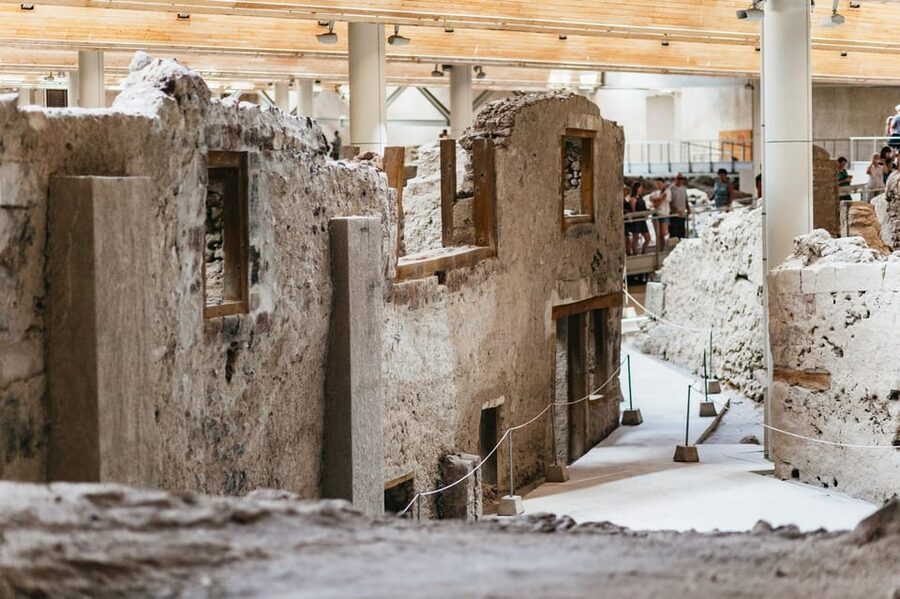
Akrotiri gives you something Santorini’s famous caldera cannot: a walk through an actual town that vanished beneath volcanic ash around 1600 B.C. You follow paved streets and squares, peer into homes with kitchens and toilets, and see how carefully this Bronze Age community planned its daily life. I especially like the way the guide uses old images to show the wall paintings now held elsewhere, and the private format lets you ask questions instead of trailing behind a large group.
The main guide praised in the booking information is Georgia, an experienced licensed guide who uses photographs and maps on a tablet to make the ruins easier to read. The drawback is value: the advertised price is $198 per group up to one, while the €20 entrance fee per person and transport are extra. At only 75 minutes, some history fans may also wish for more time.
Key points at a glance
- See a real prehistoric town: Walk along streets and squares buried by volcanic ash for roughly 4,000 years.
- Look inside ancient homes: The route includes two- and three-story buildings, kitchens, toilets, and drainage works.
- Georgia adds the missing context: Her tablet images show wall paintings and objects that are no longer inside the excavation.
- Private touring keeps it personal: You can ask questions freely and adjust the pace for children or older family members.
- Plan for extra costs: The €20 entrance fee per person and transport are not included in the $198 tour price.
- Book for the archaeological story, not the views: Akrotiri is a serious ancient site and a welcome change from Santorini’s postcard stops.
Why Akrotiri is worth your Santorini time
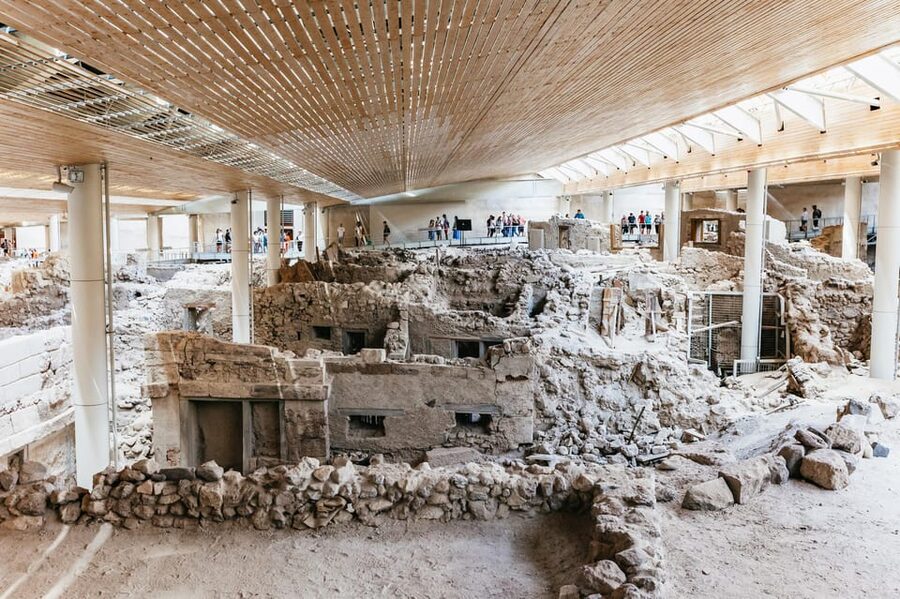
Santorini is often sold through sunsets, white villages, and cliff-top views. Those are fine, but Akrotiri tells the island’s older and more surprising story. Beneath its protective roof, you can walk through the remains of a Bronze Age settlement that was covered by ash before later construction erased it.
The site is often compared with Pompeii because a volcanic eruption preserved an entire community. The comparison helps, but Akrotiri is far older. You are not looking at a Roman town with familiar arches and roads. You are looking at a prehistoric settlement whose buildings, streets, plumbing, and social organization can still be traced.
That is why a guide matters here. Ruins without context can look like rows of stone walls and partial doorways. Georgia’s explanations help you understand which level you are seeing, how the rooms may have been used, and what archaeologists can and cannot say with certainty.
Akrotiri also has a connection to the Atlantis story. The tour explains the theories linking the buried settlement and the eruption with Plato’s lost city. Treat this as an intriguing idea, not a proven fact. The archaeological value of Akrotiri does not depend on Atlantis.
A few other Santorini mornings to price up
- From Heraklion/Crete: Santorini Island Guided Day Trip
★ 4.4 · 1,448 reviews - Santorini: Sunset Guided Tour with Hotel Pickup
★ 4.8 · 900 reviews - Santorini Luxury Custom Private Tour with Local guide
★ 5.0 · 623 reviews
Meeting Georgia at the excavation entrance
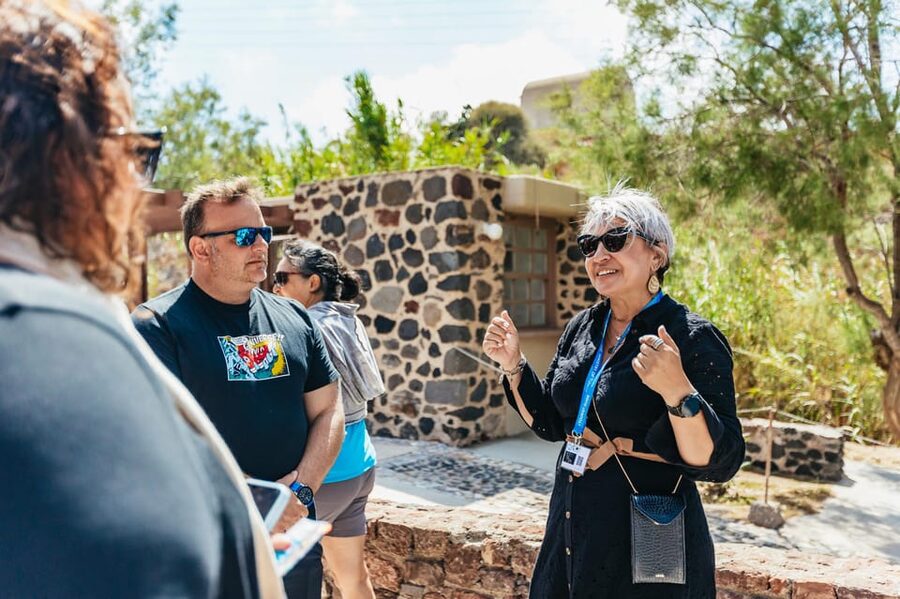
You meet the guide at the entrance to the archaeological site, across from the cashier. This is a useful arrangement because you do not need to search through Santorini for a separate office or meeting place. You should still allow time to reach Akrotiri and handle the entrance fee, since transport is not included.
The advertised experience lasts 75 minutes, with about 70 minutes described as the guided walk. That is long enough for a clear introduction and a focused circuit, but it is not an all-morning archaeological expedition. If you are fascinated by ancient urban planning, pottery, or excavation methods, you may want to return to the site or pair it with the Museum of Prehistoric Thera in Fira.
One particularly useful preparation is to visit that museum first if your schedule allows. It provides objects and wall paintings connected with Akrotiri, making the empty spaces at the excavation easier to understand. You can also do the site first and use the museum afterward to fill in the details.
The activity is offered in English, with a live licensed tourist guide and a private group. It is wheelchair accessible according to the supplied information. Opening hours can change, and the activity provider confirms the tour time by email, so check the final message before setting your day around it.
Walking the streets of a Bronze Age town
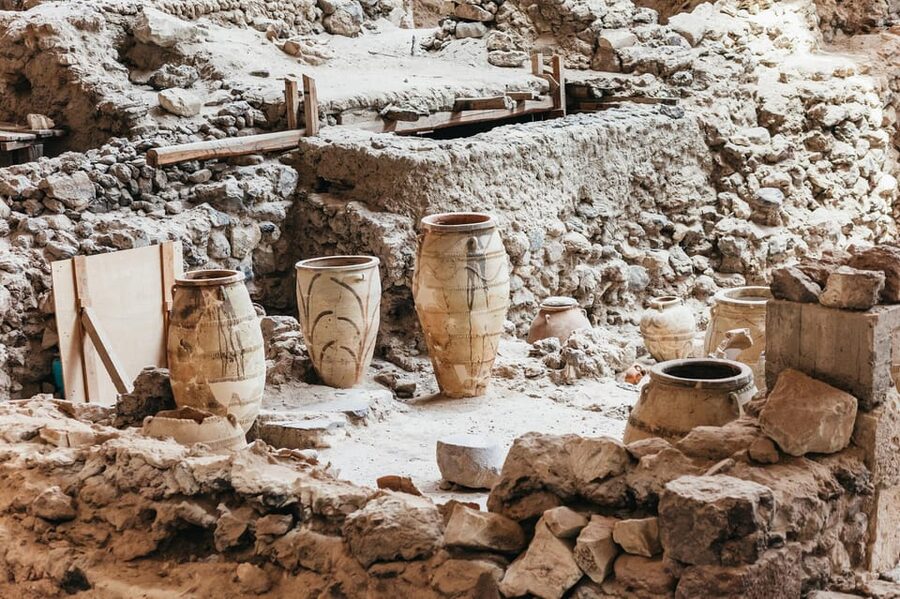
The first major pleasure is simply moving through the settlement. You do not view Akrotiri from a single platform and leave. The route takes you along ancient paved streets and through open squares, giving the place a sense of urban design.
That detail matters. A lone wall tells you little about a society. A street joining a square, with buildings arranged around it, begins to show how people moved, worked, and met. You start to picture Akrotiri as a functioning town rather than a collection of ruins.
The buildings are among the most striking parts of the visit. Some rose two or three stories, a reminder that this was not a primitive village of one-room huts. The surviving structure allows you to study doorways, stair areas, rooms, and the relationship between private interiors and public routes.
I like the way a good guide slows down at these points. Instead of throwing dates at you, Georgia helps you imagine the building as a complete structure. She also explains where interpretation is firm and where archaeologists are still working with theories. That restraint is important at a site where much of the upper structure and decoration has disappeared.
Kitchens, toilets, and ancient plumbing
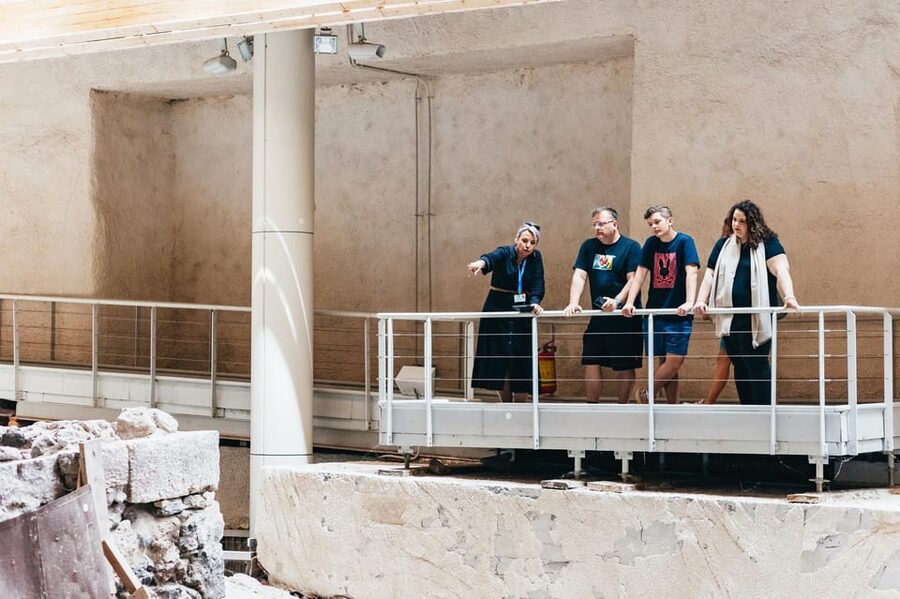
The most memorable details may be the least glamorous. Akrotiri includes kitchens, toilet facilities, and a drainage system. These features bring the ancient settlement down to everyday life.
You can think about cooking, washing, waste, storage, and movement through the home. Such remains show that the people of Akrotiri planned more than impressive rooms. They built systems that supported ordinary life and helped keep the town organized.
The drainage works are especially useful for understanding the settlement’s level of planning. You are not being asked to admire ruins simply because they are old. You are shown practical evidence of design and engineering. A family with children may find these details easier to grasp than a long discussion of pottery types, and they can turn the visit into a conversation about how cities work.
This is also where a private tour earns its keep. You can stop and ask how a feature functioned, or have the guide explain why archaeologists assign a certain purpose to a room. On a self-guided visit, you might walk past the same feature without realizing what makes it important.
Same island, an entirely different sort of day:
- Santorini Classic Catamaran Cruise with BBQ, Drinks and Transfers
★ 5.0 · 3,933 reviews - Half-Day Exclusive Catamaran Cruise in Santorini with Meal and Open Bar
★ 5.0 · 2,975 reviews - Santorini Gold Catamaran Cruise with Snorkel, BBQ & Open Bar
★ 4.8 · 2,822 reviews - Private Santorini Tailor Made – Choice of the Guest!
★ 5.0 · 1,972 reviews
Reconstructing walls that are no longer there
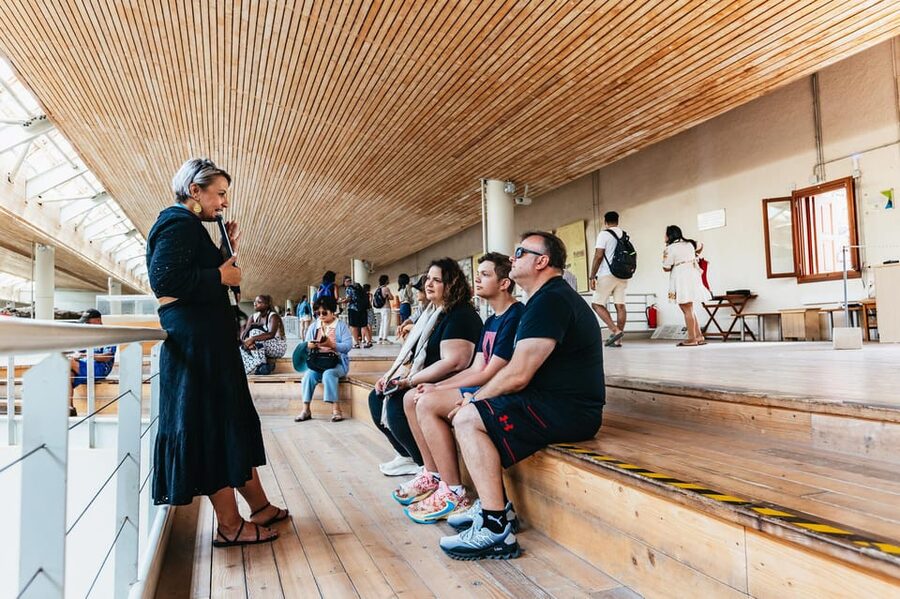
Akrotiri’s wall paintings are a key part of the story, but the original works are not simply decorating every room you visit. Georgia uses photographs on a tablet to show paintings and artifacts connected with the excavation and now displayed in museums around Greece.
That visual aid changes the visit. A bare wall can be hard to read. Seeing the colors, figures, and patterns that once decorated it helps you understand the ambitions of the people who lived in these buildings. It also gives you a better sense of how much has been removed for preservation and study.
Several people specifically valued the tablet images, maps, and drawings. That is a practical point, not a minor extra. If you have already read about Akrotiri, the images can answer questions that the ruins alone cannot. If you arrive with no background, they provide a quick visual bridge between the surviving architecture and the original town.
Bring a camera if you like taking travel photos. Food and drinks are not allowed inside the site, so plan to eat before or after the visit rather than expecting a snack break during the walk.
What the guide adds to the experience
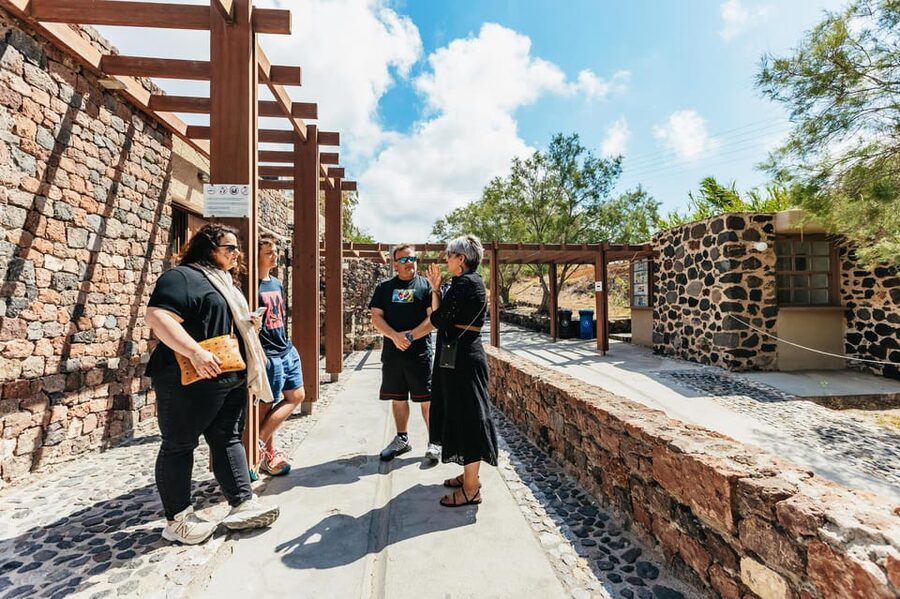
Akrotiri is possible without a guide, but the difference is substantial. The site gives you the physical remains. The guide supplies the connections between them.
Georgia’s strongest skill, based on the information provided, is making the settlement understandable to different ages and interests. Families with children found that she answered questions patiently and kept young visitors involved. Older visitors, including people with archaeological experience, also found enough detail to make the tour worthwhile.
You can expect explanations of how the society may have been organized, how people lived, and what the buildings suggest about work and status. You can also ask about the excavation and current theories. One useful correction that may come up is that Akrotiri should not simply be labeled a Minoan settlement. Its place in the wider Bronze Age Aegean world is more complicated than that quick comparison suggests.
The private format means you do not need to hold back a question because a large group is waiting. You can ask for a simpler explanation, request more detail, or pause over a building that catches your attention. The tradeoff is cost. A private guide is harder to justify if you are a solo visitor watching every euro, but it makes much more sense for a couple, family, or group sharing the fee.
Timing, heat, and the length of the walk
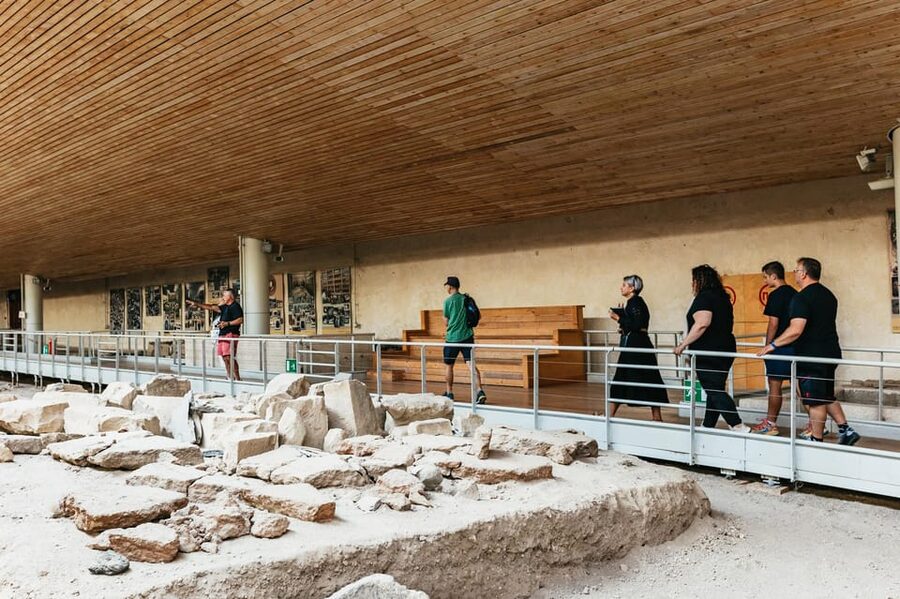
The tour is a leisurely archaeological walk rather than a strenuous hike. Still, Santorini can be hot, and families have found that children may tire during a warm visit. A morning start can be a smart choice. One early group had the site almost to itself for part of the visit, though you should not assume that level of quiet on your chosen date.
The tour time is confirmed by email, and opening hours may change. Treat the confirmed start time as essential, particularly if you are visiting Santorini from a cruise ship or fitting Akrotiri between other bookings.
The 75-minute length works well if you want a focused introduction. It also keeps the site from taking over your whole day. On the other hand, a history enthusiast may find the time short, especially if questions lead into the eruption, wall paintings, urban design, and excavation process.
You can get the most from the short visit by arriving with one or two questions in mind. Ask about the drainage system, the building levels, the wall paintings, or the Atlantis theory. A little preparation helps you use the private time well.
Price, tickets, and what you actually receive
The advertised price is $198 per group up to one. The wording is unusual, so check the booking details carefully for the final group-size calculation before paying. The tour includes the guide and private format, but not entrance tickets or transfers. The entrance fee is listed as €20 per person.
That means the real cost is higher than the headline price. You must also arrange your own way to Akrotiri. For a solo visitor, this can feel expensive compared with entering the site independently. For a private group sharing the guide cost, the value improves, especially if several people would otherwise struggle to make sense of the ruins.
The strongest case for paying is not faster walking or luxury transport. It is interpretation. Akrotiri is a site where signs alone may not explain what you are seeing, and the guide’s tablet images add material you cannot get from the bare structures. If you are mainly looking for a quick photo stop, this may be more than you need. If you want to understand the town, the fee is easier to defend.
The tour offers free cancellation up to 24 hours before the start and a reserve-now, pay-later option. Those terms help if your Santorini schedule is still shifting, but the provider’s confirmation email remains important because tour times and opening hours can change.
Who should book this Akrotiri tour?
I would choose this tour for:
- First-time visitors to Akrotiri who want the ruins explained in plain English.
- Families whose children need stories and practical details to stay interested.
- History fans who want more than a quick walk past the walls.
- Private groups that can share the guide cost.
- Cruise passengers who need a prearranged, focused visit, while remembering that transport is still their responsibility.
- Visitors pairing Akrotiri with Fira’s prehistoric museum, especially those who want to connect objects, paintings, and buildings.
I would hesitate if you have very little time, dislike guided visits, or are mainly interested in Santorini’s views. I would also check the fee carefully if you are traveling alone. The tour is highly focused on archaeology, so it is not a general Santorini sightseeing trip.
Should you book it?
Yes, if Akrotiri interests you and you want to understand what you are seeing. The site is impressive on its own, but Georgia’s explanations, tablet images, and willingness to answer questions give the streets and buildings a human scale.
The best value comes when you share the private experience with others and allow enough time for the entrance fee and transport. Book it for a morning if possible, confirm the time by email, and consider visiting the prehistoric museum in Fira as well. Skip it only if you want a brief independent stop or cannot justify the added guide cost.
FAQ
How long does the Akrotiri guided tour last?
The activity lasts 75 minutes, with the guided tour described as approximately 70 minutes.
Where do I meet the guide?
Meet the guide at the entrance of the Akrotiri archaeological site, across from the cashier.
Is the entrance fee included?
No. The entrance fee is not included and is listed as €20 per person.
Is transport to Akrotiri included?
No. You must arrange and pay for your own transfer to the archaeological site.
What language is the tour offered in?
The live guided tour is offered in English.
Is the tour private and wheelchair accessible?
Yes. The activity is offered for a private group and is described as wheelchair accessible.
Fresh on the Santorini list
- Private Tour: Customize Your Perfect Day in Santorini★ 5.0 · 45 reviews
- Imerovigli: Premium Wine Tasting with Caldera and Sea Views★ 4.9 · 45 reviews
- Santorini_All time Classic in Santorini★ 5.0 · 45 reviews
- Santorini: 6hr Small Group Shore Excursion Villages & Wine★ 5.0 · 45 reviews
- Santorini 4-Hour Private Tour including Wine Tasting, Shore Excursion★ 5.0 · 45 reviews
- Santorini: Caldera Private Power Catamaran Cruise★ 4.9 · 45 reviews
- Photoshoot in Flying Dresses in Santorini★ 4.5 · 46 reviews
- Smooth and Fun Taste of Santorini Private Tour★ 5.0 · 47 reviews
Santorini Tours, compared.

Santorini Classic Catamaran Cruise with BBQ, Drinks and Transfers
Read our review →
Half-Day Exclusive Catamaran Cruise in Santorini with Meal and Open Bar
Read our review →
Santorini Gold Catamaran Cruise with Snorkel, BBQ & Open Bar
Read our review →
Private Santorini Tailor Made – Choice of the Guest!
Read our review →
Santorini Wine Adventure with 12 Wine Tastings, Tapas and Sunset
Read our review →
Santorini Catamaran Cruise with Greek Meal, Open-Bar and Sunset
Read our review →
From Heraklion/Crete: Santorini Island Guided Day Trip
Read our review →