
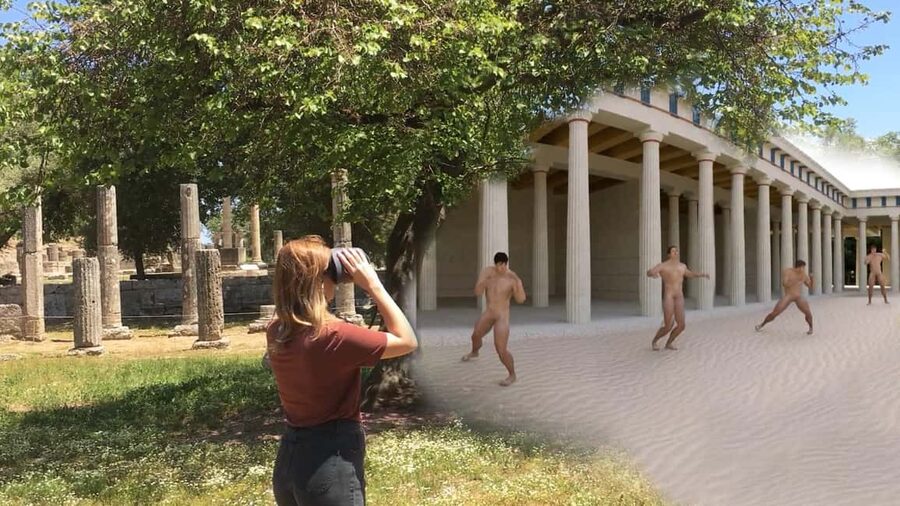
Reviewed · OLYMPIA TOURS
Olympia: Tour with Virtual Reality and Audio
Ancient Olympia can be hard to read at first. Much of what you see is a scatter of foundations, stones, and broken columns. This tour gives those remains a second life, placing 3D reconstructions over the ruins and guiding you from one monument to the next. I especially like the self-paced route and the way the audio starts as you approach each site, so you can stop, look, and listen without following a large group.
The strongest moments come in the Temple of Zeus and Ancient Stadium. Seeing the Statue of Zeus restored inside its temple and watching athletes race toward the finish line makes the site far easier to understand. The main drawback is that the VR navigation can occasionally lose its position, and the meeting office sits away from the archaeological entrance, so allow extra walking time.
Key points to know before you go
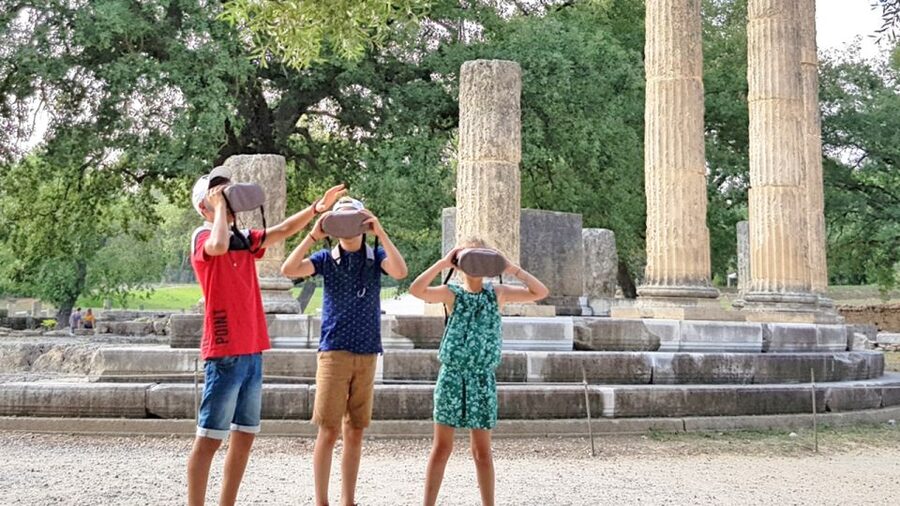
- Fifteen monuments in one route: The experience covers the Gymnasium, Palestra, Phidias Workshop, Temple of Zeus, Stadium, Nymphaeum, and other major remains.
- VR adds scale and color: The ruins are overlaid with animated reconstructions that show how buildings and ceremonies may have appeared in ancient times.
- You set the pace: This is not a group walking tour. You follow the virtual map and audio prompts through the archaeological site.
- The audio works in seven languages: Choose Greek, English, French, German, Spanish, Italian, or Dutch.
- The entrance ticket is separate: The $28.23 price covers the VR glasses, audio guide, demonstration, and technical help, but not admission to the archaeological site.
- Plan around the office location: The pickup point is on Olympia’s main street, across from the church, and the walk to the ruins takes several minutes.
Why VR helps at Ancient Olympia
Ancient Olympia is one of Greece’s most important archaeological sites, but it does not always explain itself. You know you are standing where the Olympic Games began, yet the surviving remains can make it difficult to picture the original buildings, crowds, and sporting events.
That is where this experience earns its price. The headset shows reconstructed temples and athletes while you stand among the actual stones. It does not turn the site into a photographic replica. The graphics have a video-game look, and that is worth understanding before you book. Still, the added scale and movement make the ruins much easier to interpret.
I like that the technology is tied to physical locations. As you approach a monument, the audio guide provides facts and short stories about its purpose and place in the Olympic world. You are not simply watching a historical film in an office. You are standing beside the Gymnasium while seeing athletes train, or looking across the Stadium while watching an ancient competition take shape.
The format also keeps you independent. You do not need to match the pace of a guide or wait for a large group to move on. You can pause at a favorite location, replay information, or continue when you are ready.
A few other Greece mornings to price up
- Athens: Acropolis Ticket with Optional Audio or Live Guide
★ 4.2 · 11,055 reviews - Athens: Cape Sounio & Poseidon Temple Trip with Audio Guide
★ 4.4 · 4,521 reviews - Athens: Acropolis Ticket with Audio Guide
★ 4.0 · 3,575 reviews
Starting at the Olympia Back In Time office
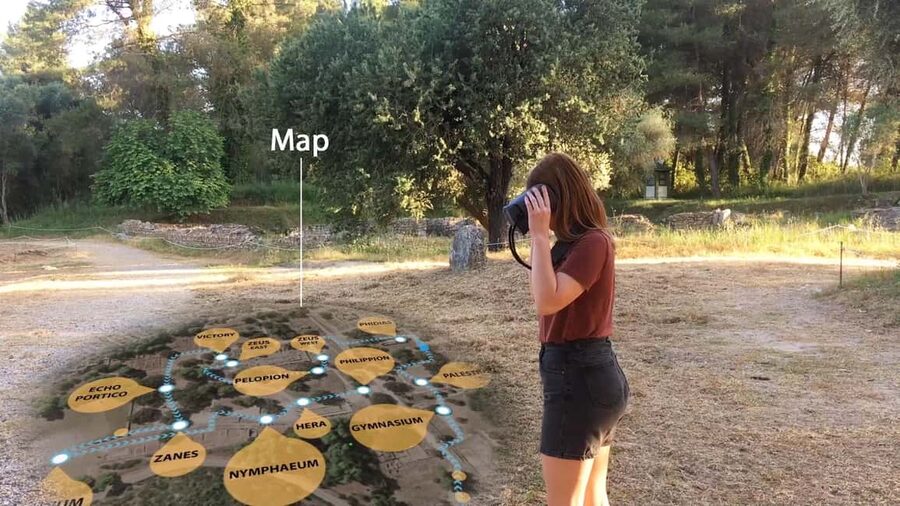
Meet the host at the local partner’s office, listed as Olympia Back In Time. It is on the main street of Olympia, across from the church. You can also search for Olympia back in time on Google Maps.
The staff first gives you a live demonstration. This short introduction matters because the headset uses a virtual map and directional prompts. You need to understand how the blue arrow works before entering the site, especially since the device can take a moment to adjust to your position.
Bring a passport, driving license, or other accepted ID because a deposit is required. Comfortable shoes are essential. The office is not at the archaeological entrance, so do not leave your arrival until the last minute. If you are coming from a coach, allow roughly 20 minutes to reach the office, and leave similar time afterward to return the equipment before continuing your day.
The experience lasts about two hours. That includes the handover and the route through the site, so your available time inside the ruins is not unlimited. If you also want to visit the Archaeological Museum, plan that carefully rather than trying to squeeze both visits into the same narrow window.
Ancient Gymnasium: where athletes trained
The first major stop is the Ancient Gymnasium. In Olympia, athletic preparation was a serious part of life, not a quick warm-up before the main event. The VR reconstruction helps you picture the building as a working training space rather than a set of foundations.
This is a good place to learn the basic rhythm of the tour. You approach the monument, the audio guide supplies the explanation, and the headset shows how the structure may have looked. The combination gives you context that a sign alone cannot provide.
The virtual images also make scale easier to judge. Ruins tend to flatten your sense of distance. A reconstruction can show where walls stood and how the building related to the wider sanctuary.
The Palestra and the athletic world

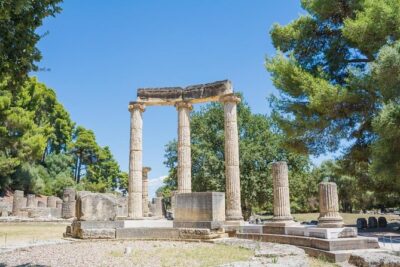
Next comes the Palestra, the training ground associated with boxers and wrestlers. This stop adds a more personal side to the Games. Instead of thinking only about the stadium and public contests, you get a sense of the practice behind them.
The audio presentation is useful here because it gives each monument a clear role. You are not just walking past another collection of stones. You learn what happened in the space and how it fitted into athletic life.
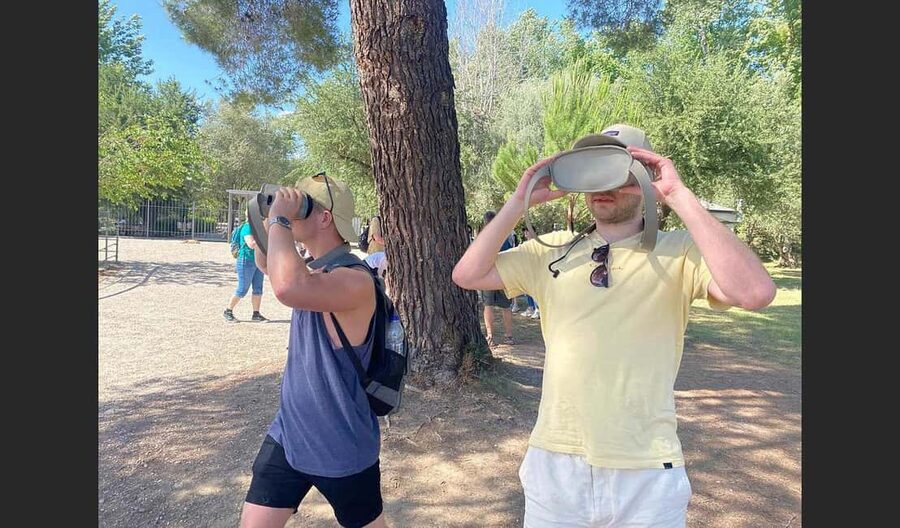
If you share one headset between two people, you can still experience the route together, but only one person can look through the glasses at a time. That may be fine for a couple or family that wants to discuss each scene, though two separate devices would make the visual experience more continuous if available.
Same island, an entirely different sort of day:
- Athens: Acropolis & up to 5 Archaeological Sites Combo Pass
★ 4.4 · 12,619 reviews - Athens: Acropolis, Parthenon & Acropolis Museum Guided Tour
★ 4.8 · 9,316 reviews - Athens: Cape Sounion & Poseidon Temple Sunset Half-Day Trip
★ 4.8 · 8,241 reviews - From Kissamos Port: Boat Cruise to Balos Lagoon & Gramvousa
★ 4.2 · 6,755 reviews
Phidias Workshop and one famous statue
The route then reaches the Phidias Workshop. This is one of the most intriguing stops because it connects a physical building to a work of art known far beyond Olympia.
Phidias created the Statue of Zeus, one of the Seven Wonders of the ancient world, in this workshop. The VR component gives the building a purpose and helps you picture the craftsman’s setting rather than treating it as another anonymous ruin.
The site’s appeal often depends on these links between ordinary remains and famous names. A workshop may look modest today, but the story attached to it gives the stones weight. The audio guide does a good job of supplying that connection without requiring you to read long panels at every stop.
Temple of Zeus and the lost colossus
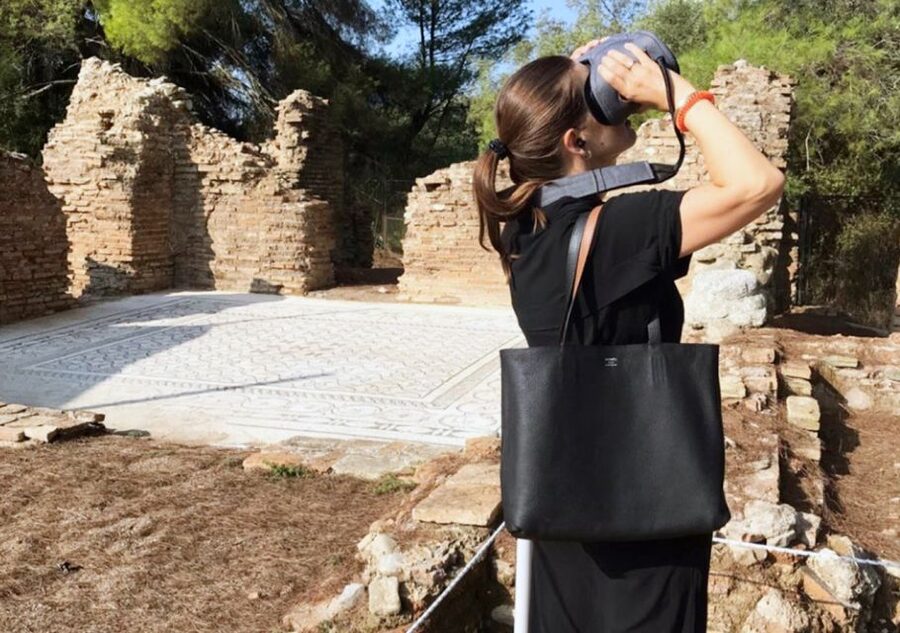
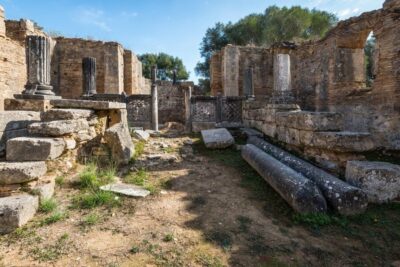
The Temple of Zeus is the route’s great architectural reveal. The surviving columns and fallen blocks show its size, but the headset lets you see the temple rebuilt in 3D and then enter a virtual version of the monument.
Inside, you see the Statue of Zeus as part of the temple setting. That is important. A statue of this scale was not an isolated object in a museum gallery. It was designed to dominate a sacred interior, and the reconstruction helps restore that relationship.
This is also where the distinction between archaeology and digital interpretation matters. The VR scenes are an aid to your imagination, not a replacement for the actual ruins. The graphics are stylized rather than lifelike, but they provide a strong visual guide to the building’s height, decoration, and arrangement.
I would spend a little extra attention here if the route allows. The temple is easier to appreciate once you have seen the earlier training areas and workshop, because the site begins to feel like a connected sanctuary rather than a line of separate stops.
Ancient Stadium and the Olympic contest
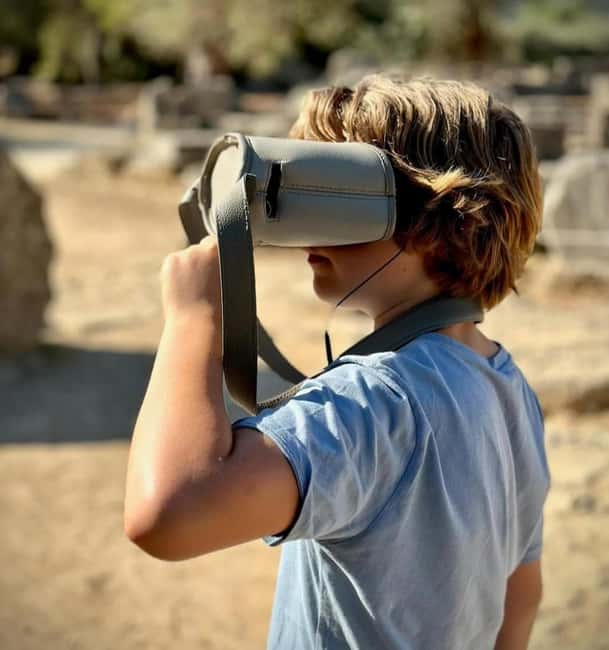
The Ancient Stadium is likely to be the most memorable section for children and sports fans. Through the headset, you see athletes train and compete, then watch an ancient event from near the finishing line.
The effect works because the stadium is already a powerful physical space. You can walk across the same ground where contests took place, then use the reconstruction to add runners, movement, and spectators to the scene.
The audio also helps explain what you are seeing. Without context, a long strip of earth and surrounding banks may not immediately read as a sports venue. With the narration and virtual event, its purpose becomes clear.
You should still watch where you walk. When you look through the glasses, your attention is naturally pulled toward the digital scene. The site can also be busy, and one review of the equipment noted that moving through crowds while partly focused on the headset can feel disorienting. Use the device when stopped or walking carefully, and listen to the staff’s instructions about orientation.
The Nymphaeum of Herodes of Atticus
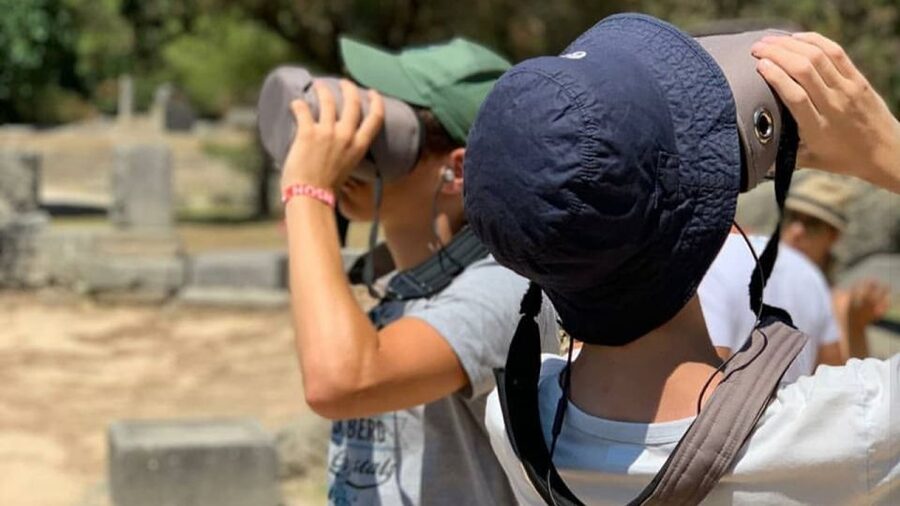
The Nymphaeum of Herodes of Atticus is another place where the 3D reconstruction does much of the explanatory work. Today, you see ruins. Through the glasses, you can view the fountain complex in its full design and understand the grandeur suggested by the remains.
This stop is valuable because not every monument at Olympia is as instantly recognizable as the Temple of Zeus or Stadium. The virtual image gives you a clear reason to care about the structure in front of you.
The route covers 15 monuments in total, so these named stops are only the main anchors. The remaining locations help fill out the sanctuary and show that Olympia was more than a stadium with a temple beside it.
The ancient Olympic Flame
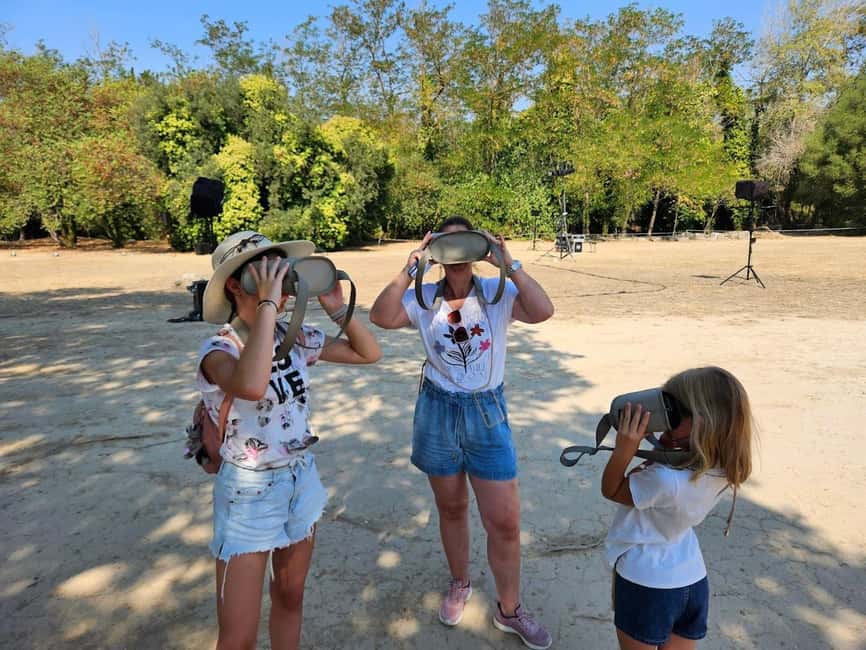
Near the end, the experience shows the lighting of the Olympic Flame in ancient times. This is a smart final scene because it links the ancient festival to a tradition that remains familiar today.
The point is not that every modern ceremony is identical to its ancient counterpart. Rather, the scene lets you consider the lasting symbolic power of fire, competition, and the sanctuary itself. After seeing athletes train and race, the flame gives the route a ceremonial finish.
It also sends you back to the real site with a stronger sense of continuity. The ruins are not only remnants of a vanished settlement. They are connected to an idea that still shapes international sport.
Audio guide, map, and ease of use
The audio guide is available in Greek, English, French, German, Spanish, Italian, and Dutch. The live staff demonstration and technical support are provided in English, French, and Greek.
The virtual map is one of the tour’s most useful tools. It shows where to go next, which is helpful in a broad archaeological site where paths and foundations can be confusing. Follow the blue arrow as instructed, even if the direction initially seems odd. The device may need a few seconds to correct itself.
GPS-style positioning is not perfect. The headset can lose track of where you are, and you may need to reorient it. Sometimes the audio may begin before you feel fully aligned with the monument. If that happens, use the physical signs and buildings as your backup. You can listen again once you reach the matching location.
This small amount of troubleshooting is the main practical weakness. The equipment is simple enough for most people, and technical support is included, but the experience is not completely hands-off. Pay attention during the demonstration and do not panic if the image or map needs a moment to reset.
Timing, crowds, and the museum question
The best way to use the tour is to begin with the outdoor archaeological site and use the headset there. If you visit the museum first, you may find yourself rushing the VR route or returning the equipment before you have seen everything you wanted.
The self-guided format can help you avoid the pace of organized groups. You can move when you want and sometimes find a quieter stretch between larger parties. At the same time, the site may be crowded, so the freedom to stop is not always the same as having complete solitude.
Returns are not available between 1:30 pm and 3:00 pm because of the provider’s working schedule. Check the exact starting time when booking and make sure your plans leave room to return the glasses to the office. Arrivals more than 45 minutes late, without contacting the provider, can be canceled without a refund.
The activity is listed as wheelchair accessible. Since the experience takes place across an archaeological site, confirm any route concerns with the local office if you need specific access information.
Is $28.23 a fair price?
At $28.23 per person, this is not the cheapest way to add information to a museum visit. The archaeological admission ticket is extra, so include that separate cost in your budget.
Still, the price is reasonable if you want more than labels and scattered ruins. You receive the VR glasses, audio guide, demonstration, technical help, and a route covering 15 monuments. A private guide would offer conversation and personal interpretation, but this experience gives you control over the pace and avoids joining a large walking group.
It can also be good value for families. Children may connect more quickly with animated athletes and restored temples than with foundations alone. Adults who enjoy taking their time will appreciate being able to pause without holding up a group.
The value is lower if you dislike wearing headsets, want a purely archaeological visit, or already have a strong guide and prefer to build your own interpretation. The virtual reconstructions are visual aids, not exact photographs of the ancient buildings.
Who should book this experience?
I would choose it for a first visit to Olympia, especially if you are unsure how much meaning you can draw from ruins on your own. It is also a strong option for families, independent sightseers, and anyone who wants the freedom of a self-guided route.
You should think twice if your schedule is tight around a coach departure, if you plan to spend a long time in the museum, or if you find digital devices distracting at historic sites. The extra walk to the office and the fixed return window matter more than they might appear on a timetable.
Book it if you want to see athletes in the Stadium, restore the Temple of Zeus in your mind, and understand how the sanctuary’s separate buildings fit together. Skip it if you prefer a traditional guide or want to focus only on the surviving stones.
FAQ
Is admission to the archaeological site included?
No. The tour price covers the VR glasses, audio guide, demonstration, technical support, and information. You must buy the archaeological site admission separately.
Where do I meet the host?
Meet at the Olympia Back In Time office on Olympia’s main street, across from the church. You can search for Olympia back in time on Google Maps.
How long does the experience last?
The activity lasts two hours. Check availability for the starting times, and allow extra time to walk between the office and the archaeological site.
Which languages are available?
The audio guide is available in Greek, English, French, German, Spanish, Italian, and Dutch. The live demonstration and staff support are provided in English, French, and Greek.
What do I need to bring?
Bring a passport, driving license, or ID card because an ID deposit is required. Wear comfortable shoes for walking around the archaeological site.
Can I cancel or change my booking?
You can cancel up to 24 hours in advance for a full refund. Reserve now and pay later is available, allowing you to hold a place without paying at the time of booking.
Fresh on the Greece list
- Private Tour: Customize Your Perfect Day in Santorini★ 5.0 · 45 reviews
- From Thessaloniki:Day Trip to Dion, Litochoro &Mount Olympus★ 4.4 · 45 reviews
- Imerovigli: Premium Wine Tasting with Caldera and Sea Views★ 4.9 · 45 reviews
- Heraklion: Sunrise Balloon Flight & Sunset Catamaran Cruise★ 5.0 · 45 reviews
- Athens Airport Arrival Transfer to Hotels or Addresses in Athens★ 3.5 · 45 reviews
- Santorini_All time Classic in Santorini★ 5.0 · 45 reviews
- Hersonissos: Alar Spectacular Dinner Show★ 4.7 · 45 reviews
- Private Luxury Tour: Unveiling the Sacred Mysteries of Eleusis★ 5.0 · 45 reviews
Olympia Tours, compared.
Archaeological Site & Museum E-Ticket & Audio Guide
Read our review →
4 hour Katakolon shore excursion (Olympia – Winery – Beach)
Read our review →
Olympia Shore Ex: Olympic site, Honey Farm & Olive Oil Tasting
Read our review →
Private local tour of the archaeological site and museum of Olympia
Read our review →
Browse the lists this tour appears in