
Reviewed · OLYMPIA TOURS
Private local tour of the archaeological site and museum of Olympia
Ancient Olympia makes far more sense with someone who can connect its scattered stones to the Olympic Games, the gods, and the people who built them. This private guided tour covers both the archaeological site and museum, with time for the stadium, temples, gymnasium, palaestra, Phidias’s workshop, and major works of ancient Greek art.
I like the one-to-one attention and the way guides such as Zoe, Niki, Georgia, and S. adjust their explanations to the group. I also like that the visit includes the museum, where Hermes by Praxiteles, the Nike of Paeonios, and the pediment sculptures from the Temple of Zeus help fill in what the ruined buildings can no longer show. The main drawback is cost: $216.02 per person, plus a separate €20 admission fee and your own transport.
Key points to know before booking
- Two important parts of Olympia: You visit the archaeological site for about 90 minutes, then spend about an hour in the museum.
- A genuinely private format: Only your group takes part, so you can ask questions and set the pace within the scheduled time.
- Phidias’s workshop is included: You see the place linked with the making of the famous gold-and-ivory statue of Zeus.
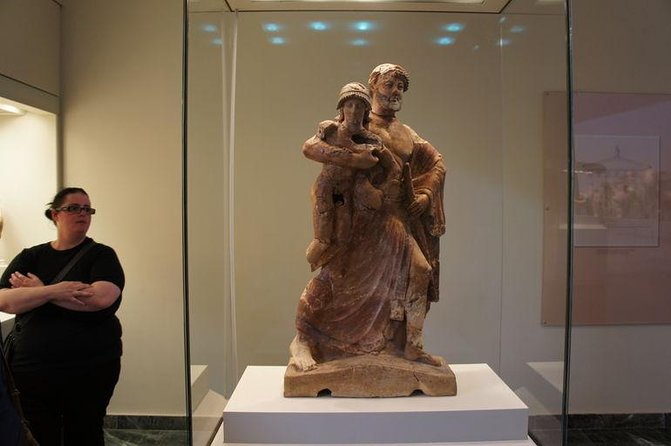
- The museum supplies the detail: Look for bronze offerings, weapons, ceramics, tools, and celebrated sculptures.
- Plan for extra costs: The guide is included, but transport and the €20 site and museum ticket are not.
- English-language guiding: The experience is offered in English, with free cancellation up to 24 hours before the start time.
Why a private guide helps at ancient Olympia
Olympia is not a single grand building. It is a wide archaeological site filled with foundations, columns, broken walls, and open spaces. That can be moving, but it can also be hard to read without help.
A private guide gives each ruin a role. The gymnasium becomes a place where athletes trained. The palaestra gains a purpose beyond being another set of stones. The Temple of Zeus becomes more than a few fallen blocks, especially once you see the sculptures from its pediments inside the museum.
I like this kind of guiding because it gives you a story without asking you to stare at a plan and guess what you are seeing. You can stop when something catches your interest, ask why a building mattered, or ask about the ancient Olympic Games as you walk.
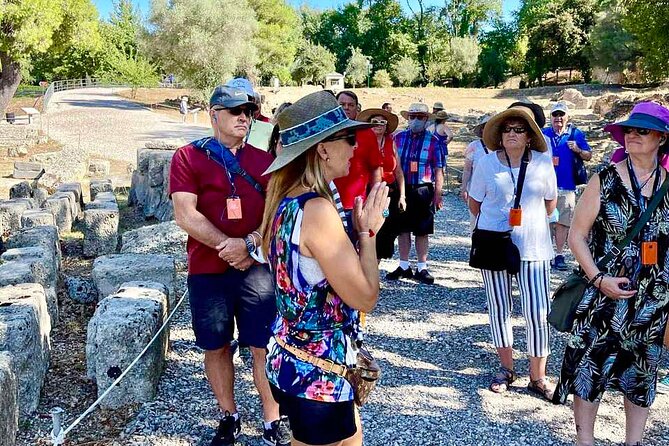
The strongest feature is the human side of the guiding. Zoe is described as both warm and highly informed, while Niki is praised for reading the group quickly and adjusting the pace. One guide made a special effort to keep group members with disabilities involved throughout the visit. Another guide, Georgia, used humor and conversation to make the ruins easier to understand.
The private setup is especially useful for families and small groups with mixed interests. Children may need a different explanation from serious ancient-history fans. A guide can make room for both, rather than giving one fixed speech to everyone.
More museums around Greece:
- Athens: Acropolis, Parthenon & Acropolis Museum Guided Tour
★ 4.8 · 9,316 reviews - Athens: Mythology of Delphi, Museum and Arachova Guided Tour
★ 4.6 · 4,008 reviews - Athens: Acropolis, Parthenon & Acropolis Museum Guided Tour
★ 4.8 · 3,579 reviews
The archaeological site: 90 minutes among the ruins
The first part lasts about 1 hour and 30 minutes. It takes place at the Archaeological Site of Olympia, and your guide leads you among the remains of buildings that shaped the religious and athletic life of the sanctuary.
Do not expect complete monuments like the Acropolis in Athens. Olympia is powerful partly because you must use your imagination. The guide’s job is to help you see the buildings that once occupied the foundations.
The gymnasium and palaestra
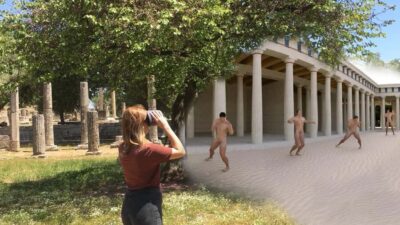
The gymnasium and palaestra show the athletic side of Olympia. These were not simply places for casual exercise. They were part of the training world that supported the ancient games.
The remains can look restrained at first. A guide helps you understand the layout and the link between physical training, competition, and the wider religious setting. If you are mainly interested in the Olympics, this is one of the stops that gives the site practical meaning.
The Temple of Zeus
The Temple of Zeus was the sanctuary’s central religious monument. Much of it lies in ruin, but its importance becomes clearer once you see the sculpture preserved in the museum.
This is where a private guide can earn the fee. The surviving stones alone do not show the temple’s full visual impact. The explanations connect the architecture outside with the statues and decoration inside, allowing you to picture the building as a complete work rather than an archaeological footprint.
A few other Greece mornings to price up
- Best of Athens Half Day Private Tour
★ 5.0 · 3,714 reviews - Athens Full Day Private Tour
★ 5.0 · 2,903 reviews - Private Santorini Tailor Made – Choice of the Guest!
★ 5.0 · 1,972 reviews - Athens Airport Private Arrival Transfer with Meet & Greet
★ 4.5 · 1,495 reviews
The Temple of Hera
The Temple of Hera offers another view of Olympia’s religious life. It is also connected with the modern Olympic tradition, since the Olympic torch is lit at an altar at the site in the present day.
That link gives the visit a nice bridge between ancient and modern customs. You are not only looking backward at a ruined sanctuary. You are also seeing a place that remains tied to the ceremonies people recognize today.
The Philippeion
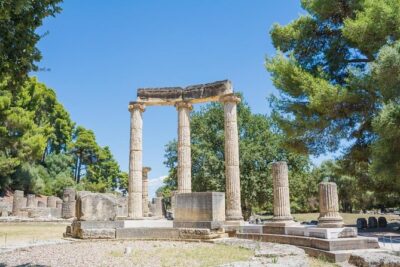
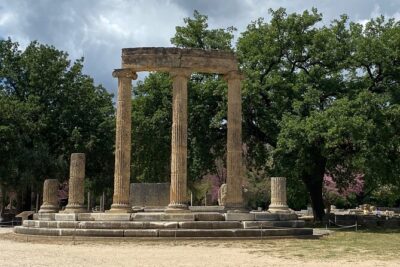
The round Philippeion is one of the site’s distinctive buildings. Its unusual form helps break up the sequence of rectangular temple foundations and gives your guide a chance to explain another part of Olympia’s political and ceremonial world.
The supplied details identify the building by name, but not every part of its story. Ask your guide about its purpose and connections when you reach it. That is one advantage of a private tour: your questions can shape the visit.
Phidias’s workshop
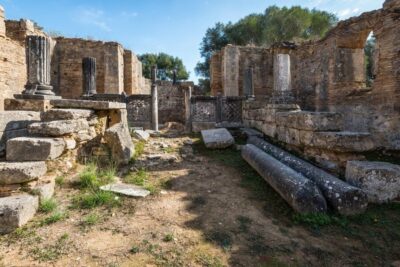
Phidias’s workshop is a major stop. This is the place where the gold-and-ivory statue of Zeus was made, one of the most famous works associated with the ancient world.
The workshop is valuable because it shifts your attention from finished temples and statues to the process behind them. You see where an enormous artistic project was carried out, then later examine tools and a cup linked with the workshop in the museum.
For many people, this is the most distinctive part of the tour. Temples and stadiums appear at several ancient sites, but a surviving workshop connected with such a celebrated statue offers a more personal look at how the ancient world produced its masterpieces.
The ancient Olympic stadium
The stadium is the natural high point for anyone interested in the games. It helps you understand the scale and setting of athletic contests better than a museum label can.
Your guide can place the athletic events within the wider sanctuary, where worship, art, politics, and competition existed side by side. The visit does not treat Olympia as only a sports venue. That balance matters, since the games were part of a larger religious festival.
You should expect walking across an archaeological site and a moderate level of physical activity. Wear practical shoes and bring what you need for time outdoors, since the itinerary includes 90 minutes at the ruins. The tour information does not promise shaded routes or weather protection, so plan sensibly for the conditions on the day.
The museum: where Olympia’s broken stones regain their color
The second stop lasts about one hour at the Archaeological Museum of Olympia. The entrance fee is not included, and the stated price is €20 per person for the archaeological site and museum.
I consider the museum essential, not an optional extra. The ruins show the plan of Olympia, but the museum shows the skill, detail, and ambition that once filled it.
You can see bronze and clay offerings, including tripods and figurines. Armor, weapons, vases, and other objects help explain the sanctuary’s religious and practical life. These smaller finds can be just as useful as the famous statues because they reveal what people handled, dedicated, wore, and used.
The museum also contains the tools and cup associated with Phidias’s workshop. Seeing these objects after visiting the workshop gives the site visit a satisfying connection. You are not simply hearing about an artist’s workplace. You are looking at objects linked with the work carried out there.
Hermes by Praxiteles
Hermes by Praxiteles is one of the museum’s major attractions. The sculpture is elegant and carefully finished, and it gives you a close look at the classical Greek ideal of the human figure.
A guide can point out details that are easy to miss when you are moving through a museum on your own. The benefit is not just learning the name of the sculptor. It is understanding why this work receives so much attention and how it fits into the wider artistic culture of Olympia.
Nike of Paeonios
The Nike by Paeonios is another highlight. It represents the goddess of victory and connects naturally with the athletic identity of Olympia.
The statue also helps you think about the meaning of victory in the ancient sanctuary. The games were not separate from religion. Athletic success, divine honor, public display, and artistic achievement were tied together.
The Temple of Zeus pediments
The classical sculptures from the pediments of the Temple of Zeus are among the museum’s most impressive displays. Their preservation gives you something the ruins cannot: a clear sense of the scale and quality of the temple’s decoration.
This is where the two-hour-and-thirty-minute structure works well. After walking through the temple remains, you can see its sculpted decoration indoors. The guide can help you connect the fragments, figures, and architectural setting.
An hour is enough for a focused visit with a guide, but it is not a full museum study session. If you like to read every label or linger over each object, you may want extra independent time, though the supplied tour details do not state that additional time is built into the schedule.
What the $216.02 price really buys
At $216.02 per person, this is not a budget way to see Olympia. The €20 entrance fee is extra, and private transportation is not included. You must reach the meeting point on Unnamed Road in Ancient Olympia and arrange your own transport.
The price makes more sense for a small group than for a solo visitor. The booking information notes group discounts, but it does not give the discount levels, so check the final price for your group before paying. Because the activity is private, the fee buys exclusive guide time rather than a seat on a large shared walk.
I would choose this tour if you care about context, have limited time in Olympia, or want to ask plenty of questions. I would be less likely to book it if I mainly wanted to walk around quietly, already knew the site well, or was traveling on a tight budget.
The guide is the central value. The strongest comments focus on guides who bring the ruins to life, explain the site in clear English, use humor, and adjust to the group. One assessment specifically notes that the tour was not cheap but felt worth the cost because the site made far more sense with a guide.
That is a fair way to judge the price. You are paying for interpretation, not just admission. If you do not value that service, the total cost may feel high. If you want the names, functions, and stories behind the stones, the private format can be money well spent.
Timing, meeting point, and practical planning
The experience lasts approximately 2 hours and 30 minutes. It begins at Unnamed Road, Archea Olympia 270 65, Greece, at the archaeological site. It ends at the Archaeological Museum of Olympia in Ancient Olympia.
The end point is useful because the museum forms the final part of the visit. You do not need to switch to a separate activity for the indoor collection. Still, since private transportation is excluded, you need to plan how you will get to the starting point.
The activity is offered in English and confirmation is provided when you book. It is near public transportation, but the exact transport options and schedules are not supplied, so check your route before the day of the tour.
A moderate level of physical fitness is advised. The site visit involves walking outdoors across archaeological remains, and the itinerary does not describe a fully step-free route. Service animals are allowed.
The cancellation policy is useful for careful planners: you can cancel up to 24 hours before the start time for a full refund. Changes or cancellations made less than 24 hours before the start time are not accepted for a refund, and cut-off times follow local time in Greece.
The tour is booked, on average, 58 days ahead. That does not guarantee that every date sells out, but it is a sensible reason to reserve early if you need a particular day, especially during a busy Greek holiday or cruise schedule.
Who will get the most from this Olympia tour
I would recommend it most strongly to:
- First-time visitors who want the site explained clearly
- Families who need a guide to keep children involved
- Small groups with different levels of interest in ancient history
- People visiting Olympia on a tight schedule
- Museum lovers who want the artifacts connected to the ruins
- Anyone who prefers asking questions instead of following a fixed large-group speech
The tour can also work well for groups that include people with disabilities, since a guide has been praised for keeping everyone engaged. However, the activity requires moderate physical fitness, and the available information does not promise special mobility arrangements. Discuss your group’s needs before booking.
History specialists may appreciate the private access to a guide’s time, but they should note the short length. Two and a half hours gives you a strong overview, not an exhaustive study of every building and object.
Should you book the private Olympia visit?
Book it if you want Olympia to feel like a place with purpose rather than a field of ruins. The combination of the archaeological site and museum is exactly right: outside, you see the gymnasium, palaestra, temples, workshop, and stadium; inside, you see the art and objects that explain what those buildings once held.
The best reason to choose this experience is the quality of the guide. Zoe, Niki, Georgia, and S. are all specifically praised for clear explanations, warmth, humor, strong English, and the ability to adjust to different groups. A private tour also lets you focus on the parts that matter most to you.
Skip it if the price, separate entrance fee, and lack of included transport make the total too high. You can still visit Olympia independently. But if you want the ancient games, religious buildings, Phidias’s workshop, and museum masterpieces tied into one readable story, this is a strong choice.
FAQ
How long does the private Olympia tour last?
The tour lasts approximately 2 hours and 30 minutes. About 1 hour and 30 minutes is spent at the archaeological site, followed by about 1 hour at the Archaeological Museum of Olympia.
What does the tour include?
The price includes licensed tour guide services. The tour is private, so only your group participates.
Is the entrance fee included?
No. The entrance ticket for the archaeological site and museum costs €20 per person and must be paid separately.
Is transportation included?
No. Private transportation is not included. You are responsible for reaching the meeting point at Unnamed Road, Archea Olympia 270 65, Greece.
What language is the tour offered in?
The tour is offered in English.
What will I see at the archaeological site?
You will see remains including the gymnasium, palaestra, Philippeion, Phidias’s workshop, the Temples of Zeus and Hera, the altar used for lighting the modern Olympic torch, and the ancient Olympic stadium.
Can I cancel for a full refund?
Yes. You can cancel at least 24 hours before the experience start time for a full refund. Cancellations or changes made less than 24 hours before the start time are not accepted for a refund.
Fresh on the Greece list
- Private Tour: Customize Your Perfect Day in Santorini★ 5.0 · 45 reviews
- From Thessaloniki:Day Trip to Dion, Litochoro &Mount Olympus★ 4.4 · 45 reviews
- Imerovigli: Premium Wine Tasting with Caldera and Sea Views★ 4.9 · 45 reviews
- Heraklion: Sunrise Balloon Flight & Sunset Catamaran Cruise★ 5.0 · 45 reviews
- Athens Airport Arrival Transfer to Hotels or Addresses in Athens★ 3.5 · 45 reviews
- Santorini_All time Classic in Santorini★ 5.0 · 45 reviews
- Hersonissos: Alar Spectacular Dinner Show★ 4.7 · 45 reviews
- Private Luxury Tour: Unveiling the Sacred Mysteries of Eleusis★ 5.0 · 45 reviews
Olympia Tours, compared.
Archaeological Site & Museum E-Ticket & Audio Guide
Read our review →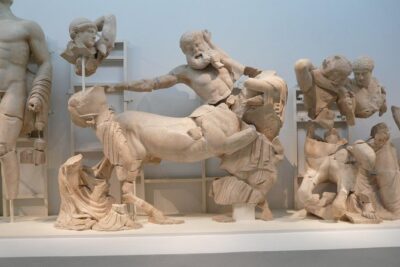
4 hour Katakolon shore excursion (Olympia – Winery – Beach)
Read our review →
Olympia Shore Ex: Olympic site, Honey Farm & Olive Oil Tasting
Read our review →
Browse the lists this tour appears in