
Reviewed · ATHENS TOURS
From Athens: City & Corinth Guided Day Tour
The most useful thing about this private tour is its reach: in one long day, you connect Athens’s great classical monuments with Corinth, the Roman-era city where St. Paul spoke to the Corinthians. That is a lot of Greece for a single booking, especially if your time is limited or you are arriving by cruise ship.
I like the door-to-door pickup and the private format, which lets the driver adjust the day for your ship schedule or interests. I also like the mix of famous sights and less obvious stops, from the Corinth Canal and Diolkos to the altar linked with St. Paul. The main drawback is that entrance fees are extra, and the driver cannot guide you inside the archaeological sites.
Key points at a glance
- Two major ancient cities in one day: Pair Athens’s Acropolis with Ancient Corinth and its Temple of Apollo.
- Private pickup from Athens or Piraeus: Start at your hotel, cruise ship, or another chosen location.
- Strong driver-guides: Names praised in past experiences include Nikos, Takis, Odysseus, Spiros, and Demitrios.
- St. Paul connection: See the place associated with his speech to the Corinthians and visit St. Paul’s church area in Corinth.
- Bring money for admissions: The Acropolis, Museum, and Corinth require separate tickets, and lunch is not included.
- A demanding schedule: Expect about 9.5 hours, walking on slippery ancient stone, and a long drive between Athens and Corinth.
Why this Athens and Corinth combination works
Athens and Corinth tell different parts of the Greek story. Athens gives you the high point of classical democracy, architecture, and civic life. Corinth adds a port city shaped by trade, Roman power, early Christianity, and the movement of people across the Greek world.
I like this pairing because it avoids making your day a parade of disconnected ruins. At the Acropolis, you see the monuments usually associated with ancient Greece. At Corinth, you see how later Roman rule changed the setting and how St. Paul addressed a community that was already important long before Christianity reached it.
The tour costs $471 per group of up to three people. That is not a bargain if you are alone, but the math improves for two or three people because the price covers the private vehicle, transfers, driver-guide, bottled water, Wi-Fi, and a mobile phone. You are also paying for the convenience of a custom pickup and a full day without arranging several separate taxis or train connections.
Still, budget for admission fees and food. The driver-guide can explain places while driving and between stops, but cannot escort you inside the Acropolis, museum, or Corinth site. If you want detailed indoor interpretation at every ruin, you may prefer to hire a licensed guide separately.
More City Tours in Athens
- Athens: City Sightseeing Hop-On Hop-Off Bus Tour
★ 4.3 · 4,520 reviews - City Sightseeing Athens, Piraeus & Beach Riviera Hop-On Hop-Off Bus Tours
★ 4.0 · 1,887 reviews - Athens:City Pass with Acropolis, Museums, Hop-On Hop-Off Bus
★ 3.9 · 586 reviews
From Athens to Corinth Canal
The drive southwest takes about an hour through Corinthia. This is useful travel time rather than dead time, since your English-speaking driver-guide can explain the region, answer questions, and point out details along the route.
The first major stop is the Corinth Canal, with about 20 minutes for photographs. The canal cuts through the narrow Isthmus of Corinth, creating the striking impression of a deep, straight-sided slot through the land. You will not spend long here, but it is a good visual introduction to why Corinth mattered: this was the land bridge between mainland Greece and the Peloponnese.
Nearby, the Diolkos recalls an even older solution to the same problem. It helped Corinthians move ships across the isthmus instead of sailing around the Peloponnese. The stop is short, so think of it as a historical pause rather than a full site visit.
Kechries, Acrocorinth, and the wider Corinth story
The itinerary includes a visit to Kechries for roughly 30 minutes. The stop is part of the broader Corinth experience and helps place the ancient city within its coastal setting.
Acrocorinth follows, also with about 30 minutes and scenic views along the way. Acrocorinth is the high defensive point above Corinth, and even a short visit gives you a sense of why control of this area mattered. The views help connect the ruins below with the roads, sea routes, and mountain approaches that made Corinth such a valuable position.
Timing matters here. This is a packed day, so you should not expect an extended fortress exploration. The value is the panorama and the context, particularly if your driver adds the sort of extra stops that several past guests appreciated. Spiros, Odysseus, and Takis were especially praised for adjusting the route, adding local sights, and helping with photographs.
Ancient Corinth and the place linked to St. Paul
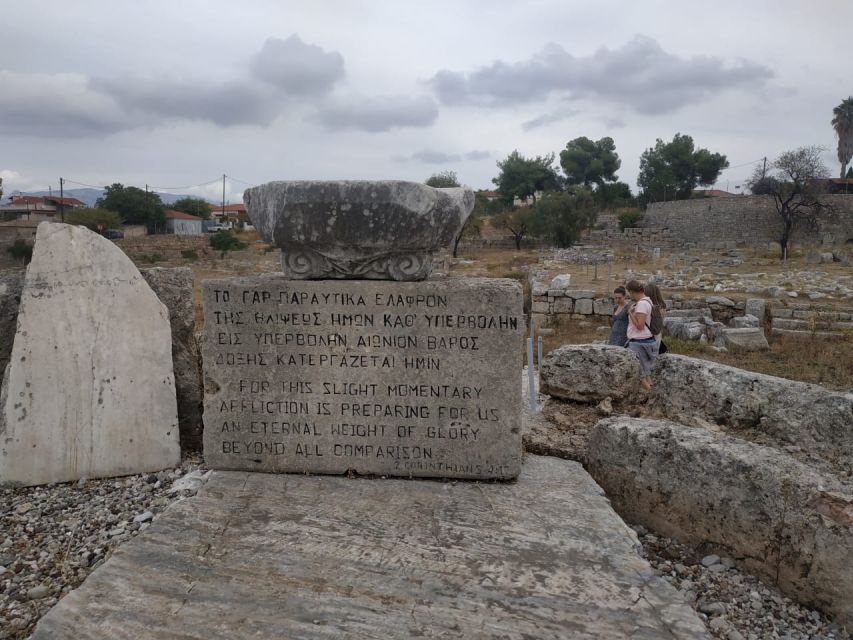
Ancient Corinth is the most rewarding stop for visitors interested in early Christianity or the Roman period. You will see the Temple of Apollo, two theaters, temples from the Roman period, and the area associated with the altar where St. Paul spoke about Christianity to the Corinthians.
The setting makes the story easier to grasp. St. Paul was not speaking to an isolated village. Corinth was a major city with public buildings, religious traditions, commercial ties, and a strong Roman presence. The ruins show the civic world in which the Christian message was presented.
The site visit lasts about an hour, followed by free time, shopping, and an optional lunch. The schedule information lists the Ancient Corinth break as 40 hours, which is clearly inconsistent with a 9.5-hour tour. You should confirm the exact free-time length when booking, rather than plan around that figure.
The Corinth Museum adds useful detail to the stones outside. Its collection contains artifacts from different periods, including statues of Roman emperors. This is where the city becomes less abstract. Instead of seeing only columns and foundations, you get objects that show who held power and how public life changed over time.
One important caution: the driver cannot escort you inside the archaeological site or museum. You will be able to visit them, but the experience inside will be self-guided unless you arrange a licensed guide. The driver’s historical commentary remains valuable, particularly on the road and at exterior viewpoints, but it is not the same as a formal guided museum tour.
A few other Athens mornings to price up
- Athens: City Highlights Bike tour
★ 4.9 · 453 reviews - The Acropolis, Athens Walking City Tour and Acropolis Museum
★ 5.0 · 442 reviews - Athens: Discover the City Electric Bike Tour
★ 4.9 · 414 reviews - Acropolis Walking Tour, Including Syntagma Square & City Center
★ 4.5 · 404 reviews
The Acropolis: Athens at its most famous
After returning toward Athens, the tour turns to the Acropolis. The listed visit lasts about an hour, which is enough for a focused look at the main monuments but not enough for a slow, detailed study of every corner.
The Parthenon is the centerpiece. You will also see the Propylaia entrance, the Erechtheion with its famous Caryatid figures, and the reconstructed Temple of Athena Nike. These buildings are not simply old structures to photograph. Together, they show how religious buildings, civic identity, artistic ambition, and political power were put on display above Athens.
The Acropolis is often presented as a symbol of democracy, and the tour uses that setting to explain the development of ancient Athens. You may also hear the Parthenon described as one of the most perfect buildings ever made. Treat that as an expression of its influence and design rather than a measurable fact. Its importance lies in the way later architects, artists, and governments repeatedly borrowed from it.
Wear athletic shoes. The ancient stone can be very slippery, particularly in summer when the site is crowded and bright. Light clothing is recommended in hot weather, and the tour information advises avoiding dark colors. Bring your passport, as it is listed among the required items.
The Acropolis opening hours vary by season. It is open from 8 AM to 7 PM in summer, and from 8:30 AM to 3 PM from November 1 through March 31. Since the day includes Corinth, an early start is important.
The Acropolis Museum and what the driver can explain
The Acropolis Museum is one of the strongest parts of the Athens program, provided there is enough time in the day. It offers a more controlled setting than the hilltop, with ancient objects presented indoors and views back toward the Acropolis.
Admission is listed separately at €10. The museum is open from 8 AM to 8 PM, so its long hours can help with scheduling, though the final order of visits may change due to conditions or traffic.
Because the driver cannot escort you inside, ask for a clear plan before entering. You will get the most from the museum if you know how long you have and which galleries are the priority. The Acropolis itself, the museum, Corinth, lunch, and Athens sightseeing add up quickly.
Temple of Zeus, Hadrian’s Arch, and the city center
The Temple of Olympian Zeus is usually seen from outside or during a short sightseeing stop. It was the largest temple in the ancient world, and even the remaining columns give you a strong sense of its former scale.
The nearby Arch of Roman Emperor Hadrian adds another layer to Athens. It marks the relationship between the older Greek city and the Roman-era expansion of Athens. These stops are brief, but they help you see that Athens was not frozen in the fifth century BC. The city continued to grow, change, and absorb new rulers.
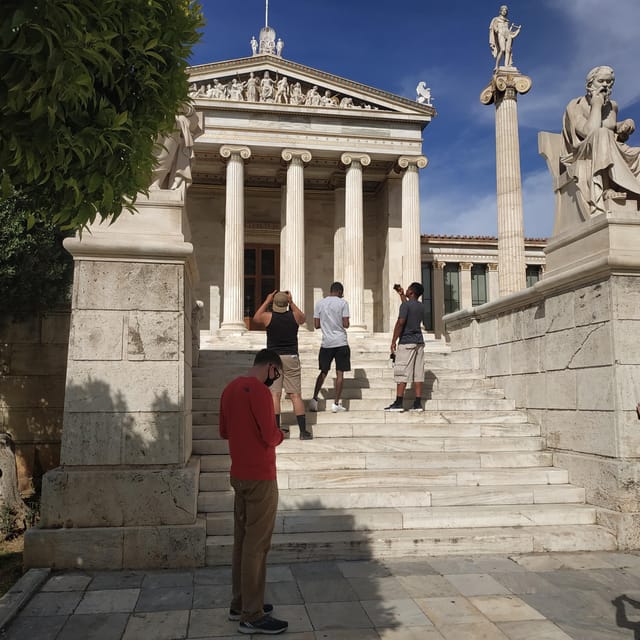
The tour also passes through central Athens, with photo and sightseeing stops at the University of Athens, the Academy of Arts and Sciences, and the National Library. Their neoclassical façades offer a sharp contrast with the ancient ruins. This is a worthwhile part of the day because it shows modern Greece’s effort to connect its new national identity with the classical past.
The itinerary also refers to the residence of Sleiman, the German archaeologist associated with the discovery of Troy. The detail adds a personal story to the city drive, though the amount of time spent there is not specified.
Lycabettus, the Panathenaic Stadium, and the guards
Mount Lycabettus provides a panoramic view over Athens and is one of the better places for photographs. The stop is especially useful after seeing the Acropolis, since you can look back at the hill within the larger city rather than treating it as an isolated monument.
The Panathenaic Stadium receives about 15 minutes for photographs. It hosted the first modern Olympics in 1896 and is built of white marble, making it easy to recognize even during a short stop. Do not expect a full stadium visit at this pace. This is a quick look and a picture opportunity.
At Parliament, you can watch the changing of the guards if the timing works. The schedule does not promise a specific ceremony time, so your driver will need to fit it around the rest of the day. The stop gives you a glimpse of present-day Greek public life after a morning focused on ancient temples.
Plaka and the final Athens hour
Plaka is the final free-time stop, with about 30 minutes for shopping and a look around. It is a practical place to buy tax-free items, but half an hour is not enough for a long meal or relaxed neighborhood wandering.
I would use this time for a small purchase, a quick snack if lunch has been skipped, or a final walk through central Athens. Lunch in Corinth is optional and not included, so you will want to discuss the food plan early in the day. A long restaurant meal may reduce time at the archaeological sites.
Return transfer is provided to Athens or Piraeus. That matters for cruise passengers. Several past bookings involved pickup and return at the port, and one account specifically praised the driver for bringing the party back in time after a full day. You should still allow a sensible buffer, since traffic and site closures can alter the schedule.
Guides, vehicles, and the private-tour advantage
The driver-guide is central to the experience. Names associated with especially strong service include Nikos, Takis, Odysseus, Spiros, and Demitrios. The praise is consistent on a few points: clear explanations of Greek history and culture, flexibility with timing, friendly service, and a willingness to add a useful stop or help with photographs.
One guide adjusted the plan for a shorter cruise stay. Another made an unscheduled Starbucks stop after learning it mattered to a passenger. Those small actions explain the appeal of a private tour better than a long list of inclusions. You are not locked into the rhythm of a large coach group.
The vehicle includes cold drinking water, Wi-Fi, and a mobile phone. Transport received a 96 percent perfect-score rating, which is a strong sign for a day involving long drives and several stops. The group limit is three people, so this works best for a couple, a family, or a small group that values comfort and control.
The tradeoff is the guide’s role. You get a driver with local knowledge and historical commentary, not a licensed guide walking beside you inside every monument. If you want formal instruction at the Acropolis Museum and Corinth Museum, ask about adding a licensed guide before you pay.
Tickets, timing, and who gets good value
The Acropolis multi-ticket costs €30 and includes the Temple of Zeus, Ancient Agora, Roman Forum, Kerameikos, and Theater of Dionysos. Corinth costs €8 in summer and €4 in winter. The Acropolis Museum costs €10. These fees are not included, so add them to the tour price when comparing options.
Not every stop requires paid entry. The Temple of Zeus may be a pass-by or sightseeing stop, and the Panathenaic Stadium and city-center buildings can be viewed briefly from outside. Confirm which admissions your exact schedule will use.
The tour runs about 9.5 hours. It suits you if you want to cover a lot of ground in one day, dislike arranging transport, or are making a short Athens visit. It is less suitable if you prefer slow museum visits, long meals, or an unhurried day at the Acropolis.
Sites close on January 1, March 25, May 1, October 28, Christmas Day, and Boxing Day. Hours are also limited around Easter, with Good Friday, Holy Saturday, Easter Sunday, and Easter Monday following special schedules. The order of stops can change, so check dates carefully.
Free cancellation is available up to 24 hours before departure, and you can reserve now and pay later. Those policies make planning easier, but they do not remove the need to verify site hours and ticket arrangements.
Should you book this Athens and Corinth tour?
Book it if you want maximum coverage with minimum transport hassle. The private format, hotel or port pickup, flexible driver-guides, and strong attention to personal schedules make the $471 group price reasonable for two or three people.
I would choose it for a cruise stop, a first visit with limited time, or a small group that wants both classical Athens and St. Paul’s Corinth. I would skip it if your priority is a long, formal guided visit inside the Acropolis and museums, since the driver cannot escort you indoors and entrance fees are extra.
Ask three things before confirming: which sites will be entered, how much free time is planned at Ancient Corinth, and whether a licensed guide can be added. With those details settled, this is an efficient and personable way to connect Greece’s ancient monuments, Roman past, and Christian story in one demanding but rewarding day.
FAQ
How long does the Athens and Corinth tour last?
The tour lasts approximately 9.5 hours.
Where can pickup and drop-off take place?
Pickup and drop-off are available in Athens or Piraeus. Pickup can be arranged at your hotel, cruise ship, or another preferred Athens location.
Is this a private tour?
Yes. The tour is for a private group of up to three people.
Is an English-speaking guide provided?
Yes. An English-speaking driver-guide provides the tour and commentary. The driver cannot escort you inside the archaeological sites.
Are entrance fees included?
No. Entrance fees are separate. The Acropolis Museum costs €10, the Acropolis multi-ticket costs €30, and Corinth costs €8 in summer or €4 in winter.
Is lunch included?
No. Lunch is optional and is not included in the tour price.
What should I bring?
Bring your passport and comfortable shoes. Athletic shoes and light clothing are recommended in summer because the Acropolis can be slippery and hot.
Can I cancel or pay later?
You can cancel up to 24 hours before the tour for a full refund. You can also reserve now and pay later.
Fresh on the Athens list
- Athens Airport Arrival Transfer to Hotels or Addresses in Athens★ 3.5 · 45 reviews
- Private Luxury Tour: Unveiling the Sacred Mysteries of Eleusis★ 5.0 · 45 reviews
- Luxury Catamaran Sunset Semi-Private & Greek Gastronomy in Athens★ 5.0 · 45 reviews
- From Athens: Aegina Island guided tour in a day★ 5.0 · 45 reviews
- Delphi, Thermopylae full day private tour from Athens★ 4.9 · 46 reviews
- Acropolis Private Wine Tasting @ Finewine store★ 5.0 · 46 reviews
- Ancient Corinth Half-Day Private Tour from Athens★ 5.0 · 46 reviews
- Athens: Traditional Greek food tour in hidden spots★ 4.6 · 46 reviews
Athens Tours, compared.

Acropolis & up to 5 Archaeological Sites Combo Pass
Read our review →

Acropolis, Parthenon & Acropolis Museum Guided Tour
Read our review →
Cape Sounion & Poseidon Temple Sunset Half-Day Trip
Read our review →


Cape Sounio & Poseidon Temple Trip with Audio Guide
Read our review →
Hydra, Poros, and Aegina Day Cruise with Lunch
Read our review →Browse the lists this tour appears in