
Reviewed · ACROPOLIS & ACROPOLIS MUSEUM TOURS
Private Guided Tour: Athens, Acropolis and Acropolis Museum
Athens makes more sense when its ancient monuments are tied to the city around them. This private walking tour links Syntagma Square, the Evzones, the National Garden, Roman ruins, the Acropolis, and the Acropolis Museum in one carefully arranged morning or afternoon. The private guide gives you room to ask questions and set the pace.
I like the route through lesser-seen corners of central Athens, especially the National Garden and Dionysiou Areopagitou walkway. I also like the south-slope approach to the Acropolis, which brings you first to the Theater of Dionysus and can help you avoid some of the crush at the main entrance. The drawback is clear: $318 per person is a serious splurge, and entrance tickets, food, and drinks cost extra.
Key points to know before booking
- A full Athens introduction in 5.5 hours: You cover central squares, royal and Roman-era sights, the Acropolis, and its museum on foot.
- A private licensed guide: Guides such as Annie, Tina, Vicky, and Theodora have been praised for clear explanations, good pacing, and adapting to adults, children, and teenagers.
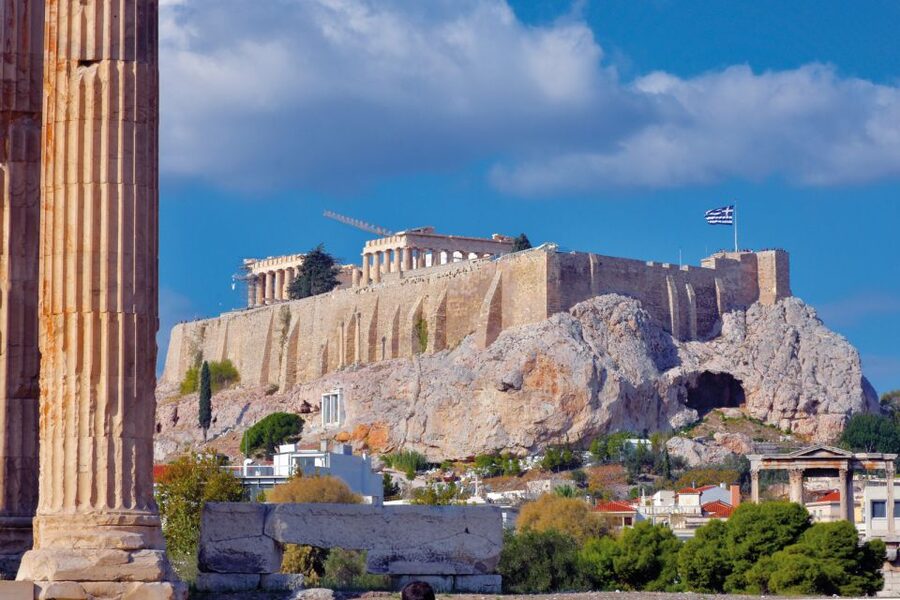
- The Acropolis is the main event: Expect the Parthenon, Propylaia, Erechtheion, Temple of Athena Nike, and views over Athens.
- Tickets are not included: You must buy Acropolis and museum admission separately and choose the correct ticket category.
- This is a demanding walk: Comfortable shoes, a hat, water, and weather-ready clothing are essential.
- The meeting point is easy to miss: Find the orange Athens Walking Tours sign inside Syntagma metro station, one level below street level.
Starting beneath Syntagma Square
Your guide meets you inside Syntagma metro station, by the ticket-validating machines under the large central clock. Look for the orange Athens Walking Tours sign. This is a practical meeting point if you are already in central Athens, but do not rush it. Syntagma Square has several entrances, and the meeting place is inside the station rather than out on the square.
The tour begins with a short look at archaeological finds from classical Athens discovered during excavations in the area. It is a small opening stop, but it helps you see modern Athens as a city built over layers of older settlements.
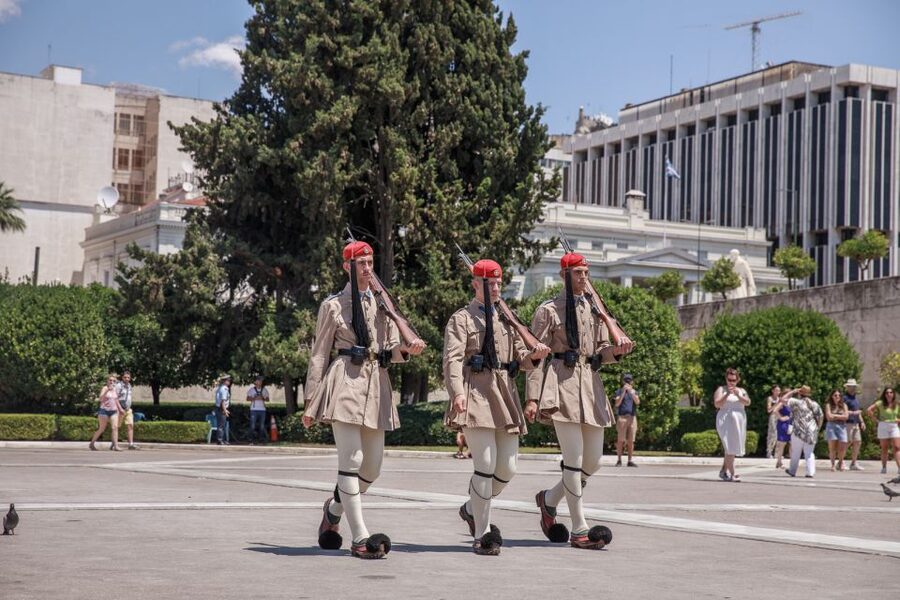
From there, you walk to the House of Parliament. In front of it, the Tomb of the Unknown Soldier is guarded by the famous Evzones, Greece’s ceremonial soldiers. The schedule offers an opportunity to see the changing of the guards, though the exact timing matters, so ask your guide at the start whether it fits your departure.
The Evzones’ uniforms and formal movements offer a glimpse of modern Greek identity, not just ancient history. This is one reason I like beginning at Syntagma. You are not dropped straight into a ruin with no context. You first see the political heart of present-day Greece.
More Museums in Athens
- Athens: Acropolis, Parthenon & Acropolis Museum Guided Tour
★ 4.8 · 9,316 reviews - Athens: Mythology of Delphi, Museum and Arachova Guided Tour
★ 4.6 · 4,008 reviews - Athens: Acropolis, Parthenon & Acropolis Museum Guided Tour
★ 4.8 · 3,579 reviews
The National Garden and Zappeion Hall
The walk continues through the National Garden, once Queen Amalia’s private garden. Its shaded paths provide a welcome break from Athens sun, especially in July and August. One guide, Nikoletta, was singled out for knowing where the shady spots were on the route, a useful quality when the temperature rises.
Next comes Zappeion Hall, an elegant neoclassical building near the gardens. Your guide explains the first modern Olympic Games and introduces important figures from Athens’ more recent past. This section gives the tour a broader frame. Athens is not only a city of temples. It is also a capital shaped by monarchy, politics, public gardens, athletic tradition, and modern national identity.
You should still expect a steady walk. The garden is not a long rest stop, and the route keeps moving toward the ancient sites. Families can manage it, but small children may need patience, and a stroller is not allowed.
Roman Athens at the Temple of Zeus
The next major stop is the Temple of Olympian Zeus, one of Athens’ great Roman-era remains. Its enormous columns make the scale of the ancient project easier to grasp than a photograph does. The temple was begun in the Greek period and completed under the Roman emperor Hadrian, which gives your guide a useful opening to explain how Greek and Roman Athens overlapped.
Nearby, Hadrian’s Arch marks the transition between the old Greek city and the Roman extension. These ruins are valuable because they broaden your understanding of Athens beyond the fifth century BC. If you only see the Parthenon, you miss how long the city continued to grow and change.
The exact amount of time at each outdoor sight depends on the guide and your interests. Private touring helps here. If your group wants more archaeology, mythology, architecture, or modern history, you can ask for more explanation. Guides such as Anna have been praised for connecting the sites with Greek philosophy and language origins, while others have adjusted their approach for children and teenagers.
Walking toward the Acropolis on Dionysiou Areopagitou
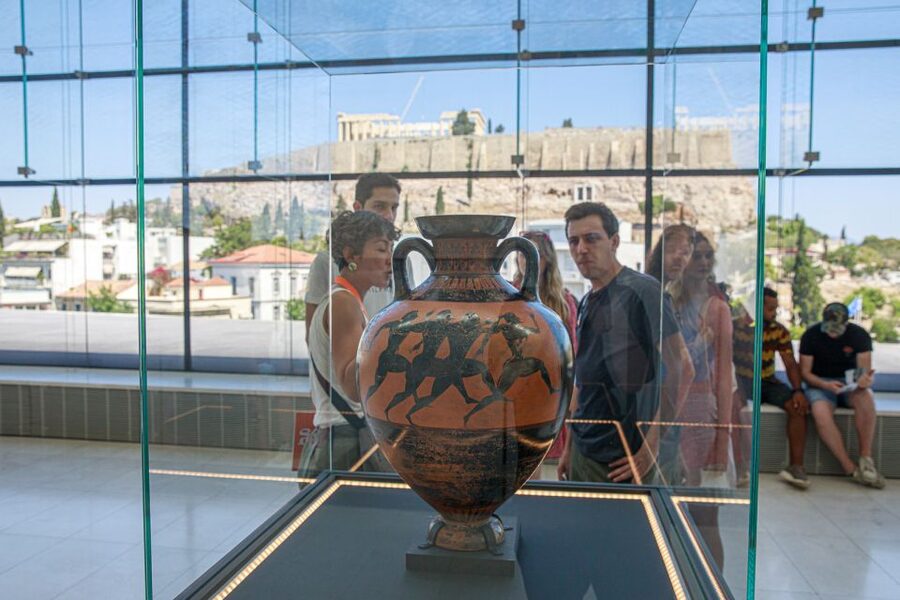
The route follows Dionysiou Areopagitou, one of the most attractive pedestrian paths in Athens. The Acropolis rises above you as you walk, and the setting shifts from city streets to a broad archaeological zone.
You pass views toward Philopappos Hill and its monument before reaching the Acropolis area. The route also brings you to the Odeon of Herodes Atticus, the large Roman theater built into the southern slope. It remains a working performance venue, although this tour focuses on its history and architecture rather than attending a show.
This is where the private format proves useful. A guide can stop for photographs, point out sight lines, and explain what you are seeing without trying to keep a large group together. One visitor described a private guide as worth the cost partly because it removed the stress of finding the way between sites and keeping up in crowded areas.
A few other Athens mornings to price up
- Athens: Acropolis & up to 5 Archaeological Sites Combo Pass
★ 4.4 · 12,619 reviews - Athens: Acropolis Ticket with Optional Audio or Live Guide
★ 4.2 · 11,055 reviews - Athens: Acropolis and Parthenon Guided Walking Tour
★ 4.6 · 5,882 reviews - Athens: Acropolis Ticket with Audio Guide
★ 4.0 · 3,575 reviews
Entering by the Theater of Dionysus
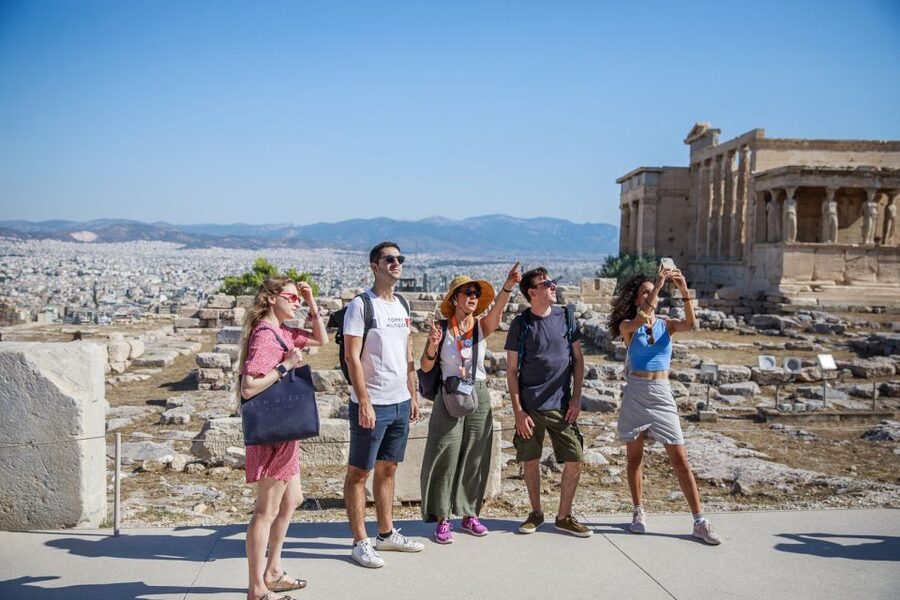
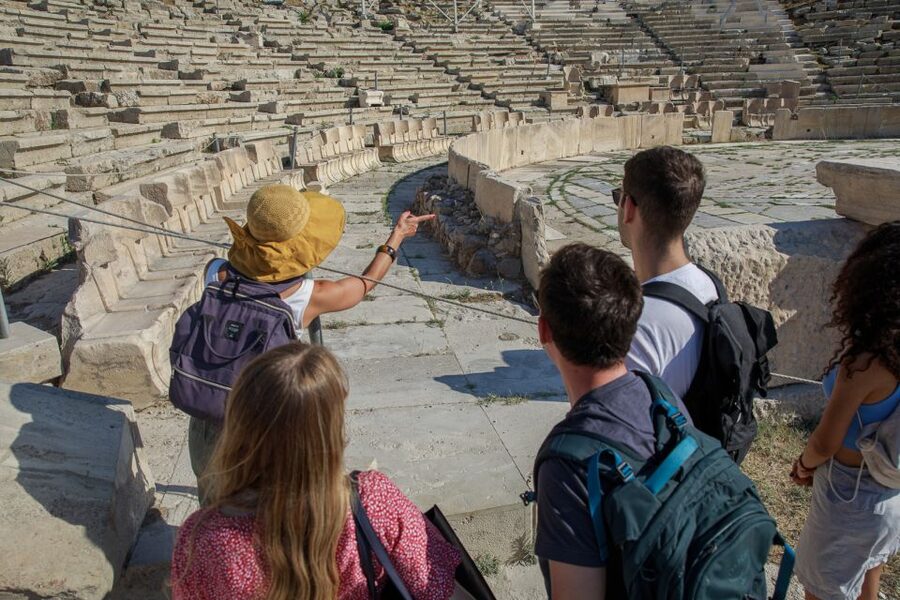
The Acropolis visit begins from the south slope. You see the Theater of Dionysus, often described as the first theater of antiquity, before climbing toward the hilltop monuments. This approach is more than a crowd-management trick. It introduces the Acropolis as a complete sacred and civic precinct rather than treating the Parthenon as an isolated picture postcard.
You then make your way toward the UNESCO-listed monuments. The climb includes uneven ancient surfaces, steps, and exposed areas. The tour is not suitable for wheelchair users or people with mobility impairments, and baby strollers and large bags are not allowed.
The south entrance is intended to help avoid some crowds, but do not assume the Acropolis will be quiet. Everyone passes through airport-style security, and in peak season waits can reach more than 30 minutes. Strict entry times also mean the guide cannot wait for late arrivals. Arrive early, wear practical shoes, and keep your booking details close.
The Parthenon and the Acropolis monuments
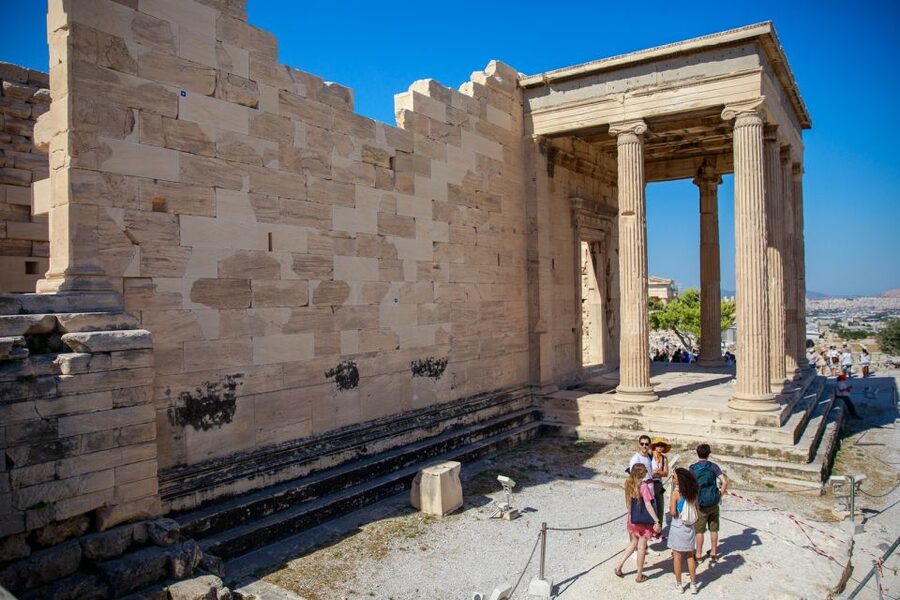
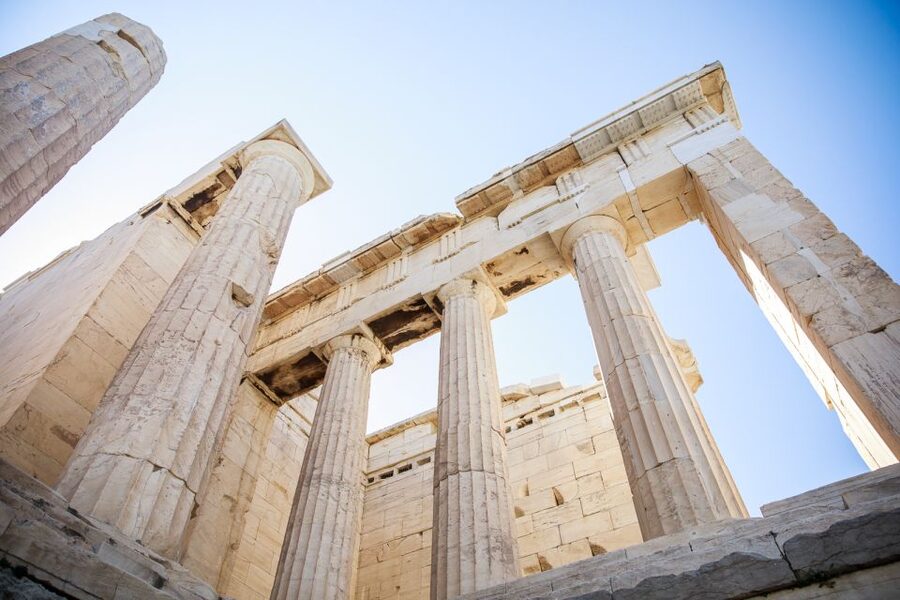
At the top, the route covers the Temple of Athena Nike, the Propylaia gateway, the Erechtheion, the Agrippa monument, and the Parthenon. The Propylaia frames the approach, while the Temple of Athena Nike occupies a small but striking position near the entrance.
The Erechtheion is especially rewarding with a guide because its unusual design and sacred associations are easy to overlook. Its porch with the Caryatids draws the eye, but the building’s uneven arrangement reflects a complicated sacred site rather than a simple rectangular temple.
The Parthenon receives the most attention, as it should. A good guide can help you look past the familiar outline and notice the planning, proportion, sculpture, damage, and later changes that shaped what you see today. The guides praised most highly, including Margarita, Panagiota, and Theodora, were valued for explaining archaeology and construction at a level that made the ruins easier to understand.
Do not expect the building to look like a complete ancient temple. The experience is about reading the surviving structure, its setting, and its place in Athenian history. Your guide supplies the background that a solo visit often lacks, particularly if you are not already comfortable with Greek mythology or classical architecture.
The view over Mars Hill and the Ancient Agora
The Acropolis summit provides one of Athens’ best city views. You can look toward Mars Hill, the Ancient Agora, and the Temple of Hephaestus, while the modern city spreads out in every direction.
I find this view more valuable after the guide has explained how the different sites relate to one another. The Agora is not just another ruin below you. It was a center of public life, and the Temple of Hephaestus helps you picture the wider sacred and civic district around the Acropolis.
You get time after the main explanation to take photographs and look around on your own. That pause matters. A tightly scripted group tour can leave you feeling that the monuments passed by too quickly. Here, you can ask for a few quiet minutes, provided the site schedule and group timing allow it.
The walk can be hot and tiring. One past participant estimated roughly 12 miles in a full day connected with the tour, while another recorded about 20,000 steps. Those figures are personal estimates rather than a fixed promise, but they make the point: bring water, use refill stations when available, and do not treat this as a gentle stroll.
Taking a break before the museum
After leaving the Acropolis, the itinerary includes a short break for a snack or drink before continuing to the museum. Food and beverages are not included, so carry cash and plan to pay for your own refreshment.
The break is useful because the Acropolis portion demands concentration as well as physical effort. Still, it is short, not a full meal stop. If you need a substantial lunch, plan it before or after the five-and-a-half-hour tour.
The Acropolis Museum and its glass floors
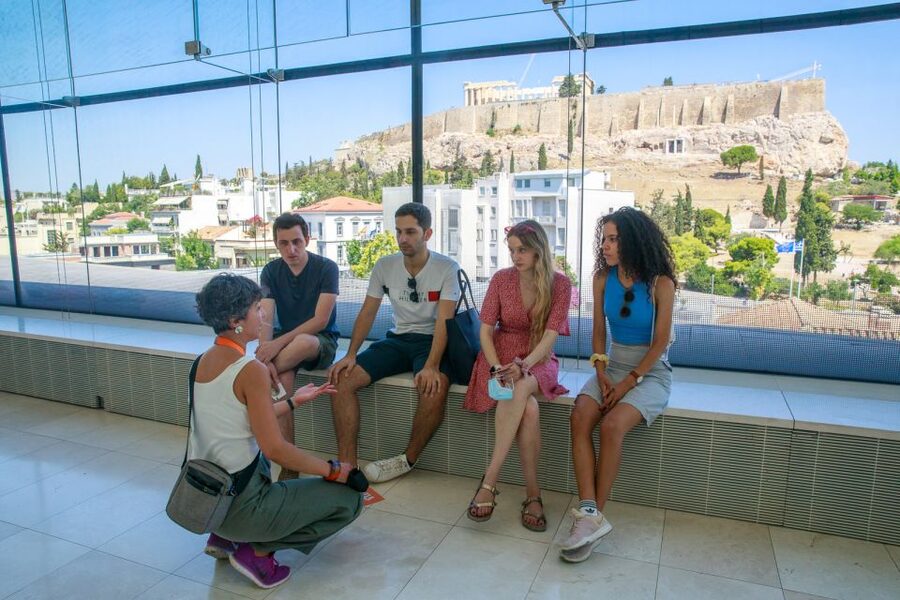
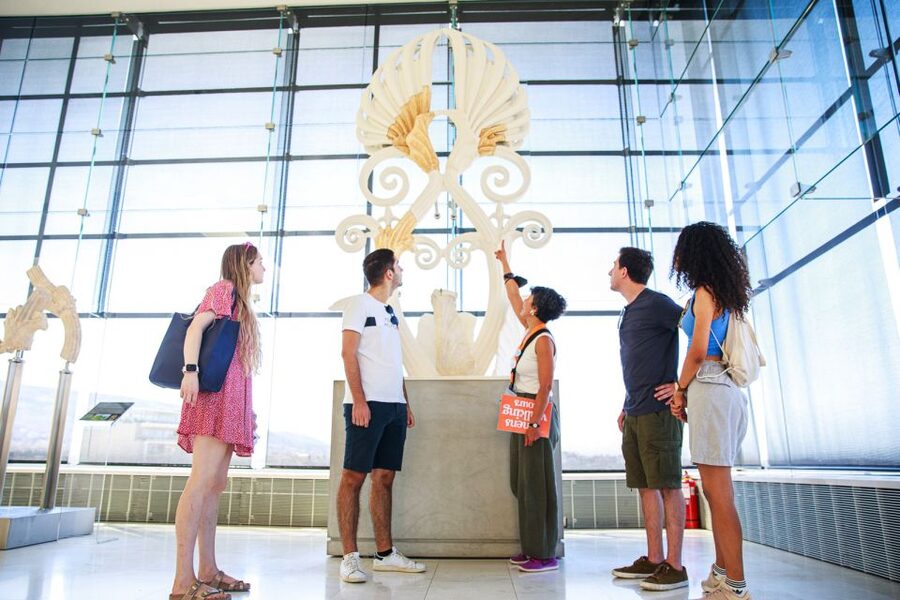
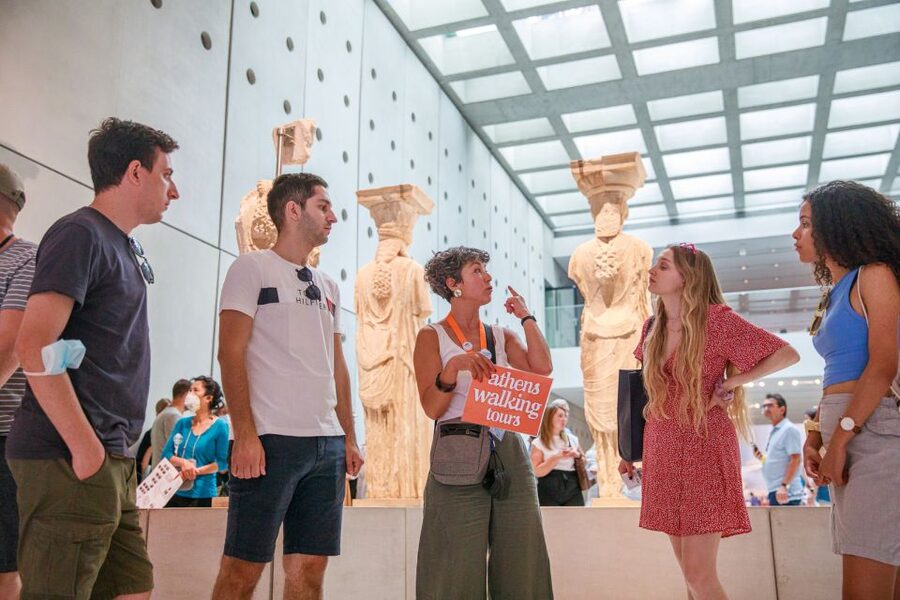
The New Acropolis Museum is a strong finish because it gives you close views of objects and sculpture connected with the monuments you have just seen. The building was designed by Bernard Tschumi in cooperation with Greek architect Michalis Photiadis.
Its glass floors reveal excavations beneath the museum. The effect is a reminder that Athens’ ancient remains are not confined to one hill. Archaeology continues under the modern city, and the museum itself was designed around that fact.
Inside, about 4,000 artifacts are displayed. Natural light, open exhibition areas, clear sight lines, and views toward the Acropolis make it easier to connect the objects with the place they came from. The museum is not simply a storage room for statues. It is the setting where details that were hard to see outdoors can become clear.
This final stop also balances the outdoor visit. On the Acropolis, you deal with sun, wind, uneven ground, and crowds. In the museum, you can focus on sculpture, architectural fragments, and archaeological finds in a more controlled environment. If you have limited time in Athens, seeing both in one booking is efficient.
What the private format is worth
The listed price is $318 per person. That price does not include entrance tickets, hotel transfers, food, or drinks, so your final cost will be higher. For a solo visitor or a couple, this is expensive. For a family or small group splitting the cost of one private guide, the value improves.
I would pay for this format when I had limited time, wanted serious historical explanation, or was traveling with people who needed a flexible pace. Families have found the private setting useful because guides can adjust stories for children and teenagers. One guide, Efie, was praised for connecting with teens, while another accommodated a four-year-old and allowed extra time for photographs.
The private structure also avoids the usual large-group problems: waiting for people who wander off, listening through an earpiece, and moving on just when you want another look. The tradeoff is that the value depends heavily on the guide assigned to you. The experience has received a 4.9 rating from 62 bookings, and named guides including Annie, Tina, Vicky, Dimitrious, Dafni, and Katerina have been praised for warmth, clear explanations, humor, and good pacing. You cannot normally choose a specific guide, so book this for the private format and licensed expertise rather than one particular name.
Tickets, timing, and practical limits
You must purchase entrance tickets separately through the tour provider’s ticket link. Select the right category, such as adult or student, and enter the booking reference beginning with GYG.
If you qualify for a reduced or free ticket, bring official proof and, when required, identification showing your age and nationality. Without the right documents, you could be denied entry or asked to pay the full price if tickets are available. The tour fee is not refundable in that situation.
The activity runs in rain or shine. Wear comfortable shoes, a hat, and clothing suited to the forecast. Cash is useful for refreshments and other small needs. Large bags, luggage, electric wheelchairs, and strollers are not permitted, and the walking demands rule out this tour for people with mobility impairments.
Cancellation is flexible only up to three days before the scheduled tour, when a full refund is available. After that, strict Acropolis entry times apply, and late arrivals are not held for.
Who should book this Athens tour?
I would recommend it to first-time visitors with one or two days in Athens, families who want the freedom to pause, and anyone who wants the Acropolis explained rather than simply photographed. It is also a good choice for travelers who have only about 36 hours in the city and want to connect the main sights without working out the route themselves.
History fans should find the combination of outdoor monuments and museum objects satisfying. The tour also suits curious beginners because the guides explain mythology, archaeology, construction, philosophy, and modern Athens at a level you can shape with your questions.
I would hesitate if you are watching every euro, dislike long walks, or prefer to explore museums at your own speed. The separate ticket cost and demanding route are real drawbacks. A private guide cannot remove the heat, security wait, uneven ground, or crowds at one of the world’s most visited ancient sites.
Should you book it?
Book this tour if the Acropolis is your priority and you want a clear, human explanation of what you are seeing. The route is well chosen, moving from modern Athens to Greek and Roman antiquity, then from the Theater of Dionysus to the hilltop monuments and the museum.
Skip it if you are comfortable researching the sites alone and want to keep costs low. For everyone else, especially families and short-stay visitors, the private format can justify the splurge because it saves navigation time and lets you shape the conversation. Just budget for admission, arrive early at Syntagma, and prepare for a very full day on your feet.
FAQ
Where does the private Athens tour begin?
The meeting point is inside Syntagma metro station, one level below the square. Your guide waits by the ticket-validating machines under the large central hanging clock, holding an orange Athens Walking Tours sign.
How long does the tour last?
The tour lasts 5.5 hours. Starting times vary, so you need to check availability for the date you want.
Is the tour private?
Yes. It is offered as a private group with a live, English-speaking licensed guide.
Are entrance tickets included?
No. You must purchase the Acropolis and Acropolis Museum entrance tickets separately. Choose the correct category and bring official documentation if you qualify for a reduced or free ticket.
Does the tour include hotel pickup?
No. Hotel pickup and drop-off are not included. You meet your guide at Syntagma metro station.
Is the tour suitable for wheelchairs or strollers?
No. The route involves extensive walking and is not suitable for wheelchair users or people with mobility impairments. Baby strollers, large bags, luggage, and electric wheelchairs are not allowed.
What should I bring?
Bring comfortable shoes, cash, a hat, and weather-appropriate clothing. Water is also a sensible choice because the route can be hot and demanding, and refill stations are available.
Fresh on the Athens list
- Athens Airport Arrival Transfer to Hotels or Addresses in Athens★ 3.5 · 45 reviews
- Private Luxury Tour: Unveiling the Sacred Mysteries of Eleusis★ 5.0 · 45 reviews
- Luxury Catamaran Sunset Semi-Private & Greek Gastronomy in Athens★ 5.0 · 45 reviews
- From Athens: Aegina Island guided tour in a day★ 5.0 · 45 reviews
- Delphi, Thermopylae full day private tour from Athens★ 4.9 · 46 reviews
- From Athens: City & Corinth Guided Day Tour★ 4.8 · 46 reviews
- Acropolis Private Wine Tasting @ Finewine store★ 5.0 · 46 reviews
- Ancient Corinth Half-Day Private Tour from Athens★ 5.0 · 46 reviews
Acropolis & Acropolis Museum Tours, compared.

Acropolis & up to 5 Archaeological Sites Combo Pass
Read our review →

Acropolis, Parthenon & Acropolis Museum Guided Tour
Read our review →
Acropolis, Parthenon & Acropolis Museum Guided Tour
Read our review →

Acropolis monuments & Parthenon Walking Tour with Optional Acropolis Museum
Read our review →
Athens All Included: Acropolis and Museum Guided Tour with Ticket
Read our review →Browse the lists this tour appears in