
Reviewed · ACROPOLIS & ACROPOLIS MUSEUM TOURS
Private Luxury Tour: Athens Acropolis & Iconic City Highlights
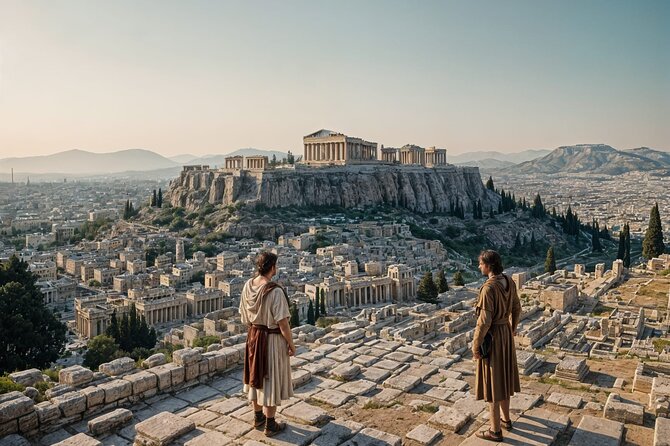
Athens’ greatest hits are spread across a hot, hilly city, and this private tour gives you a cool seat between them. You’ll begin at the Acropolis, then move through ancient temples, Roman monuments, neoclassical buildings, Plaka, and Mount Lycabettus without having to arrange taxis at every turn.
I like the private format, since your group can spend more time at a favorite stop or move on when the heat and crowds start to wear you down. I also like the practical pickup service, especially for cruise passengers, plus the air-conditioned vehicle, bottled water, and onboard Wi-Fi.
The main catch is important: entrance fees are not included, and the driver-guide does not accompany you inside the archaeological sites as a licensed guide. At about $154.24 per person, the value depends heavily on your group size and how much you value comfort, flexibility, and door-to-door transport.
Key points to know before booking
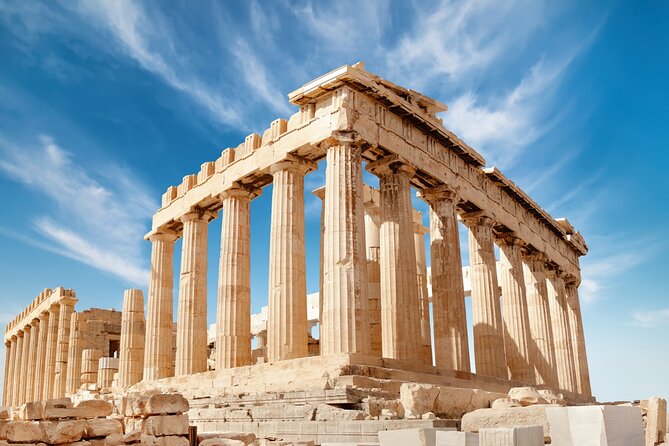
- Acropolis-focused opening: The tour gives its most attention to the Acropolis, Parthenon, Temple of Athena Nike, Erechtheion, and Odeon of Herodes Atticus.
- Private transport for one group: Groups of 1 to 4 use a luxury sedan, while groups of 5 to 7 ride in a minivan.
- Strong choice from the port: Pickup and return to your cruise terminal are included, making this useful before boarding or after leaving a ship.
- A broad Athens sweep: You’ll also see Hadrian’s Arch, the Temple of Olympian Zeus, Syntagma Square, the neoclassical trilogy, Plaka, and the Ancient Agora.
- Plan for extra costs: Archaeological admission is listed at €30 per person, and tips are optional but not included.
- The vehicle is part of the experience: Air-conditioning, Wi-Fi, private transport, and bottled water matter in Athens’ hot summer weather.
Why this private Athens tour works well
This is not a slow walking tour of one neighborhood. It is a fast, private overview of Athens, built around the Acropolis and supported by vehicle transfers across the city.
That distinction matters. In four to five hours, you can cover places that would take much longer to connect on foot. You’ll see the Acropolis, the Roman center, the Olympic stadium, central Athens, Plaka, and the Ancient Agora. The trade-off is that several stops are brief or viewed from outside.
The driver-guides are English-speaking and provide historical background while driving between locations. Names mentioned in the tour’s service include Demetrius, Dimitrios, Pericles, and Panos. The most useful part of the guide’s role is helping you connect the monuments to Athens’ political, religious, and cultural story, while also helping your group manage time.
The private setup gives you room to adjust the pace. If your group wants more time at a site, you can ask. If everyone has had enough of the sun, you can return to the cool car and continue. That flexibility is hard to get on a large coach tour.
More City Tours in Athens
- Athens: City Sightseeing Hop-On Hop-Off Bus Tour
★ 4.3 · 4,520 reviews - City Sightseeing Athens, Piraeus & Beach Riviera Hop-On Hop-Off Bus Tours
★ 4.0 · 1,887 reviews - Athens:City Pass with Acropolis, Museums, Hop-On Hop-Off Bus
★ 3.9 · 586 reviews
Entering the Acropolis and meeting Pericles’ Athens
The Acropolis receives the largest share of attention, with roughly 40 minutes listed for the hill itself. This is the heart of the experience, but you should understand what that time means.
You’ll encounter the main monuments connected with Athens’ fifth-century BC golden age. The Parthenon dominates the view, but the Acropolis is more than one temple. The Temple of Athena Nike sits near the southwest corner, the Erechtheion occupies the north side, and the Odeon of Herodes Atticus rests on the southern slope.
The site is tied closely to Pericles, the statesman who directed a major building program during Athens’ most celebrated classical period. Your driver-guide can explain how the Acropolis became a showcase for architecture, religious devotion, civic pride, and Athenian power.
The limitation is time. Forty minutes is enough for an introduction and a look at the major monuments, but it is not a leisurely archaeological visit. The admission ticket is extra, and the driver-guide is not a licensed guide entering the monuments with you. If detailed site interpretation is your priority, you may want to arrange a separate licensed guide.
You should also wear shoes suited to uneven ground and bring a hat and sunscreen. The Acropolis is exposed, and the Greek sun can be fierce even when the car is pleasantly cool.
The Parthenon, Athena Nike, and the Erechtheion
The Parthenon gets about 20 minutes of dedicated attention. Built in the fifth century BC and dedicated to Athena, it represents the architectural ideals of proportion, balance, and order associated with classical Athens.
Look beyond the familiar outline. The temple’s design was carefully planned, and its sculpture was created under the supervision of Phidias. Your guide can help place the building within Pericles’ vision of Athens as a center of civic life, art, thought, and democracy.
The Temple of Athena Nike receives about 10 minutes. It is smaller and more refined than the Parthenon, with an Ionic design dedicated to Athena in her role as a victory goddess. Its position near the Acropolis entrance made it a fitting symbol of Athenian hopes during the Peloponnesian War.
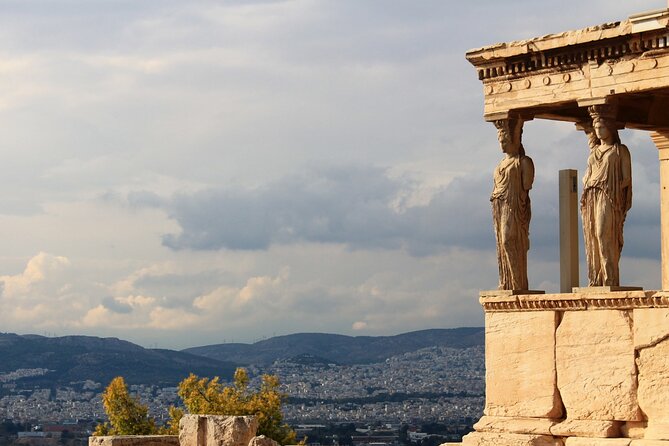
The Erechtheion receives about 15 minutes. Its uneven shape makes sense once you know that it honored both Athena and Poseidon and had to accommodate several sacred traditions. The Porch of the Caryatids, with its sculpted female figures, is the detail most people remember.
I would give the Erechtheion proper attention rather than treating it as a quick photo stop. Its myths and unusual design make it one of the more interesting buildings on the hill.
Herodes’ theater and Athens after the classical age
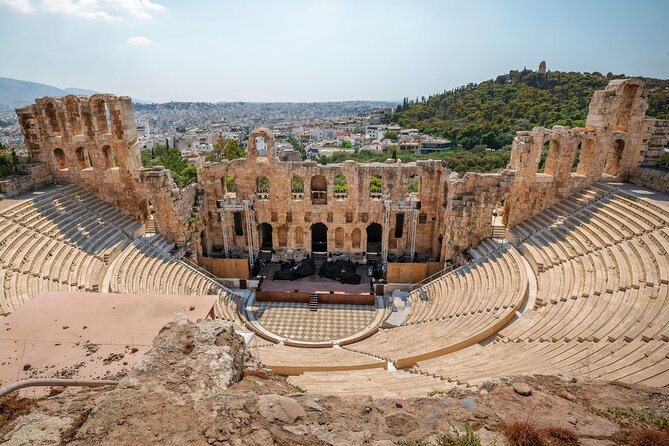
The Odeon of Herodes Atticus gets another 15 minutes. Built in AD 161 by the Roman benefactor Herodes Atticus, this theater remains connected to Athens’ cultural life because performances still take place there.
That continued use gives the monument a special character. You are not looking only at a silent ruin. You are seeing a Roman-era theater that still relates to the city’s modern arts scene.
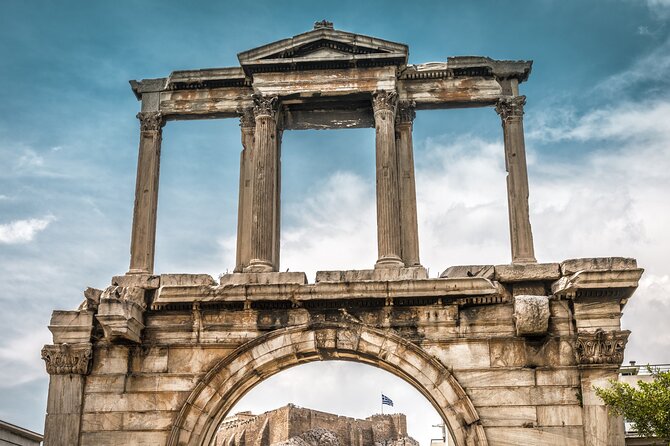
The tour also takes you past Hadrian’s Arch, built in AD 131 from Pentelic marble. Its inscriptions mark a symbolic division between the old city associated with Theseus and the new city associated with Emperor Hadrian.
This is a pass-by stop rather than a long visit, so use the car window wisely. The arch is especially striking with the Acropolis behind it, and a good driver can help you understand how Greek and Roman Athens overlap.
A few other Athens mornings to price up
- Athens: Acropolis & up to 5 Archaeological Sites Combo Pass
★ 4.4 · 12,619 reviews - Athens: Acropolis Ticket with Optional Audio or Live Guide
★ 4.2 · 11,055 reviews - Athens: Acropolis, Parthenon & Acropolis Museum Guided Tour
★ 4.8 · 9,316 reviews - Athens: Acropolis and Parthenon Guided Walking Tour
★ 4.6 · 5,882 reviews
Zeus, the stadium, and the modern Greek state
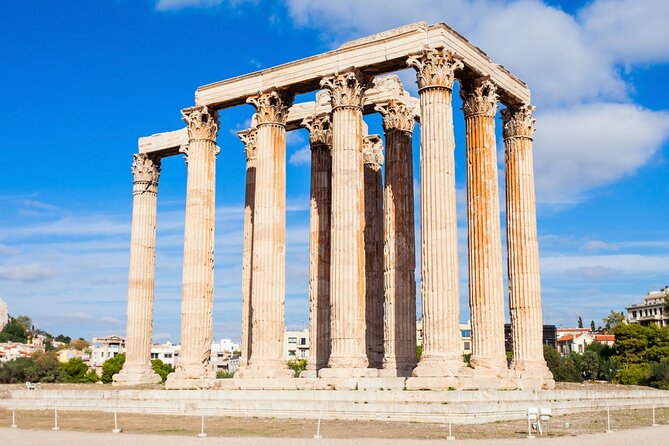
The Temple of Olympian Zeus receives about 20 minutes. Only part of the huge temple survives, but the remaining columns convey its original scale. Construction began in the sixth century BC and was completed under Hadrian in the second century AD.
The temple’s long construction story tells you something about Athens. Ancient projects could span generations, rulers, and political systems. The final Roman completion also shows how closely Greek and Roman ambitions became linked in the city.
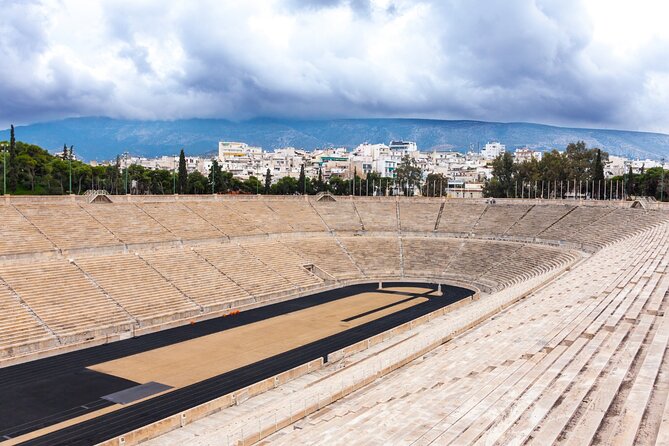
The Panathenaic Stadium gets about 15 minutes. Built in 330 BC for the Panathenaic Games, it was later rebuilt in marble by Herodes Atticus and used for the first modern Olympic Games in 1896.
I like this stop because it connects ancient athletics with the international Olympic tradition you know today. It is also a good place to appreciate the scale of a stadium made almost entirely of marble.
The Presidential Mansion, originally built as a royal palace, provides a glimpse of modern Greece’s government. You may see the Evzones, ceremonial guards in traditional uniforms, during a changing-of-the-guard ceremony. The tour also passes the Hellenic Parliament, which began life as a royal residence and now represents Greece’s move from monarchy to democracy.
At Syntagma Square, you’ll see the central meeting point of modern Athens, surrounded by hotels, cafes, and major public buildings. These stops are brief, but they help keep the ancient monuments from becoming isolated ruins. Athens is still a capital city with government, commerce, and daily life moving around them.
Mount Lycabettus for the city view

Mount Lycabettus is one of the tour’s best breaks from monuments. At about 20 minutes, it gives you a broad view across Athens, including the Acropolis and, on a clear day, the Aegean Sea.
The stop is listed as free. It also offers a different way to understand the city’s shape. From above, the Acropolis is no longer just a single archaeological site. You can see how it relates to the surrounding urban area and the wider horizon.
Do not expect a long hill walk during this short stop. The main value is the viewpoint and the chance to pause. If views matter to you, this is one place where the private vehicle saves effort and time.
Athens’ Neoclassical Trilogy
The tour passes three major neoclassical buildings along central Panepistimiou Street: the Academy of Athens, the University of Athens at Panepistimio, and the National Library at Panepistimiou 32.
The Academy of Athens was designed by the Danish architect Theophil Hansen and decorated with sculptures honoring figures such as Plato and Socrates. The University of Athens is part of the same architectural group, with Ionic columns and murals linked to education and learning.
The National Library completes the trio with its marble columns and grand staircase. It houses rare manuscripts, historical documents, and literary material, though this experience treats it as an exterior stop.
Each visit is listed at about five minutes, so think of these as photo and orientation stops rather than interior tours. Still, they are worthwhile because they show how nineteenth-century Greece used classical forms to express its modern identity.
Plaka, the Ancient Agora, and the Roman Agora
Plaka lies below the Acropolis and is the most atmospheric neighborhood on the route. Its cobbled lanes, neoclassical buildings, small squares, shops, tavernas, and Byzantine churches create a pleasant contrast with the formal monuments on the Acropolis hill.
The tour passes through Plaka rather than giving you a long free period there. If you want time for a meal or serious shopping, four to five hours may not leave enough room. You can still use the drive through the district to decide if Plaka deserves a separate evening visit.
The Ancient Agora receives about 30 minutes, making it one of the more substantial archaeological stops after the Acropolis. This was the center of public life in classical Athens, where political, social, commercial, and religious activity came together.
The Temple of Hephaestus is the major surviving structure. It is among the best-preserved temples of the ancient world, and the Agora helps you picture Athens as a working city rather than a collection of isolated temples.
The Roman Agora gets about 15 minutes. It served as a marketplace during the Roman period and includes surviving columns and other structures near Plaka.
Both Agora sites require separate admission, and the tour’s listed archaeological fee is €30 per person. Confirm how the fee is handled when booking, since the description also says entrance tickets are not included. If you plan to enter every site, budget for this cost on top of the tour price.
Vehicle comfort, group size, and timing
The tour uses a luxury sedan for groups of 1 to 4 and a minivan for groups of 5 to 7. That setup keeps the experience private while matching the vehicle to the group.
Air-conditioning is more than a nice extra in Athens. After walking on the Acropolis or standing in the sun at the stadium, a cool car makes the next stop far more manageable. Panos received special praise for keeping the van comfortable during August heat, and that is exactly when this feature matters most.
Wi-Fi onboard is useful for checking maps, messages, and ferry or cruise details. Bottled water is included. The vehicle also gives you a place to store small bags while moving between stops.
Remember that the four to five hours include driving time. The route covers a lot, so this is not a full day at each monument. You’ll see more of Athens than you could comfortably walk in one morning, but the experience favors breadth over long museum-style visits.
Is the $154.24 price good value?
At $154.24 per person, the price is not the cheapest way to see Athens. Its value improves when shared by a private group and when you need pickup and drop-off at a cruise port or hotel.
You are paying for private transportation, an English-speaking driver-guide, air-conditioning, Wi-Fi, water, and a route that links many major sights. You are not paying for archaeological admission, a licensed guide inside the sites, airport pickup, or gratuities.
For a cruise passenger with limited time, the price can make sense. One passenger described using the service before boarding, with enough room for four carry-on bags and one checked bag in a Mercedes wagon taxi. That detail is useful if you are combining sightseeing with a ship transfer, though you should still confirm your luggage needs in advance.
For two people, the per-person cost is harder to justify if you only want the Acropolis. For four people, the private format becomes more attractive, especially if you value comfort and do not want to coordinate several taxis.
Who should book this experience?
I would choose this tour if you want to cover many Athens landmarks in one outing, need reliable port or hotel transport, or prefer a private vehicle to a large coach.
It suits first-time visitors who want a broad orientation, families who need flexibility, and cruise passengers working around a fixed sailing time. It also fits people who dislike spending a hot day navigating city traffic and hills on their own.
I would look elsewhere if your main goal is deep archaeological explanation inside the Acropolis. Since the driver-guide does not enter as a licensed guide, you may get more from a dedicated guided Acropolis visit followed by self-arranged sightseeing.
Book with comfortable shoes, sunscreen, and a hat. Free cancellation is available up to 24 hours before the start time. The experience requires good weather, and a weather cancellation brings the choice of another date or a full refund.
My verdict: a smart overview with a clear trade-off
I like this tour for its range and flexibility. In one half-day, you can connect the Acropolis with Zeus, the Olympic stadium, Syntagma, Lycabettus, Plaka, and both Agora areas, all while returning to a cool private vehicle.
The strongest reason to book is convenience, especially if you are arriving or departing by cruise ship. The strongest reason to hesitate is the limited time at each major site and the extra cost of admission.
Choose it when you want a comfortable, personalized introduction to Athens and plan to explore your favorite place more fully later. Skip it when you want a slow, expert-led archaeological visit focused mainly on the Acropolis.
FAQ
How long does the private Athens tour last?
The experience lasts approximately four to five hours, including the time spent driving between stops.
Is hotel pickup included?
Yes. Pickup and drop-off are available for hotels and apartments at designated locations. The driver waits outside the accommodation.
Can I be picked up at the cruise port?
Yes. Port pickup is included from designated port options selected during checkout. The driver meets you in the arrival area with a sign showing your name.
Is airport pickup included?
Airport pickup is available, but it costs extra.
What kind of vehicle is used?
Groups of one to four people use a luxury sedan. Groups of five to seven people use a minivan.
Is the tour private?
Yes. Only your group participates in the activity.
Are Acropolis and archaeological site tickets included?
No. Entrance fees are not included. The listed archaeological admission cost is €30 per person.
Does the driver enter the archaeological sites with the group?
No. A licensed guide to accompany you inside the archaeological sites is not included.
Is the tour offered in English?
Yes. The tour includes an English-speaking driver-guide with extensive historical knowledge.
What is included in the vehicle?
The tour includes private transportation in an air-conditioned vehicle, onboard Wi-Fi, and bottled water.
Fresh on the Athens list
- Athens Airport Arrival Transfer to Hotels or Addresses in Athens★ 3.5 · 45 reviews
- Private Luxury Tour: Unveiling the Sacred Mysteries of Eleusis★ 5.0 · 45 reviews
- Luxury Catamaran Sunset Semi-Private & Greek Gastronomy in Athens★ 5.0 · 45 reviews
- From Athens: Aegina Island guided tour in a day★ 5.0 · 45 reviews
- Delphi, Thermopylae full day private tour from Athens★ 4.9 · 46 reviews
- From Athens: City & Corinth Guided Day Tour★ 4.8 · 46 reviews
- Acropolis Private Wine Tasting @ Finewine store★ 5.0 · 46 reviews
- Ancient Corinth Half-Day Private Tour from Athens★ 5.0 · 46 reviews
Acropolis & Acropolis Museum Tours, compared.

Acropolis & up to 5 Archaeological Sites Combo Pass
Read our review →

Acropolis, Parthenon & Acropolis Museum Guided Tour
Read our review →
Acropolis, Parthenon & Acropolis Museum Guided Tour
Read our review →

Acropolis monuments & Parthenon Walking Tour with Optional Acropolis Museum
Read our review →
Athens All Included: Acropolis and Museum Guided Tour with Ticket
Read our review →Browse the lists this tour appears in