
Reviewed · ATHENS TOURS
Big Bus Athens Hop-On Hop-Off with optional Piraeus & Riviera
The best reason to take this bus is its reach. One ticket can connect the Acropolis and Syntagma with Piraeus harbor, Stavros Niarchos Park, Glyfada, and Lake Vouliagmeni. I especially like the useful audio stories and the freedom to step off when a site catches your eye. The two-day option gives you time to use the city loop first, then spend a separate outing by the coast.
I also like the regular central route, which is advertised at roughly 20-minute intervals, plus staff at many major stops. The main caution is traffic. Piraeus and the Riviera buses run less often, and several departures may be 80 minutes to two hours apart. A missed bus can change a relaxed afternoon into a long wait.
Quick takeaways for choosing the bus
- Three separate routes: Use the Athens city loop for major landmarks, the Piraeus route for the port and waterfront, and the Riviera route for southern beaches and Lake Vouliagmeni.
- 48 or 72 hours: The pass works best when you plan to ride on more than one day.
- Useful first-day orientation: The central loop helps you see which sights deserve a longer visit on foot.
- Fourteen-language audio: Headphones and prerecorded commentary are included, along with free Wi-Fi.
- Plan around traffic: Buses can run late, fill up, or switch routes, especially at busy times.
- Check the ticket details: Some bookings have not made clear that all three routes may require a different pass or an extra charge.
Three routes that show Athens beyond the Acropolis
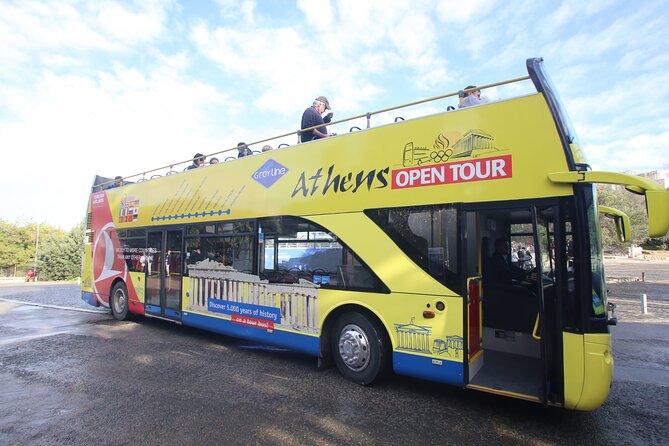
Big Bus Athens is not just a quick circuit of ancient ruins. The Athens route covers the historic center, the Piraeus route reaches the port and nearby waterfront, and the Riviera route follows the southern coast toward Glyfada and Vouliagmeni.
That range is the main value. You can use the bus as a moving introduction on day one, then use it as transport on day two. I would not treat it as a replacement for walking around Athens, since the city center is compact enough to explore on foot. I would use it to save energy between spread-out areas and to get a first look at places you might otherwise miss.
The advertised price is $27.56 per person. That is reasonable if you use the pass for two days and take several rides. It is less compelling if you only complete one loop, spend most of the time stuck in traffic, or buy a city-only ticket and later decide you want Piraeus and the coast. Before booking, confirm exactly which routes your chosen fare includes. The supplied details describe an all-route option, but some bookings have required an added payment for broader access.
A few other Athens mornings to price up
- Athens: Acropolis & up to 5 Archaeological Sites Combo Pass
★ 4.4 · 12,619 reviews - Athens: Acropolis Ticket with Optional Audio or Live Guide
★ 4.2 · 11,055 reviews - Athens: Acropolis, Parthenon & Acropolis Museum Guided Tour
★ 4.8 · 9,316 reviews
The Athens city loop, from ancient temples to modern squares
The main city route is the one most people will use. It links the Acropolis area with the Temple of Olympian Zeus, Parliament, museums, central squares, and Monastiraki.
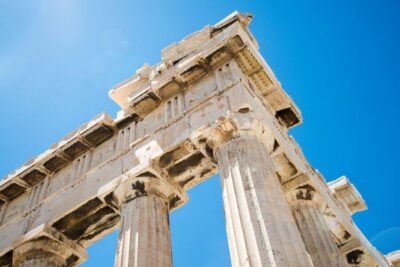
Acropolis and the Parthenon
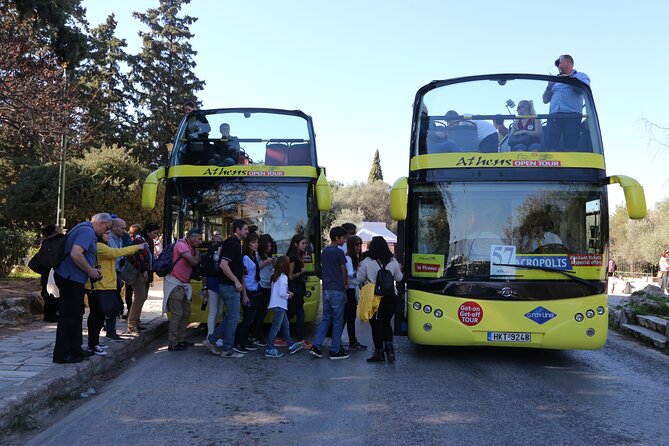
The Acropolis stop is at 69 Rovertou Galli Street, beside Dionysos Restaurant. Other city-route listings identify stops near Plaka and the south entrance of the Acropolis, including the statue of Melina Mercouri.
This is the natural place to get off if you are visiting the Parthenon or walking through Plaka. The bus will not replace your admission ticket or your time on the hill, but it can spare you a long uphill approach from another part of town. Allow extra time here. The Acropolis area is not a quick hop-off stop if you plan to visit the monuments properly.
The route labeling can be confusing because the stop numbers change from one line to another. Check both the stop name and the route color or direction before you board. Ask the driver or a staff member if you are unsure.
Temple of Olympian Zeus
The Temple of Olympian Zeus stop is beside the temple entrance. This is a handy break between the Acropolis and Syntagma Square.
The giant columns are easy to appreciate from the street, but stepping off gives you a better sense of the site’s scale. If ancient Athens is your priority, pair this stop with the Acropolis rather than racing past both from the upper deck.
Same island, an entirely different sort of day:
- Athens: Cape Sounion & Poseidon Temple Sunset Half-Day Trip
★ 4.8 · 8,241 reviews - Athens: Acropolis and Parthenon Guided Walking Tour
★ 4.6 · 5,882 reviews - All Day Cruise -3 Islands to Agistri,Moni, Aegina with lunch and drinks included
★ 5.0 · 4,958 reviews - Athens, Piraeus, and Coastline: Blue Hop-On Hop-Off Bus
★ 3.9 · 4,849 reviews
Parliament and Syntagma Square
Parliament is served near Vasilisis Amalias Avenue, and Syntagma Square is another central stop at Ermou Street. This is one of the best places to begin if you want a clear starting point in the middle of Athens.
You are close to the National Garden, Ermou shopping street, and the walking routes toward Plaka. The bus also makes this a practical place to return after exploring the old center. Since Syntagma is served by more than one route, confirm the destination before boarding.
Benaki Museum and the Panathenaic Stadium
The Benaki Museum stop is opposite the museum. The Panathenaic Stadium stop is across from the stadium, the white marble arena associated with the modern Olympic Games.
I like these two stops for a break from the most crowded ancient sites. The stadium is especially easy to combine with the Temple of Olympian Zeus and the National Garden. The Benaki Museum offers a different look at Greek art and culture, though the bus stop itself is only a starting point. You will need to allow your own museum time.
National Library and the National Archaeological Museum
The National Library stop is in front of Vallianeio Megaron, while the National Archaeological Museum stop is in front of the museum.
The library, academy buildings, and university area provide a quick look at 19th-century Athens. The National Archaeological Museum deserves more time than a short hop-off break, so use the bus to reach it, then plan to continue independently if your schedule is tight.
The museum stop also shows the value of the loop as a planning tool. You can ride past an area, note what interests you, and return later. That works well when you do not yet know how you want to divide your day.
Omonia, Karaiskaki, and Kotzia squares
The route continues through Omonia Square, Karaiskaki Square, and Kotzia Square. These stops are useful for transport connections and for seeing parts of central Athens outside the postcard circuit.
They are not the strongest hop-off points if you have only a few hours. Traffic can also make this section feel slow. I would stay on the bus here unless you have a specific reason to get off, such as a hotel, restaurant, or connection nearby.
Monastiraki and the Old Parliament
Monastiraki Square, near the Nike store, is one of the most useful stops for a walking day. From here, you can reach the market lanes, Plaka, and several archaeological areas on foot.
The Old Parliament stop adds another central option. These stops can be busy and crowded, so keep your ticket and phone handy, and look for the clearly marked bus signs. Staff are present at many major stops, which helps when several routes use nearby streets.
Piraeus route: useful for port calls and waterfront views
The Piraeus route begins near the Acropolis and crosses toward Pantios University and Stavros Niarchos Park before reaching the port.
Stops include Municipal Theatre, Cruise Terminal A, Cruise Terminal B, Pasalimani, Mikrolimano, Athens Marriott, and the InterContinental Athenaeum Athens. The cruise terminals are identified as Gate 11 and Gate 12 areas, which matters if you are arriving by ship.
This line is especially useful if your ship docks in Piraeus and you want a broad look at the port without arranging separate transport. It is not the route to choose for a tight return-to-ship schedule, though. The service is listed at about four departures per day, with intervals around 80 minutes. Traffic or a full bus can add more delay.
Pasalimani and Mikrolimano provide a change of pace from the ancient center, with waterfront scenery and marina stops. Stavros Niarchos Park is another worthwhile choice if you want a modern public space rather than another temple. The route also passes the Planetarium area near the Athens Marriott.
The route returns through the Temple of Olympian Zeus, Parliament, and Syntagma. That makes it possible to use Piraeus as a long outing and finish back in the city center. Still, I would leave a generous buffer before any ship departure or fixed appointment.
Riviera route: the long coastal outing
The Riviera line is the most distinctive part of the package. It starts near the Acropolis and Pantios University, then follows the coast through Flisvos Marina, Alimos Marina, Agios Kosmas Marina, Glyfada, Kavouri, Astir Beach, Lake Vouliagmeni, and Voula.
The coastal section can take about an hour each way, and departures are much less frequent than on the Athens loop, around three per day with intervals close to two hours. That schedule makes the route a planned half-day outing, not a casual ride you squeeze between two museum visits.
Marinas and coastal stops
Flisvos Marina is next to the public bus stop called Oulen, outside the marina. Alimos Marina and Agios Kosmas offer more waterfront stops, while the Phaleron War Cemetery and Edem provide additional points along the coast.
You can stay on board for the scenery, or get off if you have a clear plan. The important point is to check the return schedule before leaving the bus. A short stop can become a long wait if the next vehicle is two hours away.
Glyfada and the beaches
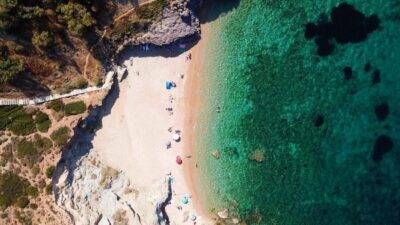
The route serves Glyfada Center, Glyfada Beach, Kavouri Beach, and Astir Beach. These stops make the pass more useful for you if you want a break from monuments and city streets.
The beach stops are not simply photo opportunities. You might find them useful for a swim or a waterfront meal, but any entrance fee is separate. Astir Beach and Lake Vouliagmeni are paid attractions, so budget for that if you plan to go inside.
Lake Vouliagmeni
Lake Vouliagmeni is the farthest and most unusual stop on this route. It is reached after Kavouri and Astir Beach, then followed by Voula Park and the return through Glyfada.
The lake is a sensible destination for a longer pass because the ride takes time and the return schedule needs attention. I would choose this stop only if you have at least a full day or a second day available for the bus. Do not use the Riviera line when you must be back at a cruise ship soon.
Audio commentary, Wi-Fi, and the ride itself
The bus provides prerecorded commentary in 14 languages, with headphones included. The narration gives short facts about the sights and the city, which is useful when you want context without joining a fixed walking group.
The quality can vary by vehicle. Some riders have had trouble with headphone connections, weak speakers, or commentary that did not match the bus’s exact position. One practical fix is to test your headset as soon as you board and ask for another pair if the sound is poor.
The audio may also feel out of sync when traffic changes the route timing. I treat it as background information, not a precise guide that tells me exactly what I am looking at every second. Free Wi-Fi is a helpful extra for checking maps, messages, and bus information.
The open upper deck gives you better views, but Athens can be very hot. Some buses have uncovered upper decks, while covered double-decker buses provide shade and more comfort. If the sun is strong, the lower deck may be the better choice.
Timing, traffic, and the art of avoiding a bad wait
Athens traffic is the biggest variable. The city route is advertised as frequent, around every 20 minutes, but delays still happen. Piraeus and Riviera service is less forgiving because the gaps between buses are longer.
Use the official app or website’s live tracking and bus-stop tools if available to you. At a minimum, take a photo of the route map and check the next departure before hopping off.
Keep these habits in mind:
- Ask the driver which route the bus is serving before you board.
- Confirm that your pass includes the route you want.
- At a coastal or port stop, note the return time before leaving.
- Expect the bus to fill during busy periods, so an immediate seat is not guaranteed.
- Use staff at major stops when the route map seems unclear.
- Leave extra time before a cruise departure or scheduled activity.
A few operational quirks have also appeared, including driver changes, route switches, and buses being replaced. These may be unusual, but they are possible. The bus is most reliable as flexible sightseeing transport, not as a precision-timed transfer.
Who gets the best value from a 48 or 72-hour pass
I think the 48-hour pass is the sweet spot for most people. You can ride the Athens loop on the first day, get off at the Acropolis, stadium, museum, or Monastiraki, then use the second day for Piraeus or the Riviera.
The 72-hour option suits a slower visit. It gives you more chances to handle traffic, revisit a stop, or wait for a coastal departure without sacrificing the rest of your plans.
You will get the most from this experience if you:
- Want an easy first look at Athens
- Prefer not to arrange separate transport to Piraeus
- Like choosing your stops as you go
- Are staying long enough to use the pass for two or three days
- Want to reach the southern coast without planning a separate bus journey
I would be more cautious if you have only one short day in Athens. The center is walkable, and traffic may consume time you could spend at the Acropolis or in Plaka. A small-group tour may suit you better if you want a guide physically present throughout the ride, rather than prerecorded commentary.
Children must be accompanied by an adult. Service animals are allowed, the bus is near public transportation, and most people can participate. The booking includes free cancellation if you cancel at least 24 hours before the local start time. Changes or cancellations inside that window are not refunded.
Should you book Big Bus Athens?
Book it if you want flexible access to three very different parts of Athens and can give the pass at least two days. The central route, helpful staff at major stops, and short audio explanations make it a sound orientation tool. The Piraeus line is useful for port access, while the Riviera route adds beaches and Lake Vouliagmeni that you might not reach on foot.
Skip it if your schedule is extremely tight, you dislike waiting, or your main goal is a detailed guided visit to the ancient sites. For the best value, choose the all-route ticket, confirm the inclusions before paying, start with the Athens loop, and save the coast for a day when you have time to wait.
FAQ
How long is the Big Bus Athens tour?
The listed ride duration is approximately two hours, but your 48-hour or 72-hour pass lets you ride and hop off during the valid period.
What routes are included?
The experience offers three routes: Athens, Piraeus, and the Riviera. Check the exact ticket option before booking, since some bookings have required an additional charge for access to all three routes.
How long are the available passes valid?
You can choose a 48-hour pass or a 72-hour pass.
What languages are available for the audio commentary?
Audio commentary is offered in a choice of 14 languages. The tour is also listed as offered in English. If you need a particular language, confirm that language before booking because the exact list is not provided here.
Is Wi-Fi available on the bus?
Yes. Free Wi-Fi is available onboard.
Are headphones provided?
Yes. Headphones are included with the ticket. Test them when you board because audio connections have not worked perfectly on every bus.
Where can I board near the Acropolis?
The Acropolis stop is listed at 69 Rovertou Galli Street, next to Dionysos Restaurant. Another Acropolis stop is near Plaka and the south entrance, in front of Melina’s statue.
Does the bus stop at the cruise terminals in Piraeus?
Yes. The Piraeus route serves Cruise Terminal A near Gate 11 and Cruise Terminal B near Gate 12.
Can I cancel for a full refund?
Yes, if you cancel at least 24 hours before the experience start time. Cancellations or changes made less than 24 hours before the start are not refunded.
Fresh on the Athens list
- Athens Airport Arrival Transfer to Hotels or Addresses in Athens★ 3.5 · 45 reviews
- Private Luxury Tour: Unveiling the Sacred Mysteries of Eleusis★ 5.0 · 45 reviews
- Luxury Catamaran Sunset Semi-Private & Greek Gastronomy in Athens★ 5.0 · 45 reviews
- From Athens: Aegina Island guided tour in a day★ 5.0 · 45 reviews
- Delphi, Thermopylae full day private tour from Athens★ 4.9 · 46 reviews
- From Athens: City & Corinth Guided Day Tour★ 4.8 · 46 reviews
- Acropolis Private Wine Tasting @ Finewine store★ 5.0 · 46 reviews
- Ancient Corinth Half-Day Private Tour from Athens★ 5.0 · 46 reviews
Athens Tours, compared.
Acropolis & up to 5 Archaeological Sites Combo Pass
Read our review →
Acropolis, Parthenon & Acropolis Museum Guided Tour
Read our review →
Cape Sounion & Poseidon Temple Sunset Half-Day Trip
Read our review →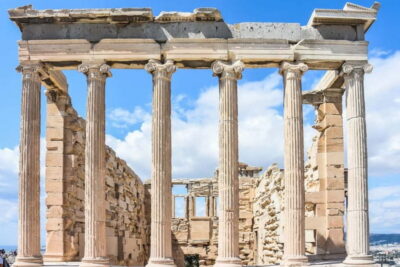

Cape Sounio & Poseidon Temple Trip with Audio Guide
Read our review →