
Reviewed · ANCIENT CORINTH & PELOPONNESE TOURS
Day tour to Ancient Olympia,Ancient Sparta Mycenae Including Meal
Ancient Olympia, Sparta, and Mycenae in one day is an ambitious Greek history sampler, not a gentle outing. You cover a huge section of the Peloponnese by Mercedes, moving from the birthplace of the Olympic Games to Leonidas’s Sparta and the Bronze Age citadel of Mycenae.
I like the private door-to-door pickup and the way the driver can adjust the day to your interests. I also like the included Greek meal at the end, served at a local restaurant owned by the tour operator. The catch is simple: this is a very long day, with considerable time spent in the car, and your driver cannot guide you inside the monuments.
The strongest part of the experience is often the person behind the wheel. Sebastian, Paddy, Ted, Dallas, George, and other named drivers have been praised for clear storytelling, careful driving, comfort breaks, and flexible planning. Still, site closures, weather, daylight, and road conditions can force changes.
Key things to know before booking
- Four major ancient destinations in one day: Olympia, Sparta, Mycenae, and the Corinth Canal make this a serious sightseeing sweep of the Peloponnese.
- Private transport from Athens: Your group travels alone in a Mercedes E-Class, minivan, or Sprinter, depending on group size.
- Local guiding rather than licensed site guiding: The driver explains history during the journey, then you explore the archaeological sites independently.
- A real Greek meal is included: Expect moussaka, Greek salad, tzatziki, a soft drink, beer, or wine, followed by baklava with ice cream.
- Plan for a 12 to 15-hour day: The advertised duration is about 12 hours, but a full itinerary can run longer.
- Entrance fees may be extra: Olympia and Mycenae each list a €20 admission fee when the entrance option is selected.
Why this packed Peloponnese day makes sense
Athens is a fine base for ancient Greece, but the mainland sites tell a much broader story. Olympia represents religious ceremony and athletic competition. Sparta brings military society and mythic figures such as Leonidas. Mycenae reaches back to the Late Bronze Age, centuries before classical Athens.
Seeing all three in one outing is difficult by public transport. The sites are spread across the Peloponnese, and the route includes hilly roads, toll roads, and long stretches between stops. A private car removes the need to coordinate buses or rental-car directions.
That convenience comes with a tradeoff. You are not getting a slow, deep visit to one archaeological site. You are getting a fast-moving day with short visits, road commentary, refreshments, and a chance to compare several very different chapters of Greek history.
I would choose this for a first visit to Greece if my time were tight and ancient sites were a priority. I would not choose it for a relaxed holiday day, for anyone who dislikes long drives, or for someone who wants a formal archaeologist-led tour at each monument.
A few other Athens mornings to price up
- From Athens: Mycenae, Epidaurus & Nafplio Full Day Trip
★ 4.8 · 2,438 reviews - From Athens: Mycenae, Epidaurus & Nafplio Full-Day Tour
★ 4.5 · 1,580 reviews - From Athens: Ancient Corinth Day Trip with Canal & VR Guide
★ 4.6 · 1,073 reviews
Olympia: where the Olympic Games began
Olympia is the emotional center of the day. The sanctuary once occupied the north bank of the Alfeios River and became the most important religious center connected with the ancient Olympic Games.
The games were held in honor of Zeus. The traditional starting date is 776 BC, though human activity at Olympia reaches much farther back, into the 4th millennium BC. By the 5th century BC, the site had become a meeting point for politics, philosophy, art, worship, and athletic competition.
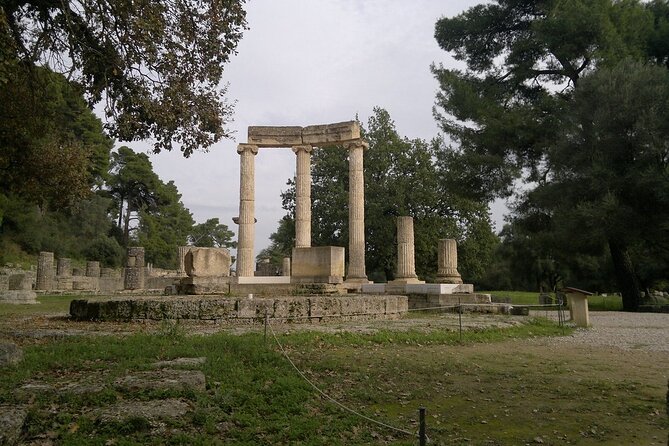
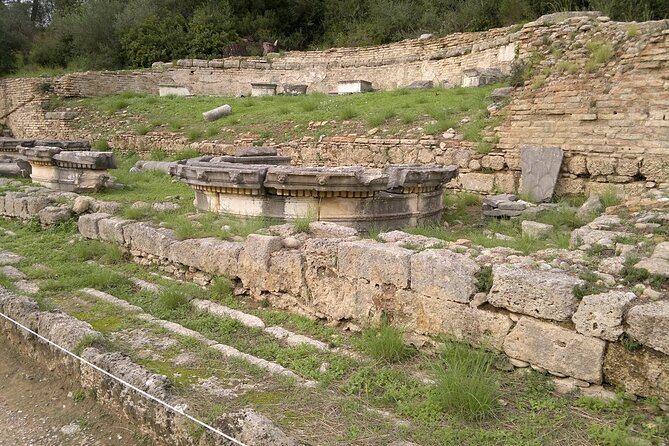
Give yourself time to picture the place as more than a sports ground. This was a sacred complex filled with temples, treasuries, athletic facilities, and monuments. The Temple of Zeus was once home to a gold and ivory statue about 12 meters high, counted among the Seven Wonders of the ancient world. The statue itself is gone, but the temple’s scale helps explain its importance.
You also see the Philippeion, a rare circular building dedicated to Zeus. It was begun by Philip II of Macedon and completed by his son Alexander the Great. The Hera Temple, palaestra, and ancient stadium add different pieces to the story.
The stadium is especially useful for understanding the physical setting of the games. You can walk through the same broad field where ancient athletes competed, though the modern visitor experience is quiet and stripped of the crowds, ceremony, and noise that once filled the sanctuary.
The Archaeological Museum of Olympia is part of the planned visit and adds objects that the open site cannot explain on its own. One particularly important work associated with Olympia is the statue of Hermes of Praxiteles, which shows the high level of Greek sculpture preserved in the museum.
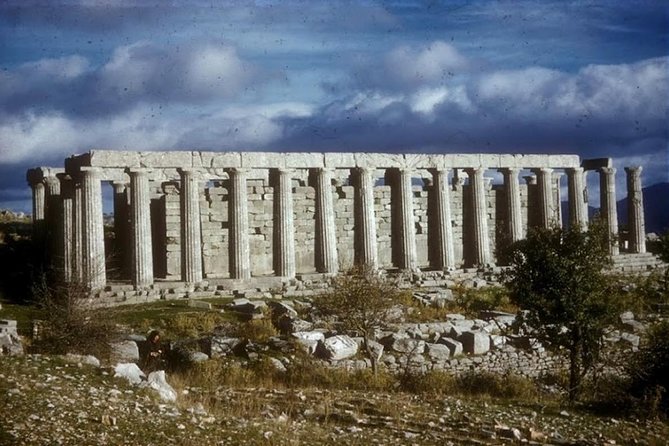
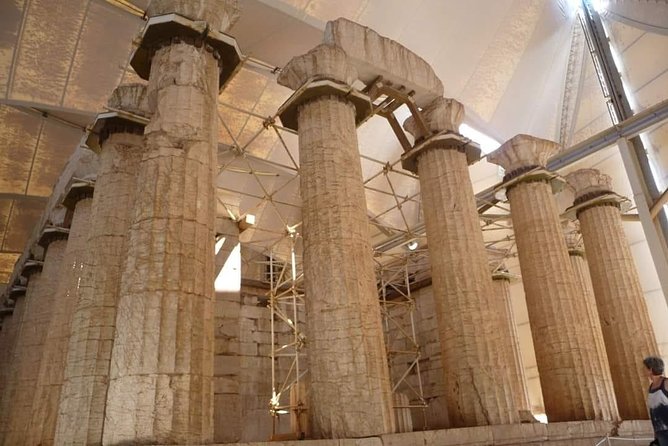
The main limitation is time. Olympia alone can occupy several hours if you read every display and examine every ruin. This tour lists about two hours, so you will need to keep moving. Some routes have also included or substituted other sites, such as the Temple of Apollo Epicurius or Mystras, but the exact plan can change because of closures, weather, daylight, and timing.
Kaiadas Cave: scenery and a disputed Spartan story
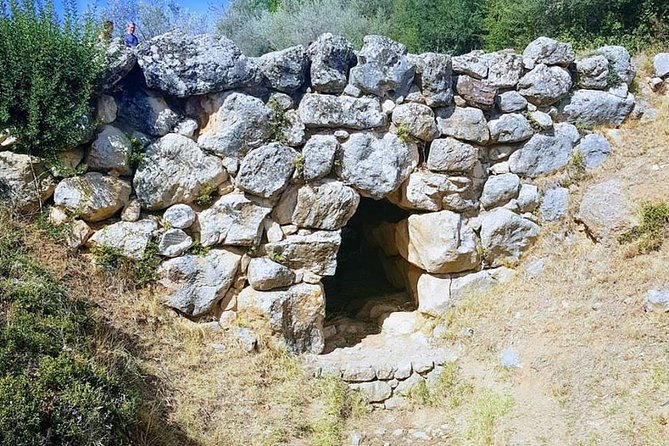
Kaiadas Cave is a brief stop, listed at about 45 minutes. The site is tied to the old story that Sparta threw unwanted infants into a pit. The information provided for this experience notes that official investigations from 1983 onward found adult male and female bones instead, linked to criminals, prisoners of war, condemned people, and others sentenced to death.
That correction matters. Ancient Sparta has attracted plenty of dramatic stories, and Kaiadas is a useful reminder to separate later legend from archaeological evidence. At the stop, you see the setting and make a short visit rather than touring a developed museum complex.
This is one of the less substantial stops in terms of ruins. Its value is the connection to Spartan customs and the chance to break up the long drive. Wear practical shoes and expect an outdoor visit rather than a polished attraction.
Ancient Sparta: Leonidas, Lycurgus, and a vanished power
Ancient Sparta is more modest than Olympia or Mycenae in its surviving remains, but the subject carries enormous weight. Sparta became a major military and political force during the Archaic period, from roughly 800 to 479 BC. Its power later reached across much of Greece, particularly after its victory over Athens and its allies in the Peloponnesian War.
That dominance ended after defeat by the Thebans in 371 BC. Sparta lost still more influence with the rise of Macedonia and was eventually conquered by Rome. By the time the traveler Pausanias visited in the 2nd century AD, much of the ancient city was already in ruins.
The archaeological area includes the Acropolis, ancient theater, Roman-era houses, and other remains. The site does not offer the monumental walls and grand temples that some first-time visitors expect, so the driver’s historical explanation is useful before you walk around.
The statue of Leonidas gives the stop a strong visual focus. Leonidas is shown in battle dress, recalling the Persian invasion of 480 BC and the famous stand at Thermopylae. You also see the reported tomb of Leonidas, whose remains were said to have been returned to Sparta decades after his death.
The statue of Lycurgus connects to the Spartan system of laws and military education. Tradition credits Lycurgus with establishing the social structure that made Sparta so distinctive, though the details of his life and reforms belong partly to the realm of legend.
The Museum of the Olive Tree and the Kaiadas material add context beyond military fame. I appreciate that the itinerary does not reduce Sparta to tough soldiers and red capes. It also presents the city as a society with laws, religion, agriculture, and complicated traditions.
The visit is listed at about one hour. That is enough for an introduction, but not for a slow study of every corner. If Sparta is your main interest, you may find the time short. If you see it as one chapter in a larger day, the stop works well.
Same island, an entirely different sort of day:
- Athens: Acropolis & up to 5 Archaeological Sites Combo Pass
★ 4.4 · 12,619 reviews - Athens: Acropolis Ticket with Optional Audio or Live Guide
★ 4.2 · 11,055 reviews - Athens: Acropolis, Parthenon & Acropolis Museum Guided Tour
★ 4.8 · 9,316 reviews - Athens: Cape Sounion & Poseidon Temple Sunset Half-Day Trip
★ 4.8 · 8,241 reviews
Mycenae: the citadel of Agamemnon
Mycenae offers some of the most striking remains on the route. The site is linked with Perseus and the legendary kingdom of Agamemnon, but its archaeological importance is even older than the literary stories.
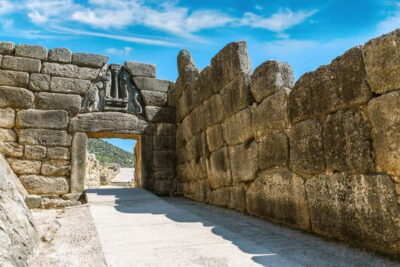
Mycenae reached its height between about 1600 and 1110 BC. It was one of the leading palace centers of Late Bronze Age Greece, and the city’s fortification walls are often called Cyclopean because later Greeks thought only giants could have placed such enormous stones.
The Lion Gate is the natural starting point. Its carved relief is one of the most recognizable images of Mycenaean Greece. Pass through it and you enter the fortified acropolis, where the walls, terraces, and remains of the palace area show how strongly the city was built for defense and ceremony.
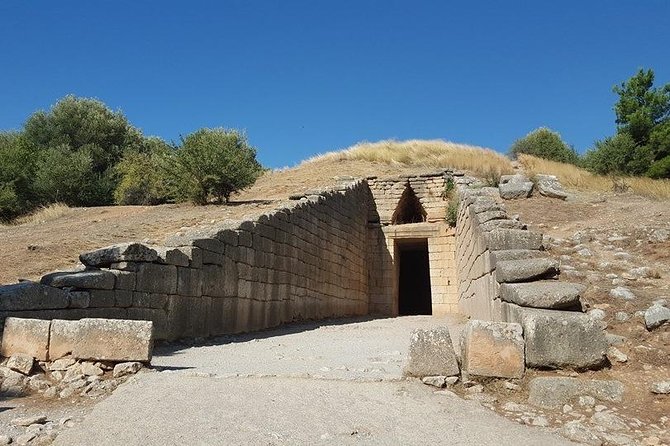
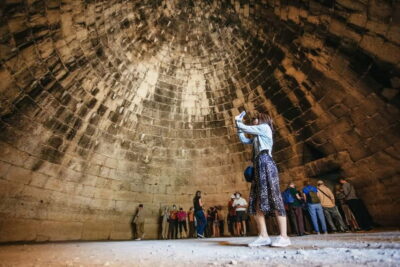
The Treasury of Atreus, often called the tomb of Agamemnon, is separate from the main acropolis area. It is a beehive-shaped tholos tomb with a long entrance passage and a huge stone construction that remains impressive even after thousands of years.
The itinerary allows about one hour at Mycenae. That is enough to see the main monuments, but you will want to listen carefully to the driver’s explanation before entering, since the driver does not accompany you into the archaeological site. A little preparation makes the independent walk much more rewarding.
Mycenae is also one of the places most affected by a late schedule. If the day starts late, daylight fades, or another stop takes longer, the visit may be shortened or removed. Ask early in the day how the timing is developing if Mycenae is your top priority.
Corinth Canal: a quick engineering pause
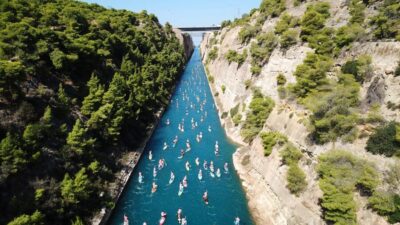
The Corinth Canal gets only about 15 minutes, so think of it as a photo and viewpoint stop rather than a full visit. The canal cuts through the narrow Isthmus of Corinth and links the Gulf of Corinth with the Saronic Gulf.
After hours among temples, tombs, and broken walls, the straight channel offers a sharp change of subject. You see how modern engineering reshaped the route between central Greece and the Peloponnese.
The stop is brief, but it helps mark the return toward Athens. It is also a useful chance to stretch your legs before the final meal.
Dinner at Theodores Grill Corner
The included dinner is served back in Athens at Theodores Grill Corner, a local-area restaurant owned by the tour operator. The listed meal includes moussaka, Greek salad, tzatziki, and one soft drink, beer, or glass of wine per person.
Dessert is baklava with ice cream. That is a pleasant finish after a day when your main meal can otherwise become an afterthought. Some accounts of the experience describe seafood and barbecue choices as well, but the clearly specified package is the moussaka meal, salad, dips, drink, and dessert.
The setting is not presented as a restaurant in the tourist center. That can be a plus if you want a straightforward local meal rather than another central Athens dining room. It can also feel less polished to anyone expecting a special restaurant reservation.
One practical point deserves attention: the published information includes dinner, while one rating specifically raised confusion about whether it was covered. I would confirm the meal details on your booking confirmation before departure, especially if you have dietary or health restrictions.
The ride, the vehicles, and the guide style
For one to four people, transport is listed as a Mercedes-Benz E-Class. Groups of five to eight use a Mercedes minivan, while larger groups use a Mercedes Sprinter, with vehicles dependent on availability.
The private format is a major advantage. You can stop for restrooms, water, or snacks, and the driver can sometimes adjust the order or substitute a location. Past itineraries have included Nafplio, Mystras, Ancient Corinth, and the Temple of Apollo Epicurius when timing or closures made a change sensible.
Do not mistake flexibility for unlimited sightseeing. The day has real geographic limits, and adding a site usually means reducing time somewhere else. A change can be excellent, but ask what you are giving up.
The driver provides local guiding services but is not a licensed guide authorized to accompany you inside monuments. Names associated with this experience include Sebastian, Paddy, Ted, Dallas, George, Demos, Michael, Marcel, Baddy, and Pantelis. You cannot assume a particular person will be assigned, but the repeated strength of this format is the driver’s narration during the road portions.
That road commentary is important because the car time is long. Drivers have explained Greek mythology, ancient politics, military customs, and modern culture while keeping an eye on comfort. Bottled water, soft drinks, and snacks are included, and regular breaks help make the distance manageable.
The roads are described as well maintained toll roads, with tolls included in the price. Some sections are hilly and twisty, especially around the Peloponnese. If you suffer from motion sickness, bring whatever you normally use and sit where you are most comfortable.
Is $286.62 a fair price?
At $286.62 per person, this is not a budget day trip. The price buys a private vehicle, pickup within the Athens region, a driver who provides local commentary, bottled water, soft drinks, snacks, liability insurance, and dinner with dessert.
For a group of two, the per-person cost is high but may compare favorably with arranging several taxis, a rental car, fuel, tolls, and restaurant meals. For four people, the private-car format becomes easier to justify. Larger groups use a minivan or Sprinter, though the exact value depends on how many people share the booking.
The price does not automatically cover every archaeological admission. Olympia and Mycenae are each listed at €20 when the entrance option is selected, so check the final price and plan for possible additional fees.
I see the value mainly in time saved and route planning. You would struggle to connect these distant places independently in a single day. I see less value if you only want Olympia, since a slower single-site outing would give you more time to study the museum and sanctuary.
Who should book this day?
I would recommend it to first-time visitors with a short Athens stay, families interested in mythology, and small groups who value a private car. It also suits people who want a broad view of mainland Greece without renting a vehicle.
History students and archaeology fans will appreciate the range of periods, from Bronze Age Mycenae to classical Sparta and Roman-era remains. The drive itself becomes part of the lesson when the driver explains what you are seeing.
I would hesitate if you need an accessible, slow-paced schedule, though the operator asks you to report health restrictions after booking. I would also hesitate if you dislike leaving Athens before sunrise, spending much of the day seated, or exploring sites without a guide inside.
Free cancellation is available up to 24 hours before the start time. Poor weather can lead to a new date or a full refund, and strikes or major city events can change the start time or route.
Should you book it?
Book this tour if your priority is maximum historical coverage from Athens in one day. Olympia, Sparta, Mycenae, Kaiadas, and Corinth Canal give you a memorable sweep of Greek history, while private transport and dinner remove much of the practical hassle.
Skip it if you want leisurely museum time or a formal licensed guide at every ruin. This is a long, flexible road trip with independent site visits. Choose it for range, comfort, and strong driver storytelling, then accept that no single stop receives the time it would on a dedicated day.
FAQ
How long does the tour last?
The advertised duration is approximately 12 hours. Some full itineraries have lasted about 15 hours, depending on traffic, stops, weather, daylight, and route changes.
Where can pickup take place?
Pickup is available from hotels, Airbnb accommodations, apartments, metro stations, bus stations, the Athens International Airport, or the cruise terminal within the Athens region. You must communicate the exact location and relevant flight or ship details after booking.
Is this a private tour?
Yes. Only your own group participates in the private activity.
What vehicle will be used?
Groups of one to four use a Mercedes-Benz E-Class, groups of five to eight use a Mercedes-Benz minivan, and groups of nine to 20 use a Mercedes-Benz Sprinter. Vehicles depend on availability.
Is dinner included?
The package specifies dinner at Theodores Grill Corner, including moussaka, Greek salad, tzatziki, one soft drink, beer, or glass of wine, plus baklava with ice cream.
Are archaeological entrance fees included?
Olympia and Mycenae entrance fees are listed separately at €20 per person each when the entrance option is selected. Check your booking details for the exact inclusions.
Does the driver guide inside the monuments?
No. The driver provides local guiding services but is not a licensed guide authorized to conduct tours inside the archaeological monuments. You receive explanations during the drive and explore the sites independently.
Can the itinerary change?
Yes. Strikes, special events, poor weather, closures, daylight, or timing can lead to changes. The operator may adjust the route in agreement with you, and previous routes have included alternatives such as Mystras, Nafplio, Ancient Corinth, or the Temple of Apollo Epicurius.
Fresh on the Athens list
- Athens Airport Arrival Transfer to Hotels or Addresses in Athens★ 3.5 · 45 reviews
- Private Luxury Tour: Unveiling the Sacred Mysteries of Eleusis★ 5.0 · 45 reviews
- Luxury Catamaran Sunset Semi-Private & Greek Gastronomy in Athens★ 5.0 · 45 reviews
- From Athens: Aegina Island guided tour in a day★ 5.0 · 45 reviews
- Delphi, Thermopylae full day private tour from Athens★ 4.9 · 46 reviews
- From Athens: City & Corinth Guided Day Tour★ 4.8 · 46 reviews
- Acropolis Private Wine Tasting @ Finewine store★ 5.0 · 46 reviews
- Ancient Corinth Half-Day Private Tour from Athens★ 5.0 · 46 reviews
Ancient Corinth & Peloponnese Tours, compared.
Ancient Corinth Day Trip with Canal & VR Guide
Read our review →
Private Biblical Tour Ancient Corinth & Isthmus Canal from Athens
Read our review →
4-Day Classical Greece Tour: Epidaurus, Mycenae, Olympia, Delphi, Meteora
Read our review →
Ancient Corinth & Nafplio Full Day Trip with Swim
Read our review →
Mycenae and Nafplion Day Trip from Athens with Official guide
Read our review →
Browse the lists this tour appears in