Reviewed · ATHENS TOURS
Athens: Guided Urban Street-Art Tour
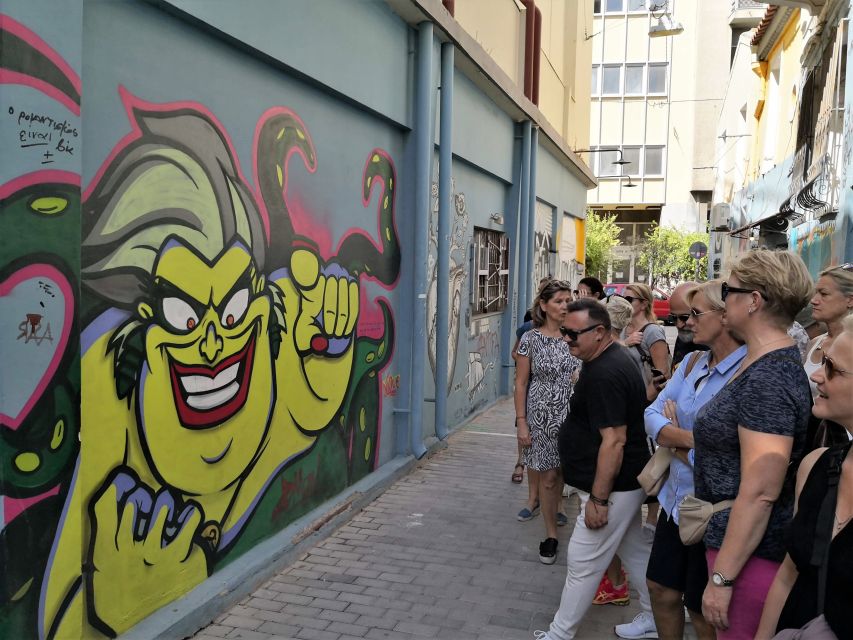
Athens tells its modern story on walls. On this two-hour walk from Monastiraki to Metaxourgeio, you’ll see bold murals, quick graffiti tags, hidden courtyards, and works shaped by Greece’s financial and political troubles. The guide helps you read what might otherwise look like a wall full of color.
I like two things especially: the route gets beyond the Acropolis postcard and into districts you might otherwise skip, and the guides connect art with real Athenian life. Penelope, Gregory, Katerina, Eleni, and Pascal are among the guides praised for clear explanations, warmth, and strong knowledge of local artists.
The main drawback is simple: this is a walking tour with a fair amount of ground to cover, often at a decent pace. Summer heat can make the route tiring, and anyone hoping for a quick photo stop at a few famous murals may find the two hours quite full.
Key points
- A city route with a story: Walk from Monastiraki through Psyrri, Sarri, Omonoia, and Metaxourgeio.
- More than photo stops: Learn how to read symbols, characters, political messages, and artistic techniques.
- Modern Greek context: The art reflects social pressure, economic hardship, political anger, and changing neighborhoods.
- Strong guide-led experience: Penelope, Gregory, Katerina, Eleni, and Pascal have all led tours praised for energy and clear storytelling.
- Small-group feel: Private and small-group options are available, and quiet-season departures may have very few people.
- Good value for art lovers: At $47 per person, the price pays for a local guide and a focused look at a side of Athens many visitors miss.
Why Athens street art deserves two hours
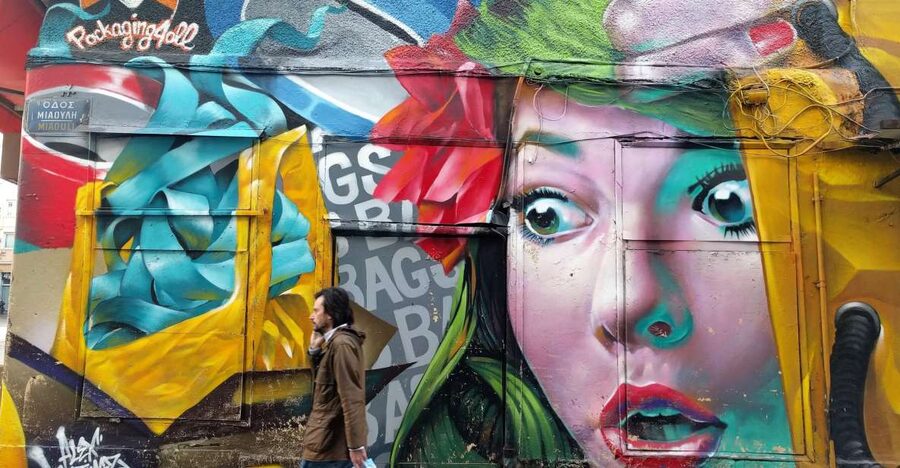
Athens is famous for ancient stone, marble temples, and museum collections. But the city’s present-day voice is often painted on apartment walls, shutters, garages, and building facades. This tour gives you a way to understand that voice without treating street art as mere decoration.
I like that the experience does not reduce every mural to a colorful backdrop. Your guide explains the artists, the images, and the reasons a particular work appeared in a particular neighborhood. Some pieces connect to Greece’s economic crisis and social strain. Others reflect political views, local identity, or the influence of artists from outside Greece.
The result is a useful counterpoint to Athens’ ancient monuments. After a few days of looking at antiquities, you can turn your attention to art made for the city’s current residents. It is a chance to consider what people are saying now, not only what earlier civilizations left behind.
The tour is also a lesson in looking. You’ll be encouraged to check upper floors, side walls, narrow alleys, and corners that are easy to pass without noticing. The guide may use a tablet or other visual material to add context, and questions are part of the experience rather than an interruption.
A few other Athens mornings to price up
- Athens: Acropolis Ticket with Optional Audio or Live Guide
★ 4.2 · 11,055 reviews - Athens: Acropolis, Parthenon & Acropolis Museum Guided Tour
★ 4.8 · 9,316 reviews - Athens: Acropolis and Parthenon Guided Walking Tour
★ 4.6 · 5,882 reviews
Starting beside Monastiraki Metro
The meeting point is at Athinas 7, in front of Lonis pastry shop, next to the Monastiraki Metro exit. If you arrive by metro, use the Athinas Street exit. This is a practical meeting place in central Athens, but give yourself enough time to identify the correct exit and pastry shop before the start.
The first portion takes you through Monastiraki. This is a useful opening because you begin in one of Athens’ most familiar central areas and then start looking beyond its main sights. Instead of focusing on the Acropolis view or the market stalls, you’ll be directed toward walls, lanes, and works that show another side of the district.
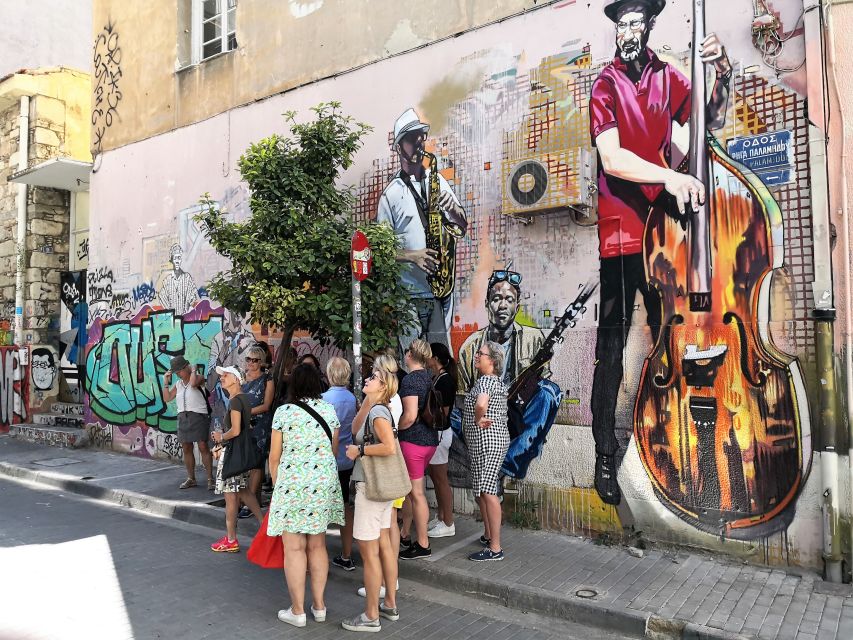
Your guide sets the tone here by explaining how to decode the images you see. A mural can use a recognizable figure, a repeated symbol, or a strange combination of objects to make a point. The guide’s job is not to tell you that there is one correct interpretation, but to give you enough background to understand the references and ask better questions.
From the meeting point, the walk toward Monastiraki takes about 10 minutes. It is a short introduction before the longer sections of the route begin.
Psyrri, where the art and neighborhood meet
The route then moves into Psyrri, with about 40 minutes of walking listed for this part. That makes it the most substantial section of the tour and one of the places where the experience feels most connected to daily Athens.
Psyrri is known for its restaurants, bars, small streets, and changing urban character. On this route, you’ll look past the obvious attractions and focus on the mixture of commissioned murals, spontaneous graffiti, tags, and older work. The guide explains how neighborhoods change and how street art can be shaped by those changes.
This is also where the social and political side of the tour becomes clearer. The financial crisis affected artists as well as everyone else, and walls became a place to express frustration, solidarity, criticism, or hope. Not every piece carries the same political weight, but the guide helps you see how the city’s pressures appear in its public art.
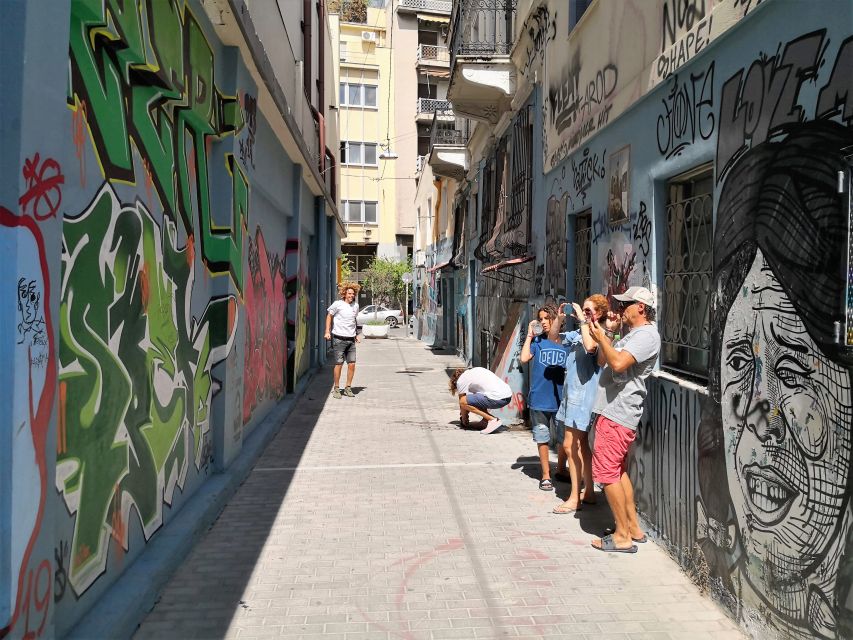
Expect to stop often. You’ll need time to look closely, hear the explanation, take photographs, and ask about styles or artists. The group may pause in a small alley or courtyard rather than at a formal attraction, so stay close to the guide and watch for traffic at street crossings.
Platia Iroon and Sarri, smaller streets with sharper detail
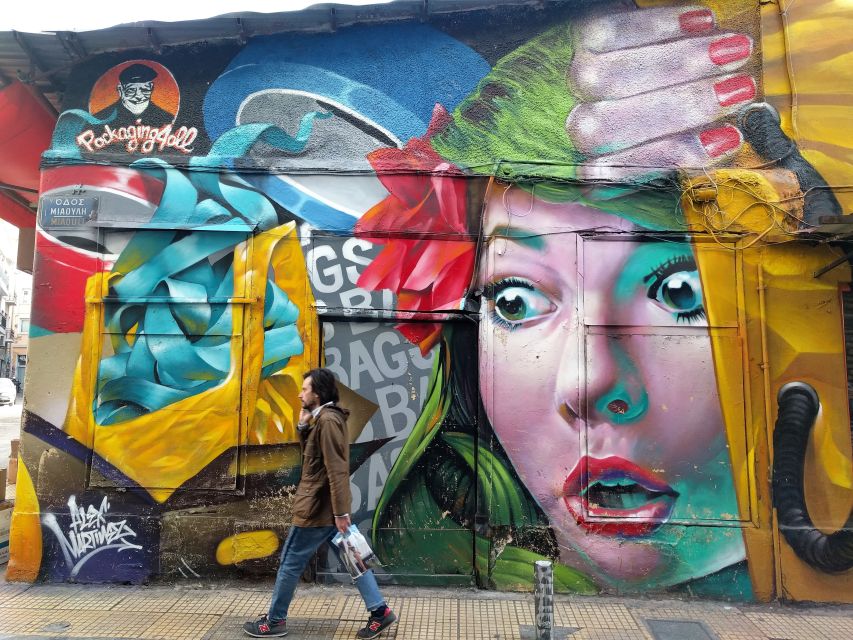
The itinerary continues to Platia Iroon, reached after about 10 minutes of walking, followed by Sarri after another 15 minutes. These shorter sections help break up the route and keep the focus on specific works rather than on a long, uninterrupted march.
A small square can show how art interacts with public space. A large wall may dominate the view, while a smaller drawing or stencil works through detail. Your guide may point out the difference between a commissioned piece and an unauthorized one, or explain how artists use scale, placement, line, and lettering to reach people passing by.
Sarri adds more of the backstreet feel promised by the tour. You’ll enter areas where the art is not arranged for visitors and where the setting is part of the meaning. A weathered wall, a shutter, or a neighboring building can change how a work looks from one year to the next.
This is one reason the tour cannot promise a fixed list of murals forever. Street art changes. Pieces are painted over, damaged, added to, or removed. The value is in having someone who knows the current scene and can select worthwhile examples on the day of your walk.
Same island, an entirely different sort of day:
- Athens: Acropolis & up to 5 Archaeological Sites Combo Pass
★ 4.4 · 12,619 reviews - Athens: Cape Sounion & Poseidon Temple Sunset Half-Day Trip
★ 4.8 · 8,241 reviews - All Day Cruise -3 Islands to Agistri,Moni, Aegina with lunch and drinks included
★ 5.0 · 4,958 reviews - Athens, Piraeus, and Coastline: Blue Hop-On Hop-Off Bus
★ 3.9 · 4,849 reviews
Omonoia and the changing face of central Athens
The route heads toward Omonoia with about 15 minutes of walking. Omonoia is a major central square and a useful place to understand the contrasts within Athens. Here, the polished tourist center gives way to a busier, more mixed urban setting.
The art you see in this part of the route may feel rougher, more direct, or more tied to the city’s social problems. Your guide discusses how economic conditions, migration, politics, and neighborhood change have affected Athens’ streets and its artists. You are not simply looking at isolated paintings. You are seeing how public walls become part of a city’s argument with itself.
Omonoia can also be more demanding as a walking environment than a quiet pedestrian lane. The tour description includes roads, alleys, and urban districts rather than a museum-style indoor visit. Keep your attention on the group and your surroundings while listening.
I find this section valuable because it resists the temptation to show only attractive murals. The point is not to make every neighborhood look pretty. It is to understand how art appears in places marked by tension, change, and uneven investment.
Metaxourgeio, finishing at the square
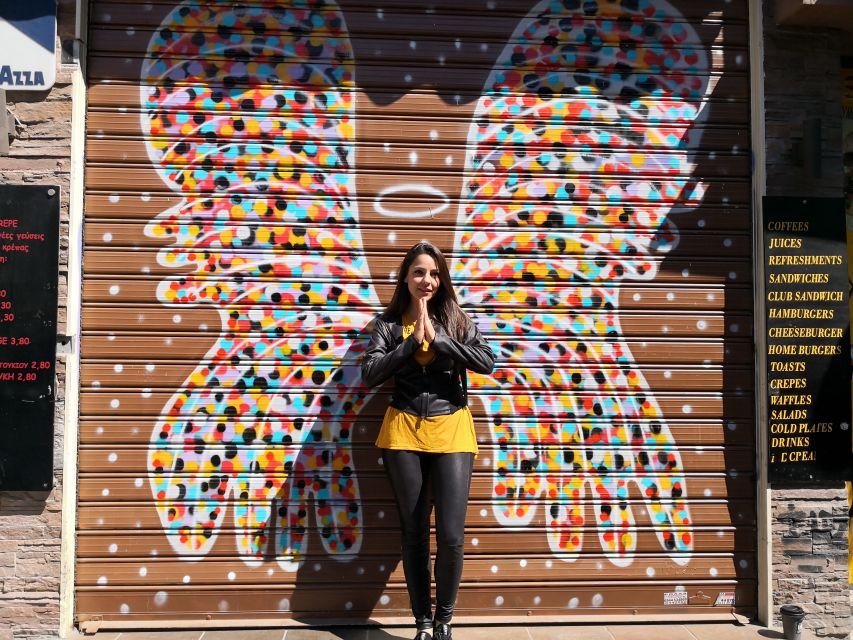
The final section takes you toward Metaxourgeio, with about 30 minutes of walking listed before the finish at Metaxourgeio Square. This gives the tour a clear arc, moving from a major visitor hub into a district with a stronger reputation for alternative culture and street art.
Metaxourgeio is a fitting place to end because the district brings together many of the tour’s themes. You may see large murals beside older buildings, works by Greek artists beside international pieces, and art that feels closely linked to the neighborhood’s identity. Your guide explains how the area has changed and how artists have helped shape its public image.
The finish at Metaxourgeio Square is also practical. You are not returned to the starting point, so plan your next move from there. The tour does not include hotel pickup or drop-off, and it does not include food or drinks. You can arrange your own onward plans once the walk ends.
The guides make the difference
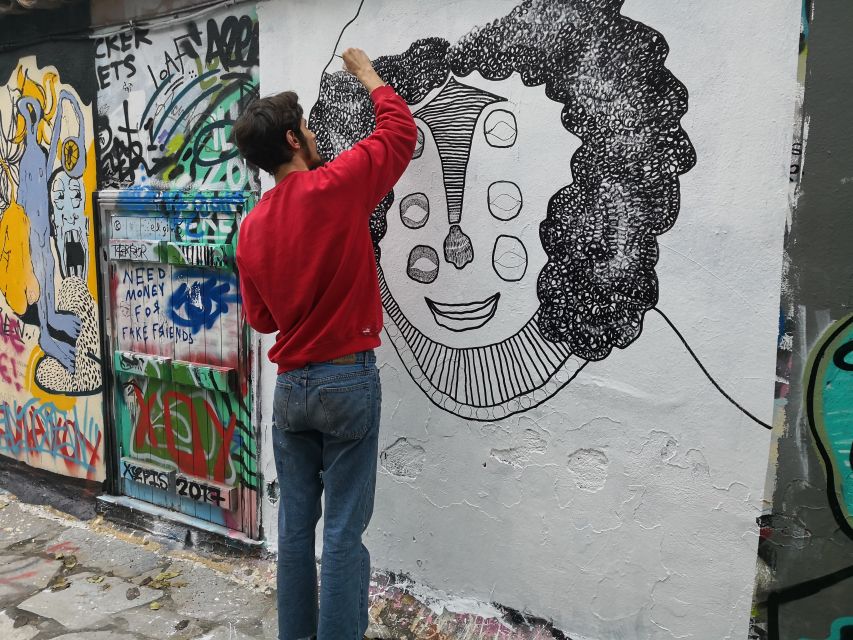
The strongest part of this experience is the guide-led interpretation. Street art is easy to see but harder to understand. Without context, you may notice a striking face or a huge animal and then walk on. A good guide explains the artist, the method, the symbols, and the local issue behind the piece.
Penelope is repeatedly praised for her clear speech, friendly manner, strong preparation, and ability to involve the whole group. She has also offered route choices and checked that groups were comfortable with the plan. That flexibility matters on a small private departure, where the walk can be adjusted around interests and questions.
Gregory is described as both an artist and someone with a strong feel for Athens and the Psyrri area. His tours include the history of the neighborhoods as well as the art. If you want links between modern Greek history, society, and the city’s creative scene, his style should suit you.
Katerina and Eleni are also praised for enthusiasm, clear English, and engaging explanations. Pascal is noted for discussing techniques and the different approaches artists take when creating their work. The exact guide is not guaranteed, but the pattern is clear: this is built around personal interpretation rather than an audio guide or a self-guided map.
What the $47 price buys you
At $47 per person, this is not the cheapest way to see painted walls in Athens. You could walk through Psyrri and Metaxourgeio on your own for nothing. The question is what you would miss.
The fee pays for two hours with an English-speaking specialist who selects the route, identifies artists, explains political and social references, and helps you notice work in less obvious places. For someone genuinely interested in street art, that can be good value. You are paying for access to a local point of view, not for transport, meals, or entry to a monument.
The value is strongest if you enjoy asking questions and want more than photographs. One guide has even tailored recommendations to the group’s artistic interests, while another used a tablet to add visual information. Those details show how a small group can turn a general walk into a more personal lesson.
If you only want a few dramatic murals for social media, $47 may feel high. The tour spends time on meaning, technique, and context. It is aimed at people who want to understand the art and the city behind it.
Walking, timing, and group size
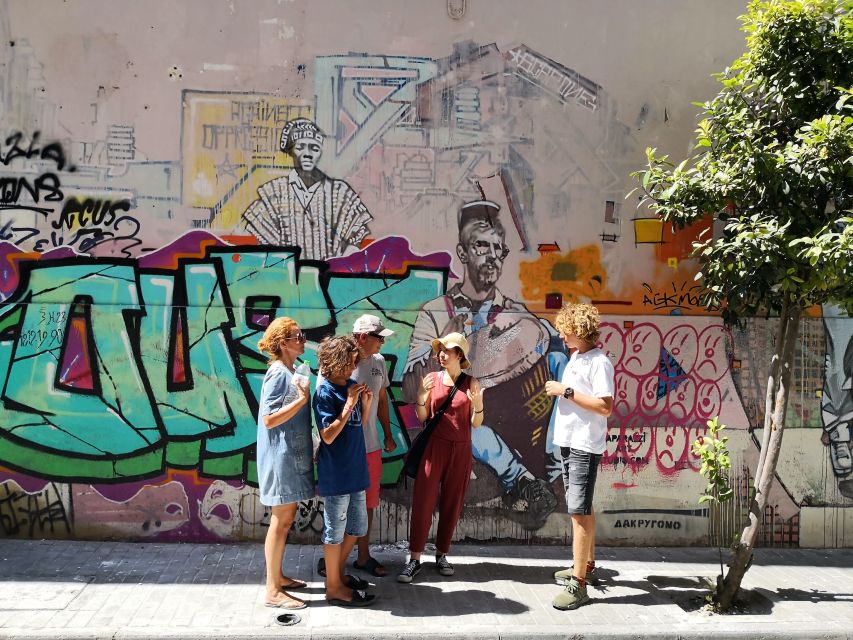
The advertised duration is two hours, but the route is active. The walking sections include approximately 10 minutes to Monastiraki, 40 minutes around Psyrri, 10 minutes to Platia Iroon, 15 minutes to Sarri, 15 minutes to Omonoia, and 30 minutes to Metaxourgeio. These figures describe the route’s movement between areas, while stops add time for explanations and photographs.
You should wear comfortable shoes and bring water, especially in warm weather. The route includes small alleys, courtyards, squares, and central streets. It is not a seated lecture, and the walk can move at a decent pace.
Summer conditions deserve special thought. One family ended early because of the heat, so an early or later starting time may be more comfortable if those options appear during booking. In cooler months, the route can be easier physically, and a small departure may give you more time for questions.
Private and small-group formats are available. A quieter departure can be a major advantage if you want to discuss particular artists, photography, or the political meaning of a piece. Larger groups may still work well, but stay near the guide when the route passes through busy central streets.
Who should book this Athens street-art walk
I would put this high on the list for anyone who has already seen the main ancient sights and wants present-day Athens. It suits art students, photographers, curious first-time visitors, and repeat visitors who feel they have already covered the standard center.
It is also a good choice if you want a local introduction to Psyrri, Sarri, Omonoia, and Metaxourgeio without simply wandering through them. The guide gives you reasons to notice how neighborhoods look, how they have changed, and how public art fits into that change.
Families can enjoy it, but consider the heat and walking time for children. One family with a 13-year-old had to stop early on a hot day. Older adults can also enjoy the tour, especially in a small group where the guide can adjust the pace, but you should be comfortable walking for most of two hours.
You may want to skip it if you dislike political discussion, prefer indoor museums, or have limited energy for city walking. You should also avoid booking it as a quick mural hunt. The best parts are the explanations between the photo stops.
Should you book it?
Book this tour if you want to see Athens as a living city rather than only an ancient one. The route reaches four distinct central areas, the guides bring strong local insight, and the art opens a direct conversation about Greece’s recent troubles and changing neighborhoods.
At $47, it earns its price when you value interpretation and local knowledge. Choose a small or private group if you want the most conversation, and plan for heat, comfortable shoes, and a finish at Metaxourgeio Square rather than back at Monastiraki.
FAQ
Where does the Athens street-art tour start?
It starts at Athinas 7, Athens, in front of Lonis pastry shop, next to the Monastiraki Metro station exit.
Which Metro exit should I use?
Use the Athinas Street exit when arriving by Metro.
Where does the tour finish?
The walk finishes at Metaxourgeio Square.
How long does the tour last?
The activity lasts two hours.
What language is the tour in?
The live tour guide speaks English.
Is the tour private or shared?
Private and small-group options are available.
What neighborhoods does the route visit?
The route includes Monastiraki, Psyrri, Platia Iroon, Sarri, Omonoia, and Metaxourgeio.
Is hotel pickup included?
No. Hotel pickup and drop-off are not included.
Are food and drinks included?
No. Food and drinks are not included.
Can I cancel for a full refund?
Yes. You can cancel up to 24 hours in advance for a full refund.
Can I reserve now and pay later?
Yes. The booking option allows you to reserve your place and pay later.
Fresh on the Athens list
- Athens Airport Arrival Transfer to Hotels or Addresses in Athens★ 3.5 · 45 reviews
- Private Luxury Tour: Unveiling the Sacred Mysteries of Eleusis★ 5.0 · 45 reviews
- Luxury Catamaran Sunset Semi-Private & Greek Gastronomy in Athens★ 5.0 · 45 reviews
- From Athens: Aegina Island guided tour in a day★ 5.0 · 45 reviews
- Delphi, Thermopylae full day private tour from Athens★ 4.9 · 46 reviews
- From Athens: City & Corinth Guided Day Tour★ 4.8 · 46 reviews
- Acropolis Private Wine Tasting @ Finewine store★ 5.0 · 46 reviews
- Ancient Corinth Half-Day Private Tour from Athens★ 5.0 · 46 reviews
Athens Tours, compared.
Acropolis & up to 5 Archaeological Sites Combo Pass
Read our review →
Acropolis, Parthenon & Acropolis Museum Guided Tour
Read our review →
Cape Sounion & Poseidon Temple Sunset Half-Day Trip
Read our review →

Cape Sounio & Poseidon Temple Trip with Audio Guide
Read our review →