
Reviewed · ATHENS TOURS
Mythology, Philosophy and Democracy Tour
The most interesting thing about this Athens walking tour is its central idea: mythology led to philosophy, philosophy shaped politics, and politics helped form democracy. Instead of simply naming ruins, guide Panos connects them into one long story about how people began explaining the world through reason, debate, and observation.
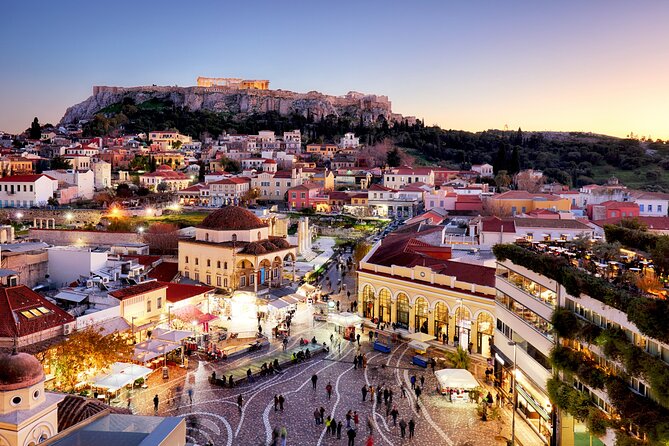
I like the route for two clear reasons. First, it reaches places many first-time visitors skip, especially Kerameikos and the Pnyx. Second, it ends on Philopappos Hill, where you get some of the finest views of the Acropolis and Athens. The only real caution is the heat and walking time. In hot weather, this can feel demanding, and the relaxed conversation may stretch the advertised three hours.
Key points to know before booking
- A history walk with a clear theme: The tour links Greek mythology, philosophy, mathematics, politics, literature, and democracy rather than treating each site as a separate stop.
- The Pnyx is the emotional center: You visit the place where ancient Athenians gathered for political debate and where Pericles delivered his famous funeral speech.
- Small groups matter: The maximum group size is 12, which suits discussion and gives you a better chance to ask Panos questions.
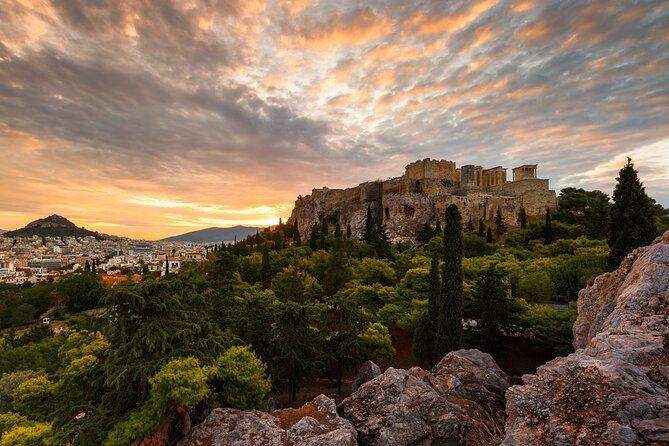
- Excellent Acropolis views: The route finishes at Philopappos Hill, after a stop at Pnyx Hill, giving you two strong viewpoints.
- A good first Athens walk: The historical context can make later visits to the Acropolis, Agora, and other ruins easier to understand.
- Plan for weather: The activity requires good weather, and the hills and open-air walking are less comfortable during extreme heat.
Why this Athens tour feels different
Many city walks move from monument to monument. This one moves from idea to idea.
At Kerameikos, you begin with death, memory, craft, and public life. At the Ancient Agora, the focus shifts to argument and civic life. The route then crosses through Monastiraki, the Roman Agora, Hadrian’s Library, and Plaka before reaching the Pnyx, the place most closely tied to Athenian democracy.
That structure gives the walk a useful rhythm. You are not just looking at old stones. You are asking what kind of society built them, how people explained nature, and who was allowed to take part in public decisions.
Panos is the guide at the center of the experience. His approach, as described through the tour itself, is conversational and reflective rather than rushed. He brings in philosophy, history, religion, mathematics, and current human problems. If you enjoy asking why as much as when, this is likely to suit you.
The small maximum group of 12 helps. A theme this broad could become a lecture, but a small group makes it easier to pause, ask questions, and follow a particular interest. Families with older children and teenagers may find the discussion especially useful, since the tour connects ancient ideas to modern life.
A few other Athens mornings to price up
- Athens: Acropolis & up to 5 Archaeological Sites Combo Pass
★ 4.4 · 12,619 reviews - Athens: Acropolis Ticket with Optional Audio or Live Guide
★ 4.2 · 11,055 reviews - Athens: Acropolis, Parthenon & Acropolis Museum Guided Tour
★ 4.8 · 9,316 reviews
Kerameikos: pottery workshops and the city of the dead
Kerameikos is an excellent opening because it is less familiar than the Acropolis but carries enormous weight in the story of Athens.
The name comes from keramos, meaning ceramic. Pottery workshops once operated here, and the district also served as Athens’ cemetery for centuries. That combination tells you something important about ancient city life: trade, work, religion, politics, and death often occupied the same urban world.
You can expect about 25 minutes here. That is enough time for Panos to explain why the site mattered and to place famous Athenians within the wider life of the city. The focus is not only on tombs. It is also on how Athens remembered its citizens and presented its values in public.
Kerameikos is linked to Pericles’ famous funeral speech, known as the Epitaphios. He delivered it for the first Athenian casualties of the Peloponnesian War, praising the civic ideals of Athens and its democratic system.
This gives the tour an early turning point. Democracy is not introduced as an abstract modern word. You encounter it alongside war, loss, public honor, and the question of what citizens owe one another.
Admission is listed as free for the tour stop. The site is also a useful reminder that Athens is more than its headline monuments. I would pay close attention here, since this is one of the places you might otherwise pass without understanding its importance.
The Ancient Agora: where arguments shaped Athens
The Ancient Agora was the center of public life. It was a place for walking, meeting, trading, conducting civic business, and discussing the issues of the day.
The tour allows about 10 minutes here, so you should think of it as a focused explanation rather than a full archaeological visit. Panos uses the setting to introduce figures such as Socrates, Plato, Solon, Themistocles, Pericles, Thucydides, Sophocles, and Aristophanes.
That list covers philosophy, law, war, drama, history, and political leadership. The point is not to memorize names. It is to see how many kinds of public thought developed in the same city and how closely they were tied to everyday debate.
This is where the connection between philosophy and democracy becomes practical. A democratic city needs citizens who can argue, listen, persuade, and judge competing claims. The Agora was not a classroom in the modern sense, yet it helped create the habits of public discussion that made Athenian civic life possible.
If you plan to visit the Ancient Agora properly on another day, this short stop can serve as an introduction. If you expect a full tour of the archaeological grounds, you may find 10 minutes brief.
Monastiraki and the Roman Agora: old Athens in a living city

The route then moves through Monastiraki Square and its flea market. This is a lighter section of the walk, with about 10 minutes at an easy pace.
You will pass antique and tourist shops, and the surroundings provide a sharp contrast with the earlier archaeological sites. Athens is not a museum sealed away from modern life. Ancient remains, commerce, food, shopping, and daily city traffic all share the same streets.
The Roman Agora is also allotted about 10 minutes. Located north of the Acropolis and east of the Ancient Agora, it shows how Athens continued to develop under Roman rule. The name can cause confusion, since it is not the same place as the earlier Greek Agora.
The short visit works best as a piece of the larger story. It helps you see that Athens did not stop changing after its classical period. Greek political and intellectual traditions continued within a Roman city, alongside new buildings and new systems of power.
Same island, an entirely different sort of day:
- Athens: Cape Sounion & Poseidon Temple Sunset Half-Day Trip
★ 4.8 · 8,241 reviews - Athens: Acropolis and Parthenon Guided Walking Tour
★ 4.6 · 5,882 reviews - All Day Cruise -3 Islands to Agistri,Moni, Aegina with lunch and drinks included
★ 5.0 · 4,958 reviews - Athens, Piraeus, and Coastline: Blue Hop-On Hop-Off Bus
★ 3.9 · 4,849 reviews
The Tower of the Winds: an ancient weather station
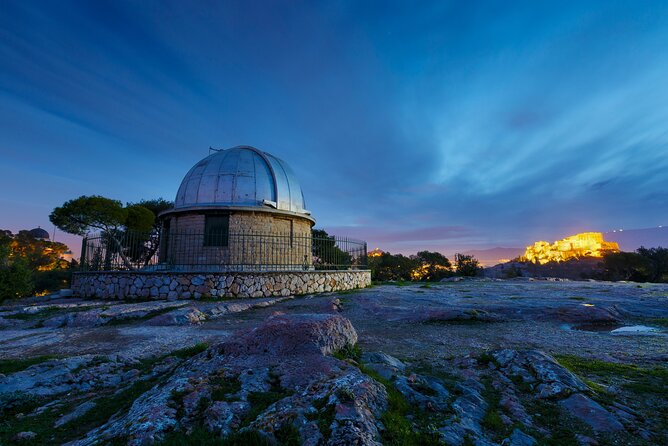
The Tower of the Winds is one of the route’s most unusual stops.
This octagonal building was created by Andronicus of Kyrristos in the first century BC. It served as a wind indicator, a sundial, and a water-powered clock. In effect, it acted as an early weather station and public timekeeper for Athens.
The tour gives it about 10 minutes, which is enough to explain why the structure matters. The detail I find most memorable is the hydraulic mechanism. On cloudy days, when the solar clock could not work, water-powered machinery produced a sound every hour.
That small fact makes ancient technology feel immediate. You are not only looking at a classical building. You are seeing people solve a practical problem with the tools available to them.
This stop also fits the tour’s larger movement from belief toward observation. Mythology supplied stories about the gods and nature. Later thinkers increasingly asked how the natural world actually worked. The Tower of the Winds gives you a physical example of that curiosity.
Hadrian’s Library and Plaka: Roman power and neighborhood life

Hadrian’s Library was built by the Roman emperor Hadrian in AD 132 on the north side of the Acropolis. It was once among the largest libraries in the world.
The tour includes about 10 minutes here. That is not enough for a long architectural study, but it provides useful context about Rome’s role in Athens and the value placed on learning, books, and public institutions.
Hadrian was strongly interested in Greek culture, and his building projects helped reshape Athens during the Roman period. The library is a reminder that the city remained important as a center of learning even after it lost its earlier political independence.
From there, the walk reaches Plaka, a scenic neighborhood of small houses and narrow streets. This part of the route gives your eyes and feet a change of pace. You move from large archaeological questions to the scale of lanes, homes, and ordinary urban life.
I like that the tour does not isolate ancient Athens from present-day Athens. Plaka helps you understand that the city’s past is layered into neighborhoods where people still live, eat, shop, and walk.
Pnyx Hill: the place where democracy became physical
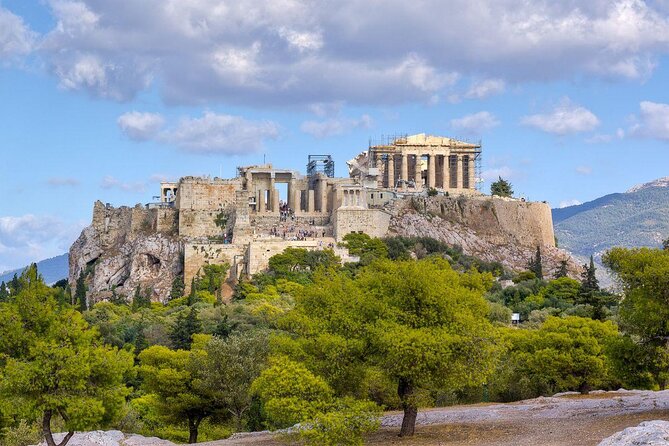
Pnyx Hill is the key stop for the tour’s political theme.
It is described as the first parliament in the world, and it offers broad views across the surrounding area. Ancient Athenians gathered here to debate and make decisions. Standing on the hill gives democracy a physical setting: citizens came to a particular place, heard arguments, and took part in public life.
The tour allows about 25 minutes. That gives Panos room to explain the system and its limits. Ancient Athenian democracy was not the same as modern democracy, and the setting is a good place to consider both its achievements and its exclusions.
The Pnyx is also an excellent sunset location. If your tour is scheduled in the evening, the light can make this section especially pleasant. If it takes place during the day, bring water and protect yourself from the sun, since the route is outdoors and includes hills.
This is one of the moments when the tour’s main idea comes together. Myth, philosophy, and civic life are not separate school subjects. They grew through the same city, shaped by arguments about nature, justice, power, and the good life.
Philopappos Hill: finish with Athens at your feet

The final stop is Philopappos Hill, also called the Hill of the Muses. The tour gives it about 45 minutes, making it the longest single stop.
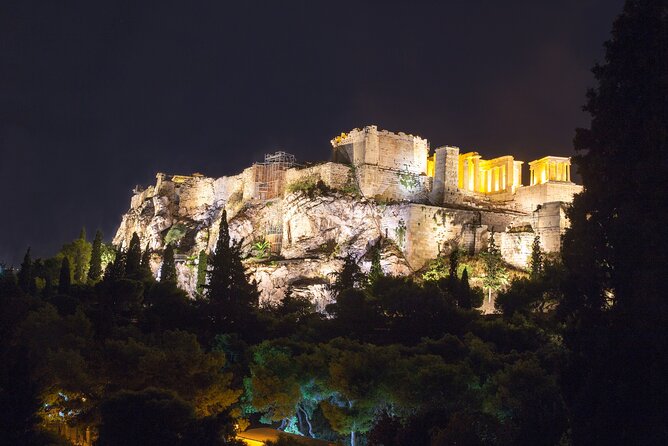
That extra time matters. You are not being dropped at a viewpoint for a quick photograph. The hill is the place to pause, review the ideas from the walk, and take in the Acropolis and Athens by day or night.
The Acropolis views are a major reward. You also get a different perspective from the city center, where the monuments can feel crowded and close. From Philopappos Hill, the larger relationship between the Acropolis, surrounding neighborhoods, and the city becomes easier to see.
The tour ends here rather than returning to the starting point near the Statue of Theseus. Keep that in mind when planning your evening. The end point is Philopappos Hill, while the meeting point is in central Athens at Athens 105 55.
Price, timing, and group size
At $50.69 per person, this is not the cheapest way to walk around Athens, but the price can make sense if you want interpretation rather than directions.
You are paying for a themed walk led by Panos, with a maximum of 12 people, across several important areas. The route includes many free outdoor stops, so the value rests mainly in the guide’s explanations, the route design, and the connections between sites.
I would not book it solely to check monuments off a list. I would book it if you want the city to make more sense. The tour can be especially useful before visiting the Acropolis or Ancient Agora, since you will already have a framework for understanding Athenian politics, religion, and public life.
The published duration is about three hours. The listed stop times add up to roughly three hours, before allowing for walking. Some descriptions of the experience place it closer to four hours, especially when discussion is lively. Leave room in your schedule and avoid booking a tight dinner reservation immediately afterward.
The tour is offered in English and includes mobile ticketing. Group discounts are available. Confirmation is provided at booking, and service animals are allowed. Most people can participate, but you should expect a walking route with hills and outdoor exposure.
Who will enjoy this walk most
I would recommend it most strongly to:
- People who enjoy history with ideas attached to it
- First-time Athens visitors who want context before seeing the Acropolis
- Families with teenagers or young adults
- Anyone interested in the origins of democracy and philosophy
- Visitors who prefer smaller groups and conversation
- Repeat visitors looking for less familiar places, such as Kerameikos and the Pnyx
You do not need a university background in philosophy. The tour is designed around explanation and storytelling, not prior expertise.
Still, this is not the best choice if you want a fast photo walk or a detailed archaeological tour of every site. The experience asks you to listen, think, and sometimes discuss. Those who prefer short factual commentary may find the philosophy sections more than they need.
Practical advice for a better experience
Wear comfortable shoes. Even though the route is described as easy paced, it covers several parts of central Athens and finishes on hills.
Choose a cooler time if possible. Heat has made the walk harder for some people, while evening tours in June have been described as more pleasant. Water and occasional breaks are sensible, especially in summer.
Bring your curiosity. The strongest part of this experience is the way Panos links one subject to another. You may hear about mathematics while discussing philosophy, or compare an ancient political problem with one that still exists today.
I would also schedule this tour early in an Athens visit. It can give you a better sense of what you are seeing when you later visit the Acropolis, Agora, Roman Agora, or the city’s museums.
Free cancellation is available up to 24 hours before the start time for a full refund. Changes or cancellations made inside that window are not accepted for a refund. Since the activity requires good weather and a minimum number of participants, a cancellation by the operator may result in another date, another experience, or a full refund.
Should you book the Mythology, Philosophy and Democracy Tour?
Yes, if you want Athens explained through the ideas that shaped it.
The strongest reasons are Panos’ subject knowledge and delivery, the small group size, the visit to the Pnyx, and the final views from Philopappos Hill. You also get a useful mix of famous areas and quieter historical places, with Kerameikos providing an especially worthwhile start.
I would skip it only if your priority is a short, monument-heavy walk with little discussion. For everyone else, $50.69 is a fair price for a thoughtful introduction to Athens, particularly at the beginning of your stay.
FAQ
Where does the tour begin?
The tour begins at the Statue of Theseus in Athens, Greece, in the 105 55 postal area.
Where does the tour end?
The tour ends at Philopappos Hill, listed at Fylis 215, Athens 117 41.
How long does the tour last?
The advertised duration is approximately three hours. The walking and discussion may take longer, so leave extra time afterward.
What language is the tour offered in?
The tour is offered in English.
How much does the tour cost?
The listed price is $50.69 per person.
How large is the group?
The activity has a maximum of 12 participants.
Is the tour available with a mobile ticket?
Yes, mobile ticketing is available.
Are group discounts offered?
Yes, group discounts are listed as a feature of the experience.
Is admission included at the stops?
The itinerary lists free admission for each stop included in the walk.
Can I cancel for a full refund?
You can cancel at least 24 hours before the start time for a full refund. Cancellations or changes made less than 24 hours before the start time are not accepted for a refund.
Fresh on the Athens list
- Athens Airport Arrival Transfer to Hotels or Addresses in Athens★ 3.5 · 45 reviews
- Private Luxury Tour: Unveiling the Sacred Mysteries of Eleusis★ 5.0 · 45 reviews
- Luxury Catamaran Sunset Semi-Private & Greek Gastronomy in Athens★ 5.0 · 45 reviews
- From Athens: Aegina Island guided tour in a day★ 5.0 · 45 reviews
- Delphi, Thermopylae full day private tour from Athens★ 4.9 · 46 reviews
- From Athens: City & Corinth Guided Day Tour★ 4.8 · 46 reviews
- Acropolis Private Wine Tasting @ Finewine store★ 5.0 · 46 reviews
- Ancient Corinth Half-Day Private Tour from Athens★ 5.0 · 46 reviews
Athens Tours, compared.

Acropolis & up to 5 Archaeological Sites Combo Pass
Read our review →

Acropolis, Parthenon & Acropolis Museum Guided Tour
Read our review →
Cape Sounion & Poseidon Temple Sunset Half-Day Trip
Read our review →


Cape Sounio & Poseidon Temple Trip with Audio Guide
Read our review →