
Reviewed · ATHENS TOURS
Private Luxury Tour: Unveiling the Sacred Mysteries of Eleusis
The most fascinating part of this private tour is that Eleusis begins long before you reach the famous sanctuary. You follow fragments of the ancient Sacred Way, the route once used by pilgrims heading from Athens to the rites of Demeter and Persephone. The journey itself is the story, not just the final ruins.
I like the relaxed private format and the way the driver-guide can explain the sites between stops. I also like the mix of ancient religion, Roman engineering, and Byzantine art, especially the Monastery of Daphni. The main drawback is that your driver is not a licensed guide inside the archaeological sites, and the visit can feel brief if you want a full museum and sanctuary tour.
Key points about the Sacred Way tour
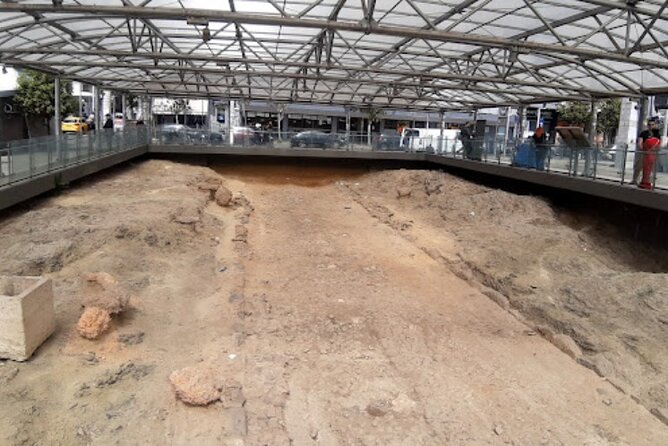
- Follow the route to Eleusis: See surviving sections of the ancient road and the bridges that carried pilgrims across the Kifisos River.
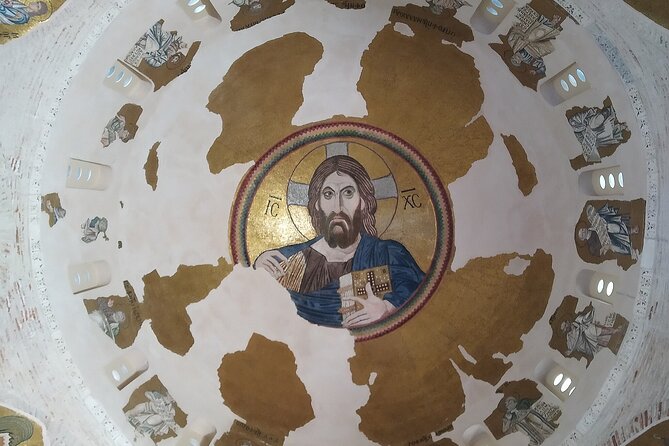
- Add Daphni Monastery: Spend time with its 11th-century Byzantine mosaics, including Christ Pantocrator in the dome.
- Travel privately: Groups of one to four use a luxury sedan, while groups of five to seven ride in a comfortable minivan.
- Meet strong driver-guides: Pericles and Demetrios are noted for their kindness, clear explanations, and ability to keep the trip unhurried.
- Explore the heart of the mysteries: Visit the Telesterion, Great Propylaea, Kallichoron Well, Ploutonion, and Eleusis Museum.
- Budget for admission: Transportation and bottled water are included, but archaeological site and museum entry costs €10 per person.
Why the road to Eleusis matters
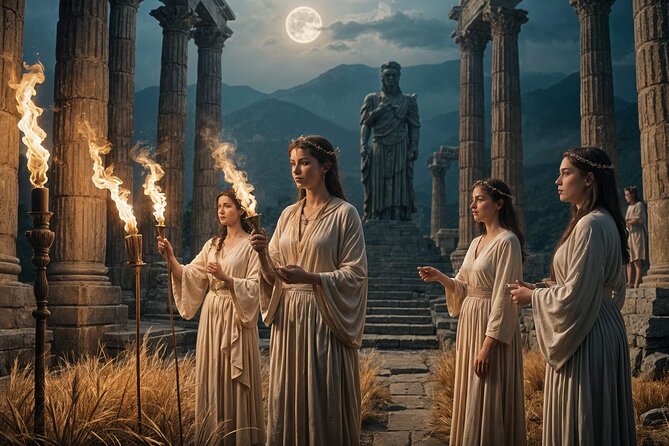
Eleusis was not simply another ancient Greek town. It was the center of the Eleusinian Mysteries, a major religious tradition linked to Demeter, goddess of grain and harvest, and Persephone, whose return from the underworld explained the cycle of life and renewal.
The rituals themselves were kept secret. That is part of the appeal today. You can learn the myths and see the places tied to them, but the central experience of the initiates remains unknown.
This tour helps you understand the route before you arrive. The Sacred Way connected Athens with Eleusis, and pilgrims once traveled along it carrying sacred objects, singing hymns, and taking part in ceremonies. Modern Athens has covered or interrupted much of the route, but several fragments remain.
I find this approach more useful than simply arriving at Eleusis and trying to make sense of scattered stones. The ancient sanctuary has impressive remains, but the sites along the way explain how the journey worked and why the destination mattered.
A few other Athens mornings to price up
- Best of Athens Half Day Private Tour
★ 5.0 · 3,714 reviews - Athens Full Day Private Tour
★ 5.0 · 2,903 reviews - Athens Airport Private Arrival Transfer with Meet & Greet
★ 4.5 · 1,495 reviews
Ancient bridges hidden in modern Athens
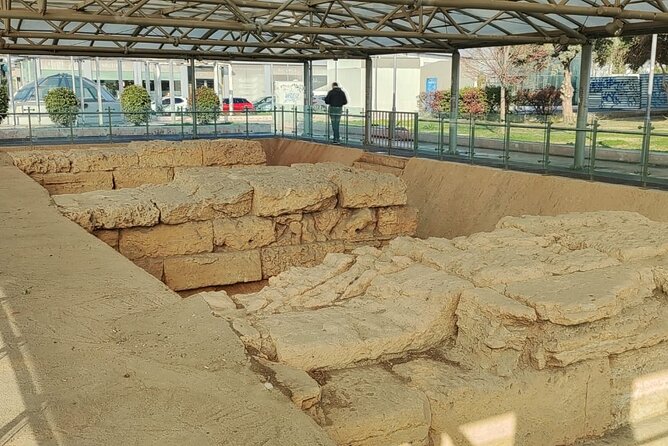
The first stop is a short visit to remains of the Sacred Way near the Eleonas Metro Station. Construction uncovered three surviving piers from an arched stone bridge over the Kifisos River. The original structure had at least five arches.
You may spend only about 10 minutes here, but the stop gives you a clear example of how old and new Athens overlap. A metro station now sits near a crossing once used by merchants, pilgrims, and people traveling toward Eleusis.
The bridge also adds a practical point to the story. Religious processions needed roads, crossings, and working infrastructure. The Eleusinian Mysteries were not held in an isolated wilderness. Thousands of people had to reach the sanctuary, and ancient engineering made that possible.
A second short stop in Aigaleo brings you closer to the surviving line of the Sacred Way. Here, you can walk along remnants of the route and think about the procession as a journey of several miles, not a single ceremony at the sanctuary.
Do not expect a long, intact ancient road. These are fragments within a modern urban setting. Their value is historical context. If you need large ruins and dramatic columns at every stop, the first part may feel modest. If you enjoy piecing together the past, these brief visits are worthwhile.
Daphni Monastery and the shift from pagan Greece to Byzantium
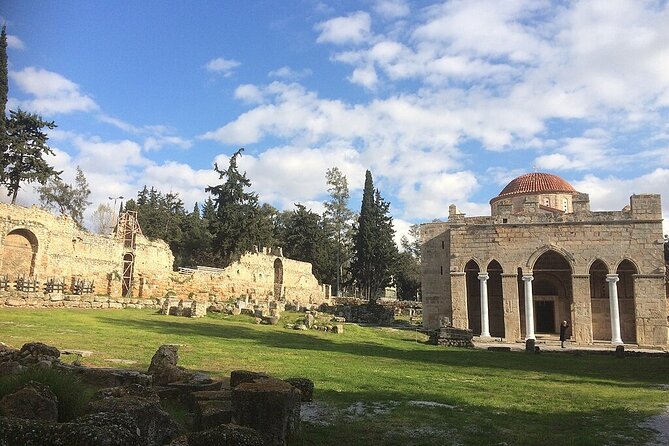
The Monastery of Daphni is one of the strongest stops on the route. It was built in the 11th century and is a UNESCO World Heritage Site. Its location along the Sacred Way gives the tour a useful change of mood: you move from pagan Greek worship to Byzantine Christianity without leaving the same historic route.
The main attraction is the mosaic of Christ Pantocrator in the dome. Ancient cypress trees and the quiet setting add to the sense of pause. You are scheduled to spend about 30 minutes here, enough to see the main features without turning the tour into a full Byzantine architecture visit.
I especially like this stop because it broadens the day. The tour is not only about Demeter and Persephone. It also shows how one route continued to matter after the ancient religious world had changed.
The monastery is listed with free admission for this experience, but opening conditions can affect what you see. As with any historic religious site, dress and behavior should be respectful. Comfortable footwear remains useful because this is a day of walking over uneven ground.
The Sanctuary of Aphrodite at Skaramagkas
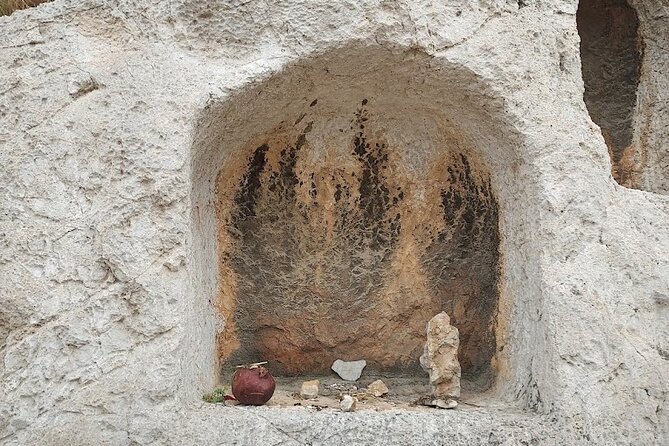
The Sanctuary of Aphrodite near Skaramagkas is another small stop linked to the Sacred Way. It was dedicated to Aphrodite, the goddess of love and beauty, and sits near the route used by pilgrims traveling toward Eleusis.
The remains are limited, so this is more of a historical pause than a major sightseeing visit. On weekends, the sanctuary is open to the public and you can enter. On weekdays, the tour makes a brief outside stop, with time for photographs and a view of the site.
That distinction matters. If entering the sanctuary is important to you, choose a weekend departure and confirm current access when booking. On a weekday, keep your expectations modest. The stop is useful for showing that the Sacred Way included more than one place of worship, but it will not occupy much of the day.
Same island, an entirely different sort of day:
- Athens: Acropolis & up to 5 Archaeological Sites Combo Pass
★ 4.4 · 12,619 reviews - Athens: Acropolis Ticket with Optional Audio or Live Guide
★ 4.2 · 11,055 reviews - Athens: Acropolis, Parthenon & Acropolis Museum Guided Tour
★ 4.8 · 9,316 reviews - Athens: Cape Sounion & Poseidon Temple Sunset Half-Day Trip
★ 4.8 · 8,241 reviews
Hadrian’s Roman bridge near Eleusis
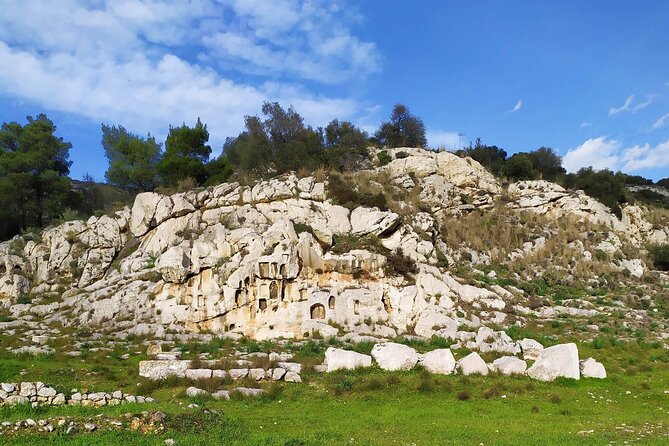
Before reaching the main archaeological site, you stop at a Roman bridge built during the reign of Emperor Hadrian in 125 CE. It is about 50 meters long and 5.30 meters wide, constructed from Piraeus limestone.
The bridge has four arches, with two wider central arches and two smaller ones at the ends. Inclined approaches lead up to it. This is a compact stop, around 10 minutes, but the structure is easy to understand even if you are not an expert in Roman construction.
Its purpose was practical. The bridge helped connect the Sacred Way with the Eleusinian Kifisos River. Once again, the tour shows you the systems that supported the religious procession: roads, bridges, and crossings.
I like this kind of stop because it keeps the day from becoming a parade of temples. You see how people actually moved through the area. The short visit also works well for photographs, though it is not a place where you will spend an hour exploring.
Entering the Archaeological Site of Eleusis
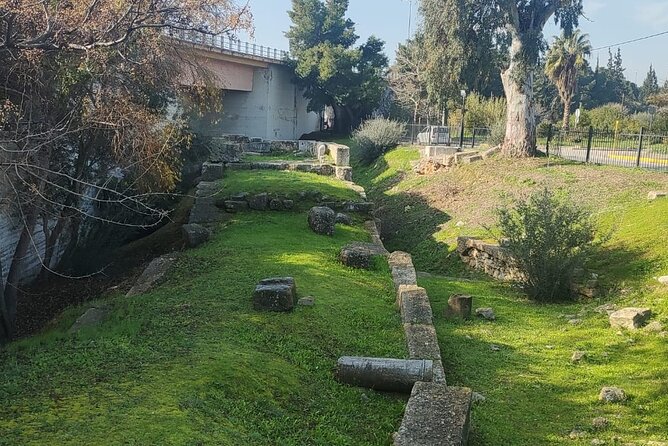
The main Eleusis archaeological site is the center of the tour. It preserves the sanctuary dedicated to Demeter and Persephone, the setting for the Eleusinian Mysteries.
You can expect a mix of gateways, walls, foundations, carved stone, and sacred spaces. The site also has views toward the Saronic Gulf and the surrounding hills, giving you a sense of why this location could feel separate from Athens while still being connected to it.
The scheduled visit is about 30 minutes, followed by shorter stops at individual features. That is enough to identify the key remains, but it is not a slow, expert-led archaeological examination. Since the driver is not a licensed guide who enters the sites with you, you should be ready to read signs and explore at your own pace once inside.
This arrangement has both benefits and limits. A private driver-guide can offer background during the journey and adjust the pace for your group. But if you want detailed explanations beside every ruin, you may prefer to hire a licensed guide separately or allow extra time with your own guidebook.
Admission to the archaeological site and museum is not included. The stated fee is €10 per person. Check the current price and opening conditions before you go, since admission rules can change.
The Telesterion, the center of the mysteries
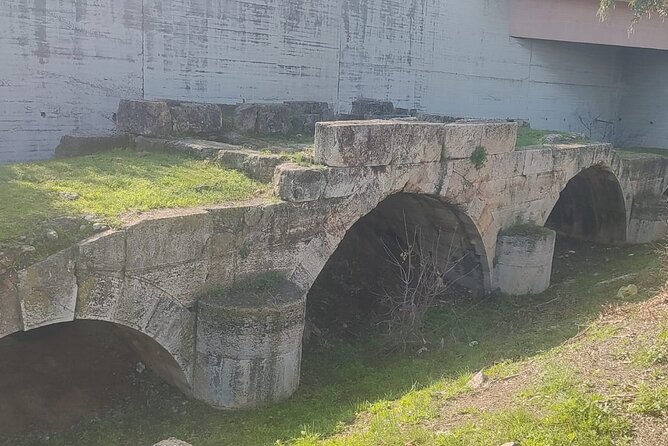
The Telesterion was the great hall where initiates took part in the central ceremonies of the Eleusinian Mysteries. Its remains are among the most important parts of the site.
You will not see a complete building. Instead, you will look across foundations, walls, and the broad footprint of a structure designed for religious gatherings. The scale helps you picture a large group assembling for a ceremony that outsiders were not allowed to reveal.
The Telesterion is scheduled as a 10-minute stop, but it deserves your attention. This is where the tour’s mythology and archaeology meet most directly. Demeter, Persephone, the underworld, and the promise of renewal all become linked to a real place under your feet.
One practical tip: listen closely to the driver-guide before entering. A guide such as Demetrios may explain the sequence of the journey and prepare you for what you are seeing. That background can make the ruins much easier to read.
The Great Propylaea and the sacred entrance
The Great Propylaea was the monumental entrance to the sanctuary. Built in the second century CE under Emperor Marcus Aurelius, it echoed the Propylaea of the Acropolis.
Its purpose was more than practical. A grand entrance marked the change from ordinary life to sacred ground. The columns and massive stonework helped create a clear threshold for the people approaching the sanctuary.
Today, the ruins are incomplete, but the scale remains easy to appreciate. This is another short, 10-minute stop, and it works best when you look for the relationship between the entrance and the enclosed sanctuary beyond it.
I like the comparison with the Acropolis because it shows how important Eleusis was. Athens had its great ceremonial gateway, and Eleusis had one too. The site was not a minor shrine on the edge of the city’s world.
The Kallichoron Well and the Ploutonion
The Kallichoron Well is tied to the story of Demeter searching for Persephone. According to tradition, Demeter rested here, and the name refers to beautiful dances said to have taken place around the well.
The physical remains are modest, but the myth gives the place emotional weight. This is a useful reminder that ancient sanctuaries were made up of small sacred points as well as major buildings.
Nearby, the Ploutonion is a rocky cave associated with Hades, or Plouton. Ancient belief connected it with the entrance to the underworld and with Persephone’s descent.
You can expect about 10 minutes at each location. These are not grand monuments, but they are among the most evocative stops because they connect the physical site with the central themes of death, return, and renewal.
The ground around ancient ruins can be uneven. Wear shoes with good support, and bring a hat and sunscreen. Greece can be hot and bright, especially when you are walking through open archaeological ground.
The Eleusis Archaeological Museum
The museum completes the visit. Its displays include statues of Demeter and Persephone, offerings, and reliefs connected to the Eleusinian Mysteries.
This is where small fragments gain meaning. After seeing the Telesterion, the gates, and the sacred precinct, you can look at the objects found in and around the sanctuary. The museum also helps you understand the artistic side of the cult and the daily acts of devotion that supported it.
The planned museum visit lasts about 30 minutes. That is enough for the main exhibits, but anyone with a strong interest in ancient religion may want longer. If the museum is a priority, tell your driver-guide early in the day so the timing can be handled as well as possible.
Admission is included in the same €10 per person cost listed for the archaeological site and museum, though you should confirm the current arrangement before departure.
Private transport, group size, and value
The price is about $192.23 per person. That is a serious cost for a four to five-hour outing, but the value depends heavily on your group size.
For one person, the price is harder to justify than for a family or small group sharing private transport. Groups of one to four ride in a luxury sedan. Groups of five to seven use a comfortable minivan. You also get hotel or cruise port pickup and drop-off, air conditioning, Wi-Fi, private transportation, bottled water, and an English-speaking driver-guide.
The tour includes travel time between stops, so the actual time on foot is less than the advertised four to five hours. That is normal for a route stretching from Athens to Eleusis, but you should not expect several uninterrupted hours inside the sanctuary.
I see the main value in the route planning and the private ride. You do not have to arrange taxis between scattered sites, and your group can ask questions along the way. Wi-Fi is a useful extra if you need to stay connected, though it should not be the reason you book.
The driver is not a licensed archaeological guide inside the sites. This is the most important limitation in the price calculation. You are paying for transportation, route knowledge, historical explanation during the drive, and convenience. You are not paying for a full guided museum and ruin tour.
Guides, timing, and the feel of the day
The strongest personal touch comes from the driver-guides. Pericles is described as kind and well informed about the ancient sites, while Demetrios is praised for making many stops and giving enough background before Eleusis. That matters because the route can otherwise feel like a string of disconnected ruins.
The best version of this tour is unhurried. The schedule includes many 10-minute visits, but the private format gives the driver some room to respond to your interests. If you care more about mythology than Roman bridges, say so. If Daphni Monastery or the museum matters most, make that clear early.
The tour is offered in English. Pickup is available at designated hotels, apartments, and ports. At a port, the driver meets you in the arrival area with a sign bearing your name. Airport pickup is possible for an extra charge.
The tour normally finishes at the original meeting point. Most people can take part, but you should be comfortable walking over uneven archaeological ground and standing outdoors. Wear practical shoes, and bring sun protection.
Free cancellation is available up to 24 hours before the start time for a full refund. Changes or cancellations inside that window are not accepted for a refund. The tour requires good weather, and poor weather may lead to a new date or a full refund.
Who should book this Eleusis tour?
I would recommend it to anyone who wants more than a quick taxi ride to the Eleusis ruins. It suits mythology fans, first-time visitors to Athens who want a half-day outside the center, and small groups that value a private vehicle.
It is also a good choice if you want to connect several periods of Greek history in one outing: ancient religious practice, Roman public works, and Byzantine Christianity. The route gives you a broader picture than a visit limited to the sanctuary.
I would be more cautious if you want a long archaeological lecture or extensive time in the museum. Since the driver does not accompany you inside as a licensed guide, you will need to explore independently once you enter.
For the best experience, book on a weekend if you want to enter the Sanctuary of Aphrodite, wear sturdy shoes, and tell the driver which stops matter most. Expect a thoughtfully arranged introduction to Eleusis, not a full academic study.
FAQ
How long does the tour last?
The tour lasts approximately four to five hours, including the time spent driving between Athens, the Sacred Way, and Eleusis.
What is the price?
The listed price is $192.23 per person. The final cost may depend on the booking details and group size.
Is hotel pickup included?
Yes. Pickup and drop-off are available at designated hotels and apartments. The driver waits outside the accommodation.
Is cruise port pickup included?
Yes, selected port pickup options are available during checkout. The driver meets you in the arrival area with a sign showing your name.
Is airport pickup included?
Airport pickup is available at an additional cost.
Is admission to Eleusis included?
No. Entrance fees for the archaeological site and museum are not included. The stated admission cost is €10 per person.
Does a licensed guide enter the archaeological sites?
No. A licensed guide is not included to accompany you inside the archaeological sites. The English-speaking driver-guide provides historical information during the route.
What vehicle is used?
Groups of one to four people travel in a luxury sedan. Groups of five to seven use a comfortable minivan. All vehicles are air-conditioned.
Is the tour available in English?
Yes. The tour is offered in English and includes an English-speaking driver-guide.
What happens if the weather is poor?
The experience requires good weather. If it is canceled because of poor conditions, you will be offered another date or a full refund.
Can I cancel for a refund?
You can cancel at least 24 hours before the start time for a full refund. Cancellations or changes made less than 24 hours before the start time are not refunded.
Should you book it?
Book this tour if you want the full route from Athens to Eleusis, not just the final archaeological site. The ancient bridges, Sacred Way fragments, Daphni Monastery, and short stops at Aphrodite’s sanctuary give the day a strong sense of place.
The price makes the most sense for two or more people sharing a private vehicle. Go in knowing that site admission is extra and that your driver will not provide a licensed guided tour inside the ruins. With those limits understood, this is a practical and thoughtful way to reach one of Greece’s most important sacred places.
Fresh on the Athens list
- Athens Airport Arrival Transfer to Hotels or Addresses in Athens★ 3.5 · 45 reviews
- Luxury Catamaran Sunset Semi-Private & Greek Gastronomy in Athens★ 5.0 · 45 reviews
- From Athens: Aegina Island guided tour in a day★ 5.0 · 45 reviews
- Delphi, Thermopylae full day private tour from Athens★ 4.9 · 46 reviews
- From Athens: City & Corinth Guided Day Tour★ 4.8 · 46 reviews
- Acropolis Private Wine Tasting @ Finewine store★ 5.0 · 46 reviews
- Ancient Corinth Half-Day Private Tour from Athens★ 5.0 · 46 reviews
- Athens: Traditional Greek food tour in hidden spots★ 4.6 · 46 reviews
Athens Tours, compared.

Acropolis & up to 5 Archaeological Sites Combo Pass
Read our review →

Acropolis, Parthenon & Acropolis Museum Guided Tour
Read our review →
Cape Sounion & Poseidon Temple Sunset Half-Day Trip
Read our review →


Cape Sounio & Poseidon Temple Trip with Audio Guide
Read our review →