
Reviewed · ACROPOLIS & ACROPOLIS MUSEUM TOURS
Athens: Acropolis Guided Walking Tour without Entry Ticket
The best part of this tour is that it puts a guide beside you in one of the world’s most important ancient sites, rather than leaving you to sort out the ruins alone. In about two hours, you’ll see the Parthenon, the Theater of Dionysus, the Propylaea, the Erechtheion, and the Temple of Athena Nike while connecting the stones to Greek gods, festivals, and old Athenian life.
I like the small-group format, which gives you a better chance to ask questions than a large walking party. I also like the mix of famous sights and less obvious stops, especially the Theater of Dionysus, the Caryatides, and the Odeon of Herodes Atticus. The main catch is important: your Acropolis entry ticket is not included, so you must buy the correct time slot before arriving.
Key points to know before you go
- Spanish-language guiding: The tour is conducted in Spanish, with guides such as Juan praised for clear explanations and engaging historical stories.
- Two hours inside the Acropolis: The route covers the Parthenon, Propylaea, Erechtheion, Caryatides, Temple of Athena Nike, Theater of Dionysus, and Odeon of Herodes Atticus.
- Ticket required in advance: The $32.75 tour price covers the guide, not admission to the archaeological site.
- Timing changes by season: Ticket time slots differ for the low season from November 1 through March 31 and the high season from April 1 through October 31.
- Free time after the guided walk: You can remain at the Acropolis and continue looking around at your own pace.
- Uneven ancient-site access: Baby strollers, non-folding wheelchairs, and electric wheelchairs are not allowed.
Why a guided Acropolis visit helps
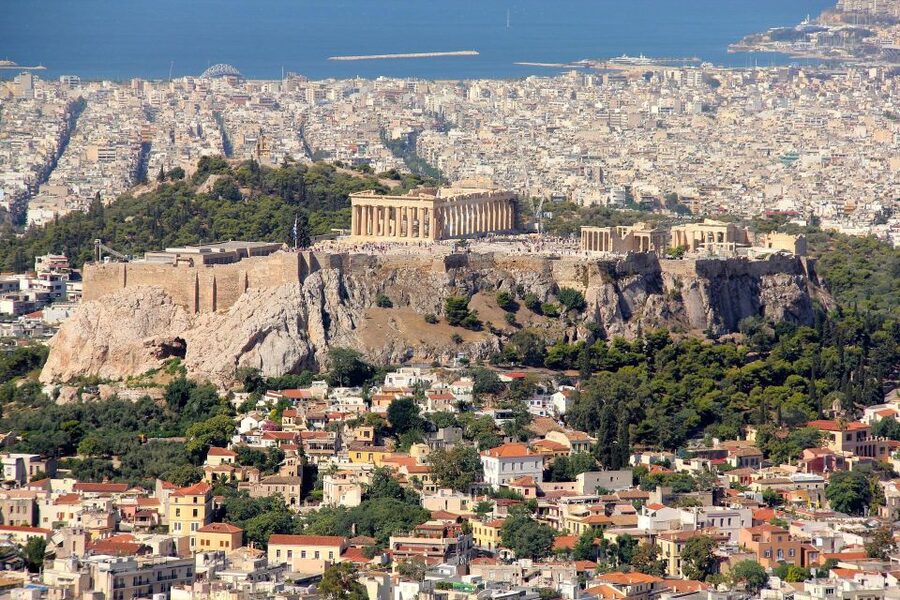
The Acropolis is not simply a hill with one famous temple on top. It is a rocky citadel filled with monuments from different periods, each tied to a different part of ancient Athenian life. Without context, you can admire the columns and marble but miss why the site mattered.
A guide helps you make sense of the remains in real time. You’ll hear about Athena, the goddess who protected Athens, and the myths connected to the buildings and sacred ground. You’ll also learn how the site related to religious festivals, public theater, and the long story of the Greek capital.
I find this especially useful at the Acropolis because several monuments are partly ruined or rebuilt. A guide can point out what you are looking at, explain the role of each structure, and give you a sense of how the citadel functioned in ancient times.
This tour is conducted in Spanish. That makes it a practical choice if you understand Spanish more comfortably than English. The guide’s storytelling is a central part of the experience. Juan, one guide associated with the tour, is praised for combining historical facts with anecdotes, which helps keep the two-hour walk lively even when the site is hot or crowded.
More Walking Tours in Athens
- Athens: Acropolis and Parthenon Guided Walking Tour
★ 4.6 · 5,882 reviews - Greek Food Walking Tour in Athens
★ 5.0 · 4,740 reviews - Acropolis: Acropolis and Parthenon Guided Walking Tour
★ 4.7 · 3,442 reviews
Meeting your guide near Acropolis Metro station
The meeting point is at street level by the entrance to Acropolis Metro station. You should arrive between 10 and 5 minutes before the scheduled start, with your admission ticket already arranged if possible.
This location is easy to identify, but the ticket detail deserves care. The meeting point and the South Entrance ticket office are separate places, although the walk between them takes less than two minutes. If you buy your ticket at the ticket office instead of online, you are asked to arrive in that area around 30 minutes before the tour begins. That allows time to wait in line, collect the ticket, and then walk to the guide.
I would buy the ticket online before the day of the tour. That removes one queue and reduces the risk of arriving late. If no ticket availability appears, the operator says it will help you, but you should still treat the ticket as your responsibility when planning.
Your guide will take attendance and lead the group toward the Acropolis. Hotel pickup and drop-off are not included, so you need to make your own way to the metro station and back afterward. The tour ends at the same meeting point.
The Theater of Dionysus begins the ancient story
The Theater of Dionysus is one of the first major sights connected with the visit. It could hold about 17,000 spectators and hosted festivals honoring Dionysus, the Greek god associated with theater and celebration.
This stop gives the tour a welcome change of scale. The Parthenon is the monument most people picture when they think of the Acropolis, but the theater shows how public performance formed part of religious and civic life. Instead of looking only at temples, you begin to see the Acropolis as a place used by a whole city.
Your guide explains the myths behind the ruins and connects the theater to ancient festivals. That kind of narration matters here because the remaining stone seating and structure can be hard to read without help.
The site involves walking over ancient, uneven ground. You should expect a proper walking tour rather than a smooth museum visit. Sturdy footwear and water are sensible choices, particularly during the warmer months. The tour is only two hours, but the heat and crowds can make the route feel more demanding.
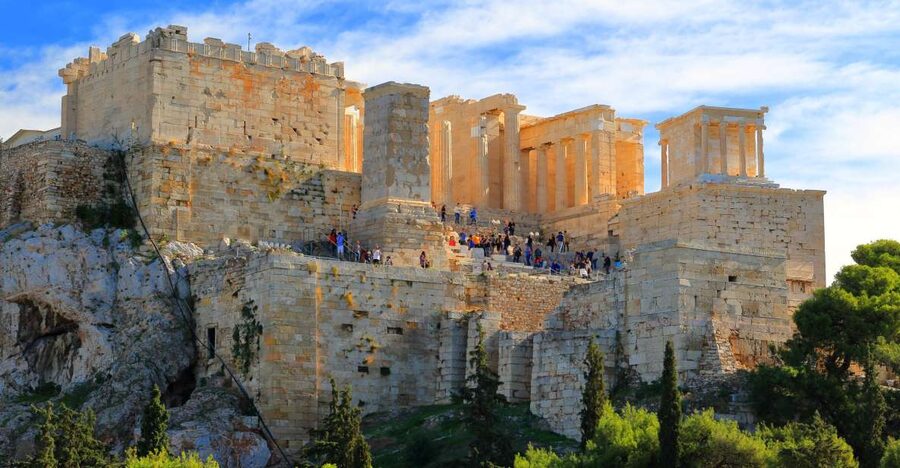
Entering through the Propylaea
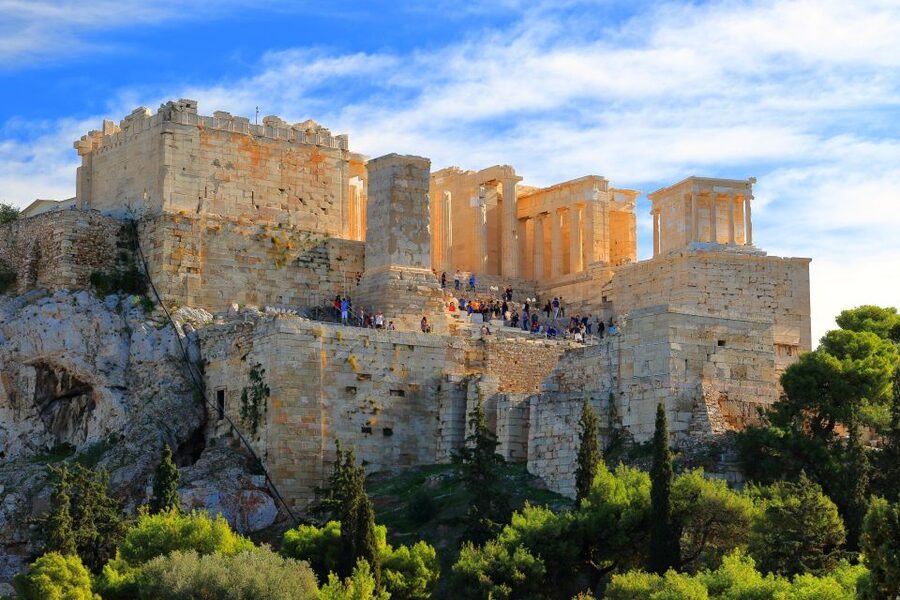
The Propylaea is the monumental gateway into the Acropolis. Passing through it gives the tour a strong sense of arrival, since this was designed as an impressive entrance to the sacred citadel.
Your guide explains how the gateway frames the approach to the monuments above. The walk from the entrance toward the central ruins is not just a route between stops. It helps you understand that the Acropolis was planned as a ceremonial place, with visitors moving from the lower approach into a more important religious setting.
This is one of the points where a small group is useful. The Propylaea can be busy, and it is easy to lose sight of a guide in a large crowd. A smaller party makes it easier to stay together and ask a quick question while the group pauses.
A few other Athens mornings to price up
- Athens: Acropolis & up to 5 Archaeological Sites Combo Pass
★ 4.4 · 12,619 reviews - Athens: Acropolis Ticket with Optional Audio or Live Guide
★ 4.2 · 11,055 reviews - Athens: Acropolis, Parthenon & Acropolis Museum Guided Tour
★ 4.8 · 9,316 reviews - Athens: Acropolis, Parthenon & Acropolis Museum Guided Tour
★ 4.8 · 3,579 reviews
The Parthenon and the worship of Athena
The Parthenon is the visual center of the visit. Dedicated to Athena, protector of Athens, it represents the religious importance and public pride of the city.
You’ll have time to look at the temple while your Spanish-speaking guide explains its role and the myths tied to Athena. The tour does not treat the building as an isolated photo stop. Instead, it places the Parthenon within the wider Acropolis, alongside the gateway, smaller temples, sacred spaces, theaters, and sculptural details.
The Parthenon is also the busiest part of the experience, so patience helps. Your view may change as groups move through the area. A guide cannot remove the crowds, but can help you focus on the features that matter and make better use of the limited time.
If you want long, quiet time with the Parthenon, two hours may feel short. The benefit is that you get a clear route through the major parts of the site, then free time afterward to continue exploring on your own.
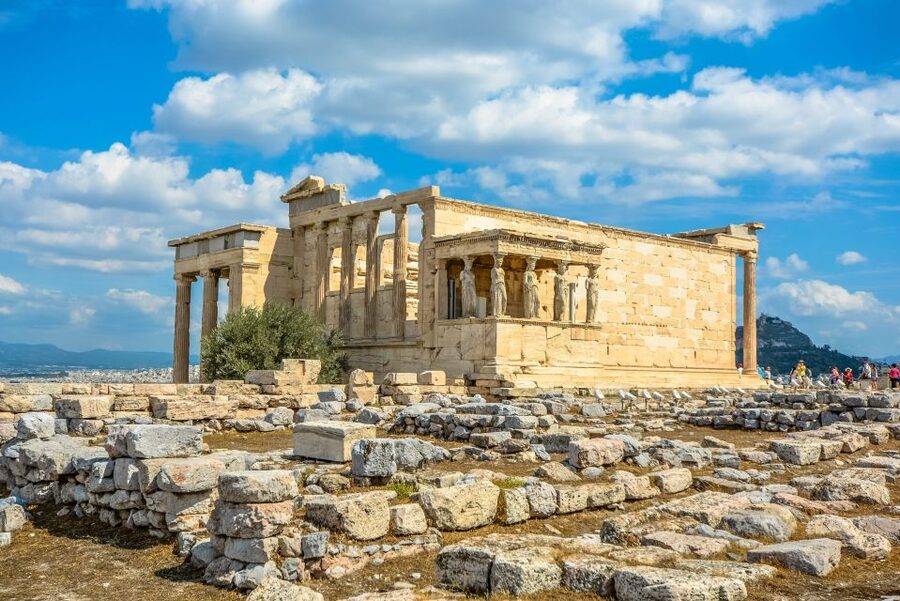
The Erechtheion and its famous Caryatides
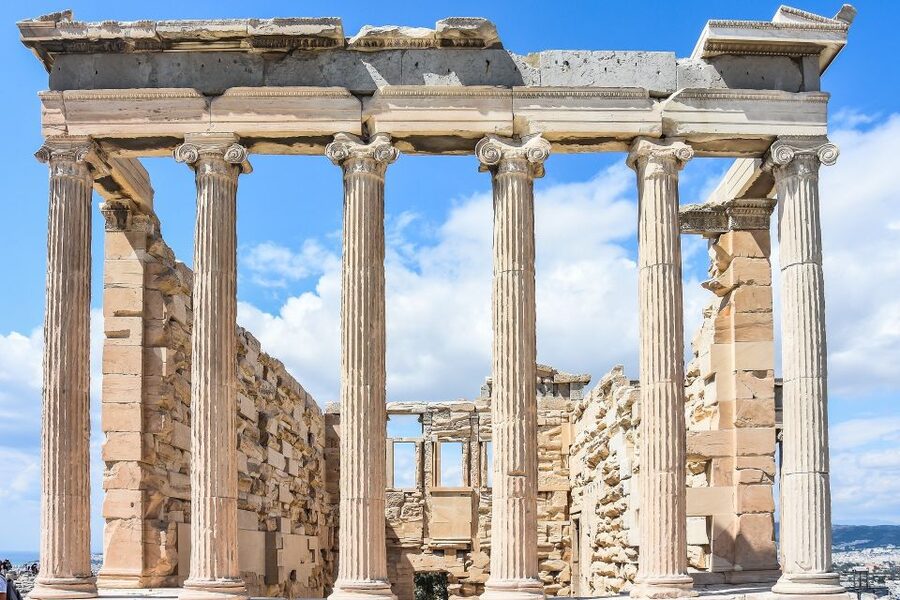
The Erechtheion is named after Erechtheus, a demi-god from Greek tradition. Its unusual form and multiple sacred associations make it a useful contrast to the more regular shape of the Parthenon.
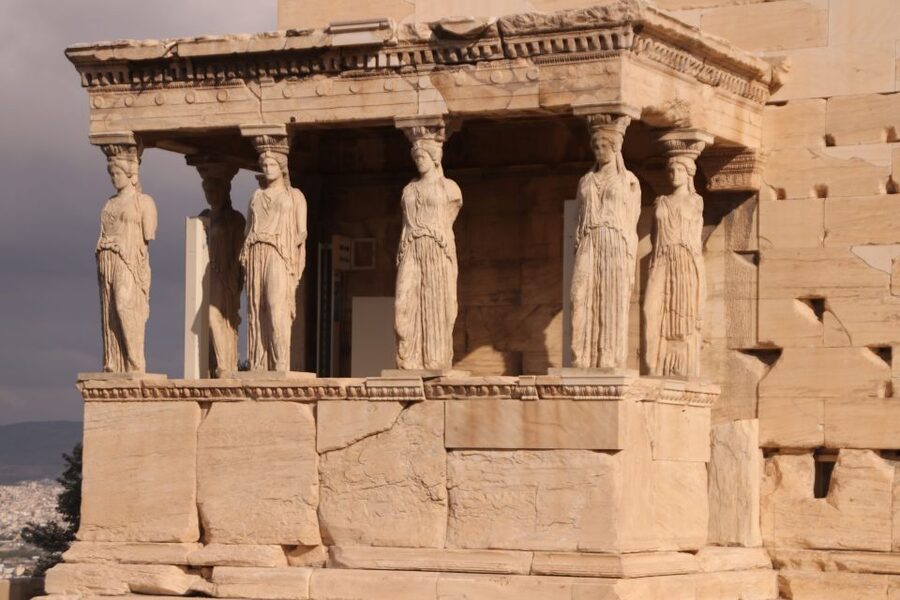
The Caryatides are the carved female figures that support part of the building. They are among the most memorable details on the Acropolis, and your guide will point them out while explaining their place in the monument.
This is exactly the sort of stop where guided commentary earns its keep. You can easily recognize the figures, but the story behind them adds meaning to what you are seeing. The guide also helps you distinguish the Erechtheion from the other temples nearby, so the upper Acropolis does not blur into one collection of marble fragments.
Expect people to gather around this area for photographs. You may need to wait briefly for a clear view, and you should stay close to the group as the guide moves between monuments.
The small Temple of Athena Nike
The Temple of Athena Nike is described as the smallest temple on the tour. Its size makes it easy to overlook beside the larger buildings, but its dedication to Athena Nike gives it a clear place in the religious story of the Acropolis.
The guide uses this stop to explain another aspect of Athena, connected with victory. That helps you see how the ancient Athenians honored different roles and qualities through separate buildings and rituals.
I like having this included because it adds variety to the route. You see a monumental gateway, a giant temple, an unusual sanctuary, and a smaller temple with its own purpose. The sequence makes the Acropolis feel less like one famous ruin and more like a working sacred center.
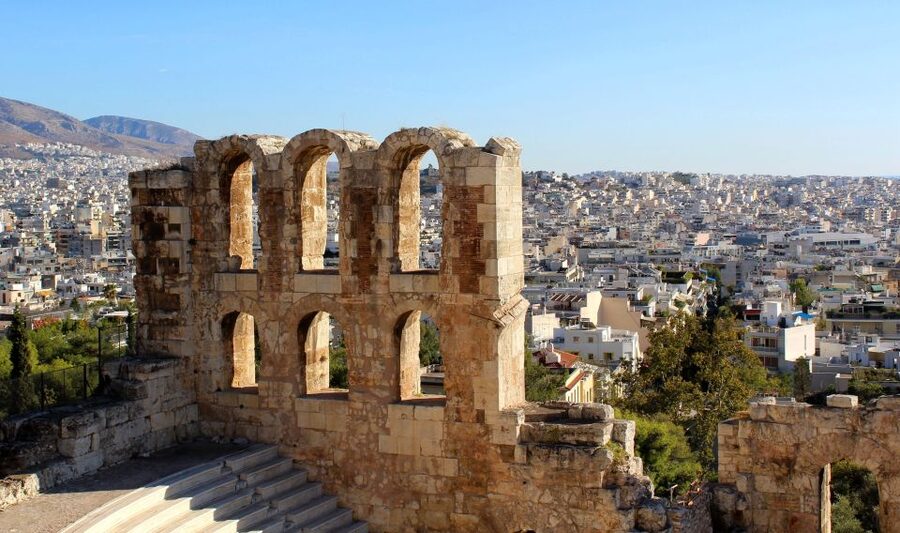
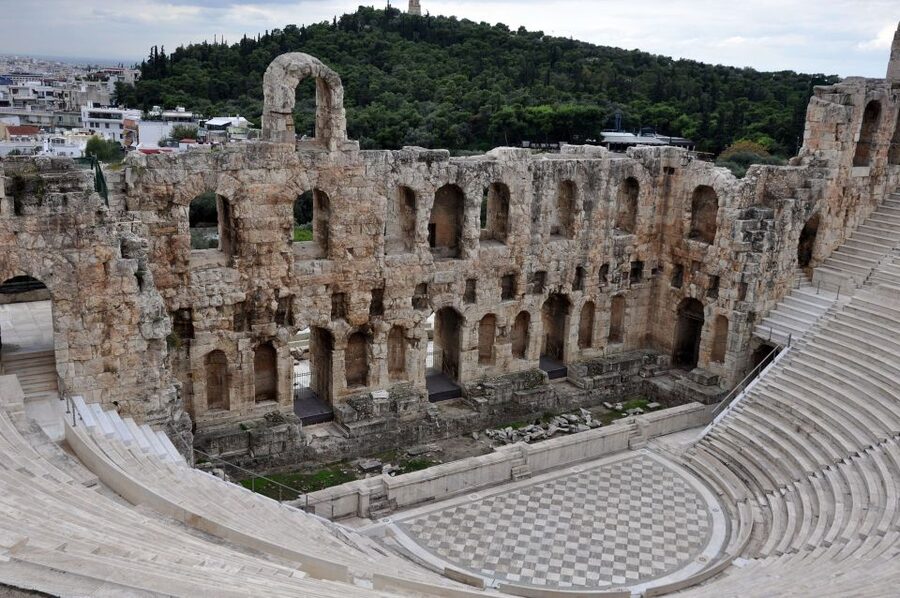
The Odeon of Herodes Atticus
The Odeon of Herodes Atticus is a large stone theater located on the Acropolis site. Its scale is striking, especially after the smaller Temple of Athena Nike and the more enclosed spaces around the upper citadel.
Your guide explains the theater and its place among the monuments. The stop also gives you another chance to consider how performance and public events shaped the ancient city.
The Odeon is a good reminder that the Acropolis experience is not limited to the Parthenon. You’ll see temples, gateways, carved figures, and theaters in one compact archaeological area. That range is one of the tour’s strongest features.
Mythology that makes the stones easier to read
The tour places real emphasis on Greek mythology. You’ll hear stories connected with Athena and other ancient figures while walking through the site, including the traditions linked with the Theater of Dionysus and Erechtheion.
For me, mythology is most useful when it explains why a building exists. The stories are not just colorful extras. They show how religion, civic identity, festivals, and political life were tied together in ancient Athens.
The guide also discusses the long history of Athens, giving you a sense of how the ancient citadel relates to the modern capital below. You do not need a background in classical Greece to follow the visit. The format is designed around explanations at the monuments themselves, with the chance to ask questions as you go.
The information will be delivered in Spanish, so you should choose this tour only if that is the right language for you. The live guide format is a better fit than an audio guide if you want to ask about a particular carving, story, or building while standing in front of it.
What the $32.75 price actually buys you
At $32.75 per person, the cost covers a two-hour guided visit and a licensed guide. You are paying for interpretation, organization, and a planned route through a major archaeological site.
You are not paying for Acropolis admission. That extra cost needs to be added to your budget, and the ticket must match the tour time closely. The required time slot changes by season:
- From November 1 through March 31, the 9:15 tour requires a ticket for 9:00 to 10:00, while the 2:30 tour requires a ticket for 2:00 to 3:00.
- From April 1 through October 31, the 8:15 tour requires a ticket for 8:00 to 9:00, while the 5:00 tour requires a ticket for 5:00 to 6:00.
Check availability for the actual starting time before buying the ticket. If your admission time does not line up, the smooth two-hour plan can quickly become a queue problem.
The value is strongest if you want context and a structured route. If you already know the Acropolis well and prefer to wander alone, the extra guide fee may not suit you. If this is your first visit, the explanation of the myths, theaters, temples, and carved figures can make the admission cost feel more worthwhile.
Small groups, heat, and the pace of the walk
A small group gives you a more personal setting and makes questions easier. That matters at a site where the guide may need to explain a detail while other groups pass nearby.
You should still prepare for crowds and heat. The experience takes place outdoors on an ancient rocky site, and the route includes walking between several monuments. One guide’s tour was described as enjoyable despite the heat and the number of people, but that is a reminder to plan sensibly rather than expect an empty hilltop.
Bring water and allow time to move carefully. The tour operator does not allow baby strollers, non-folding wheelchairs, or electric wheelchairs. Those restrictions make the tour unsuitable for some visitors, so check your needs before booking.
After the guided portion, you can stay longer and explore the Acropolis at your own pace. This is a useful feature. The guide gives you the framework, while the free time lets you return to a favorite monument, take more photographs, or look around without keeping up with the group.
Who should book this Acropolis walk
I would choose this tour if you want a clear introduction to the Acropolis and prefer learning through a live Spanish-speaking guide. It suits first-time visitors, couples, families with older children, and anyone who wants mythology and historical explanation woven into the walk.
It also suits you if you like a focused visit but do not want to leave immediately after the guide finishes. The combination of a two-hour route and free time gives you structure without taking away the rest of your visit.
I would hesitate if you need step-free access, plan to bring a baby stroller, or cannot manage uneven walking surfaces. I would also reconsider if you want an English-language guide, since the stated tour language is Spanish.
The rating is 4.7 from 191 reviews, and the praise centers on the guide’s detailed history, clear anecdotes, and ability to keep the visit engaging. Juan is singled out by name in the available feedback, while the tour itself is operated by Secrets of Greece IKE.
Should you book the Acropolis guided walking tour?
Book it if you want the Parthenon and its neighboring monuments explained in Spanish, with the Theater of Dionysus, Caryatides, Erechtheion, Propylaea, Athena Nike, and Odeon of Herodes Atticus included in one route.
The deciding factor is the separate admission ticket. Buy that first, match the correct seasonal time slot, and arrive early if you need to use the South Entrance ticket office. With that detail handled, the $32.75 guide fee offers solid value for a small-group visit that gives the ancient stones a human story.
FAQ
Is the Acropolis entry ticket included?
No. The $32.75 price includes the guided Acropolis tour and licensed guide, but you must purchase the Acropolis entry ticket separately.
Where does the tour start?
Meet your guide at street level by the entrance to Acropolis Metro station.
Where does the tour end?
The activity ends back at the Acropolis Metro station meeting point.
How early should I arrive?
You should arrive between 10 and 5 minutes before the tour begins. If you plan to buy your ticket at the South Entrance ticket office, arrive there around 30 minutes before the tour so you have time for the queue.
What language is the tour conducted in?
The live tour guide is Spanish-speaking.
How long does the tour last?
The guided walking tour lasts two hours. Afterward, you can remain at the Acropolis and explore independently.
What sights are included?
The route includes the Acropolis, Parthenon, Propylaea, Theater of Dionysus, Erechtheion, Caryatides, Temple of Athena Nike, and Odeon of Herodes Atticus.
Are strollers and wheelchairs allowed?
Baby strollers, non-folding wheelchairs, and electric wheelchairs are not allowed on this activity.
Fresh on the Athens list
- Athens Airport Arrival Transfer to Hotels or Addresses in Athens★ 3.5 · 45 reviews
- Private Luxury Tour: Unveiling the Sacred Mysteries of Eleusis★ 5.0 · 45 reviews
- Luxury Catamaran Sunset Semi-Private & Greek Gastronomy in Athens★ 5.0 · 45 reviews
- From Athens: Aegina Island guided tour in a day★ 5.0 · 45 reviews
- Delphi, Thermopylae full day private tour from Athens★ 4.9 · 46 reviews
- From Athens: City & Corinth Guided Day Tour★ 4.8 · 46 reviews
- Acropolis Private Wine Tasting @ Finewine store★ 5.0 · 46 reviews
- Ancient Corinth Half-Day Private Tour from Athens★ 5.0 · 46 reviews
Acropolis & Acropolis Museum Tours, compared.

Acropolis & up to 5 Archaeological Sites Combo Pass
Read our review →

Acropolis, Parthenon & Acropolis Museum Guided Tour
Read our review →
Acropolis, Parthenon & Acropolis Museum Guided Tour
Read our review →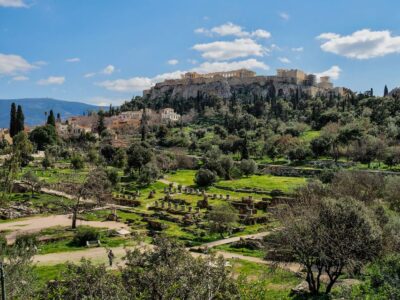

Acropolis monuments & Parthenon Walking Tour with Optional Acropolis Museum
Read our review →
Athens All Included: Acropolis and Museum Guided Tour with Ticket
Read our review →Browse the lists this tour appears in