
Reviewed · ACROPOLIS & ACROPOLIS MUSEUM TOURS
Athens: Ancient Agora E-Ticket and Audio Tour
The Ancient Agora is where Athens gets practical. This was not just a field of broken columns, but the working center of early democracy, where citizens met, argued, made laws, and tried to protect their new political system. This self-guided audio tour gives those ruins a human voice, from Solon’s reforms to the lives of Pericles, Aristides the Just, and Socrates.
I like the offline map and commentary, since you can listen without using mobile data inside the archaeological site. I also like the freedom to pause for photos, linger in the museum, or move on when you are ready. The main drawback is navigation: the directions can be vague on parallel paths, and a live guide is not there to sort out confusion.
Key points
- Follow democracy from Solon to the popular assembly: The audio explains how Athens built its early civil society and political institutions.
- See the Temple of Hephaestus and the old Bouleuterion: These are among the most important sights inside the Agora.
- Spend time in the Agora Museum: Its displays explain daily life, law, public duty, and the harsh tools used to defend democracy.
- Look across Athens from the Pnyx and Rock of Ares: These hills offer memorable views toward the Acropolis.
- Connect Socrates with the wider city: The route includes the prison traditionally associated with him and ends near the Theatre of Dionysus.
- Prepare your phone before arrival: Download the separate ticket and audio tour in advance, because there is no internet access inside the site.
Why the Ancient Agora matters more than a pile of ruins
The Acropolis gives you Athens at its grandest. The Agora gives you Athens at work.
This broad archaeological site was the center of civic, commercial, religious, and social life in classical Athens. The audio tour helps you see beyond scattered stones. It explains how the city moved from rule by a small group of powerful families toward a system in which male citizens took part in public decisions.
That political change did not happen overnight. The route begins with Solon, whose legal reforms helped prepare the ground for Athenian democracy. You then hear how institutions developed, how citizens took part, and how the city tried to prevent one person or faction from taking too much power.
I find this approach useful because the Agora can feel confusing without context. You may see a wall, a foundation, or a row of stones and have no idea what happened there. Once you understand that laws were proposed, debated, and voted on nearby, the site feels less like an open-air ruin field and more like a place where arguments shaped the ancient world.
The tour is designed for about 90 minutes to two hours. That is enough time for the main route, though you should allow more if you want to study museum objects, take photographs, or stop often.
A few other Athens mornings to price up
- Athens: Acropolis & up to 5 Archaeological Sites Combo Pass
★ 4.4 · 12,619 reviews - Athens: Acropolis Ticket with Optional Audio or Live Guide
★ 4.2 · 11,055 reviews - Athens: Acropolis, Parthenon & Acropolis Museum Guided Tour
★ 4.8 · 9,316 reviews
Entering with the e-ticket
The practical appeal is simple: you receive an adult Ancient Agora ticket in advance, along with instructions for using the audio tour on your phone. At the entrance, you use the actual e-ticket, either printed or downloaded to your device.
Do not rely on the booking voucher alone. The entrance staff needs the separate ticket sent by the local partner. Check your spam folder if that email does not appear quickly, then download everything before you arrive.
The ticket process is intended to make entry quick, but you still need to follow the site’s validation procedure. Tickets must be printed or shown on your phone at the validating machines. EU students and minors who qualify for free admission need to queue for a zero-value pass with identification. Non-EU students and people over 65 who qualify for reduced admission must also go to the ticket office.
The $30 price is reasonable if you want both admission and structured interpretation without joining a scheduled group. It is less attractive if you already plan to buy a broader Athens archaeological ticket or qualify for free or reduced admission. In that case, check the numbers before booking, since this activity is non-refundable.
The Temple of Hephaestus and the first lessons in democracy
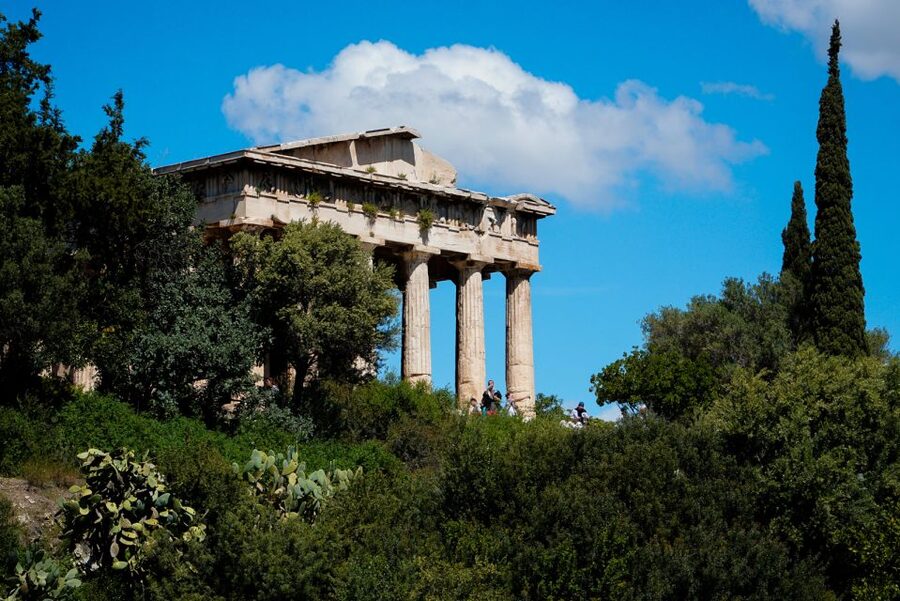
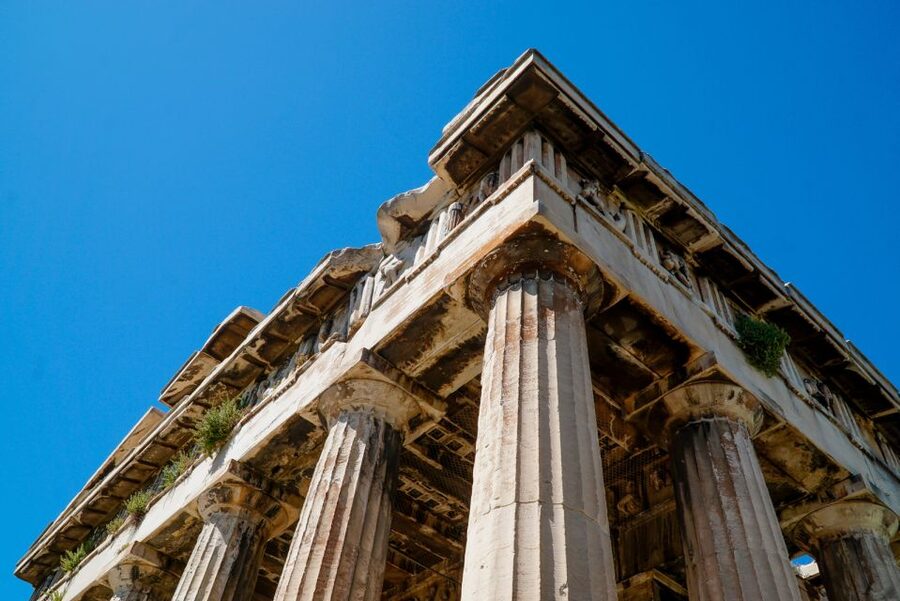
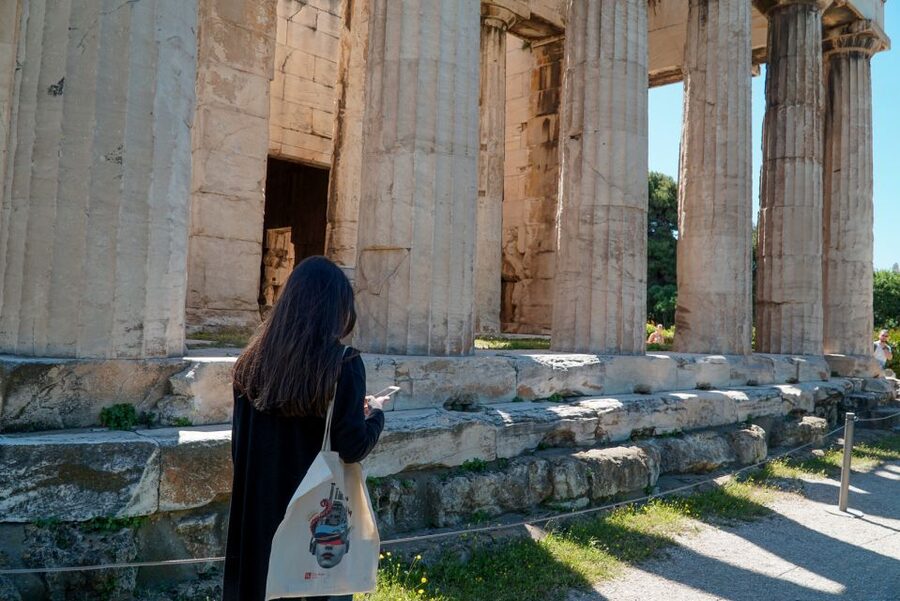
The route begins near the Temple of Hephaestus, one of the most complete ancient temples in Athens. The audio uses this setting to introduce the chain of political changes that made democracy possible.
You will hear about Solon and the legal reforms that helped form an early civil society. The value here is not simply knowing a name and date. The commentary explains that democracy grew from arguments about law, citizenship, power, and responsibility.
The temple itself is a strong opening point. It gives you an immediate landmark, and its position on the hill lets you understand how the Agora was arranged below. Take a moment to look at the surrounding foundations before moving on. The audio is best used as a guide to the ground under your feet, not as something to play while rushing from one stop to the next.
You will need comfortable shoes. Paths across an archaeological site can be uneven, and the route also includes hills beyond the Agora. Warm weather can make the walk tiring, so an early morning or late afternoon visit is a sensible choice. The museum offers an air-conditioned break during hot days.
The Tholos and the Bouleuterion
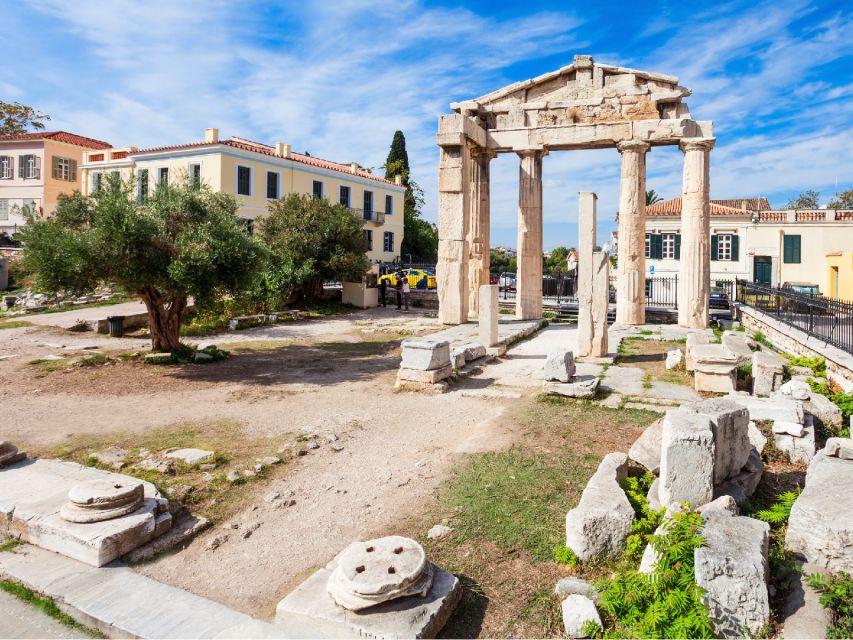
Near the Tholos, the audio introduces the Bouleuterion, where a council of 500 Athenians met to prepare laws and proposals for the popular assembly. Much of the structure is now ruined, so this is one of the places where the narration does important work.
The council was not the same thing as the full citizen assembly. Its role was to prepare business and help manage the city’s daily affairs. That distinction helps you understand that Athenian democracy had procedures, offices, and layers of decision-making, not simply a crowd voting on everything at once.
The physical remains may not impress you in the same way as the Temple of Hephaestus. That is normal. The Bouleuterion rewards attention to the audio rather than quick photographs. Look for the foundations and listen for the explanation of how the council functioned.
The route also brings ancient personalities into the story. Aristides the Just and Pericles appear through anecdotes that make the political system easier to picture. The tone is designed to be lively, and the commentary moves beyond a dry list of dates.
Same island, an entirely different sort of day:
- Athens: Cape Sounion & Poseidon Temple Sunset Half-Day Trip
★ 4.8 · 8,241 reviews - Athens: Acropolis and Parthenon Guided Walking Tour
★ 4.6 · 5,882 reviews - All Day Cruise -3 Islands to Agistri,Moni, Aegina with lunch and drinks included
★ 5.0 · 4,958 reviews - Athens, Piraeus, and Coastline: Blue Hop-On Hop-Off Bus
★ 3.9 · 4,849 reviews
The Agora Museum and its second-floor view

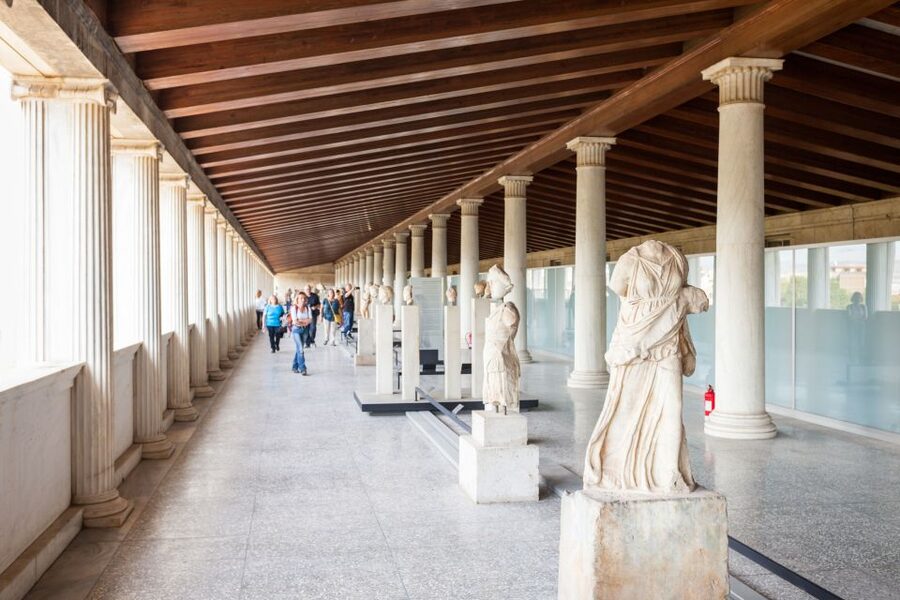
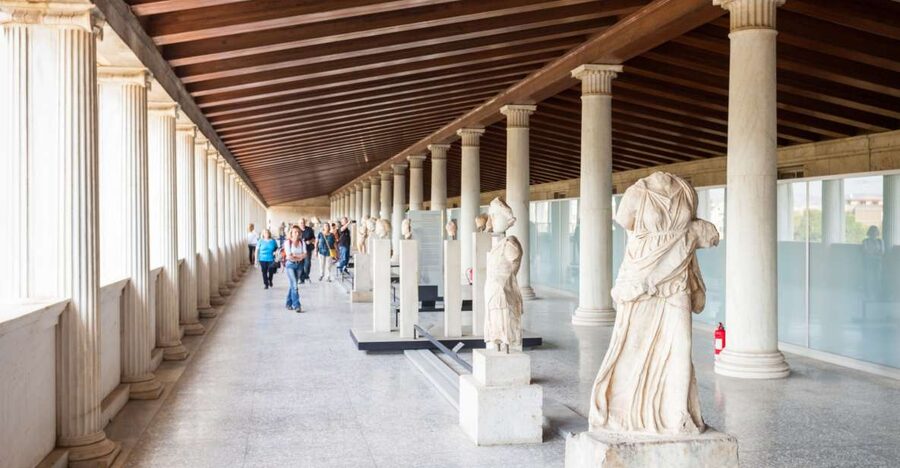
The Museum of the Ancient Agora is housed in the reconstructed Stoa of Attalos. It is one of the best places to pause because it brings together objects connected with public life, law, trade, religion, and ordinary people.
The displays also explain the less flattering side of Athenian democracy. The city developed ways to defend itself against people seen as dangerous to the political order. Some of the objects reveal how ingenious, and at times cruel, those methods could be.
Do not skip the upper level. From the second floor, you can get a different view over the Panathenaic Way, a perspective that is easy to miss if you simply follow the ground-level route. This is also a good place to slow down and let the museum information settle before continuing.
The museum is especially valuable for people who want more than monumental architecture. It gives you small objects and civic details that help explain how the Agora functioned. On a hot day, the air conditioning is a practical bonus, not a minor detail.
Pnyx, Mars Hill, and the best views toward the Acropolis
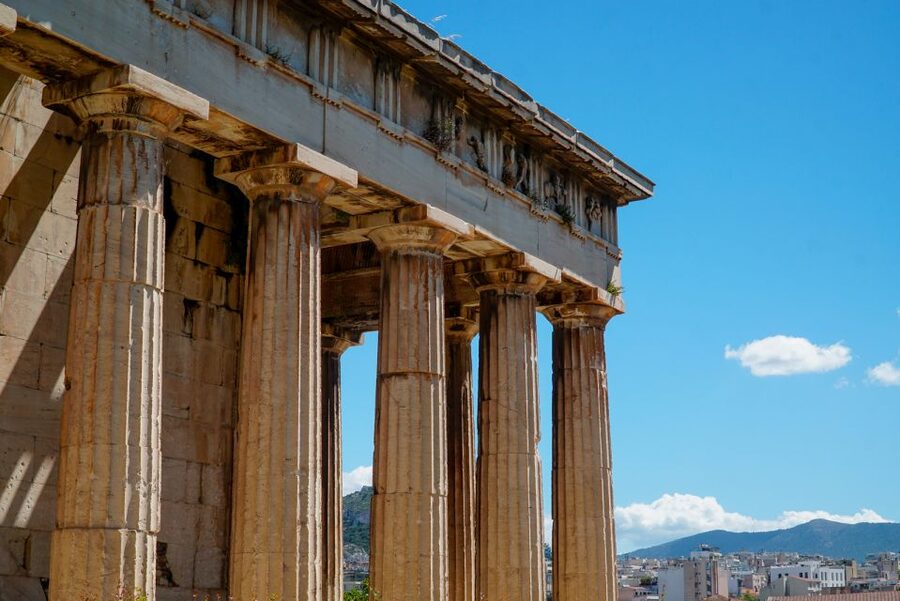
The experience extends beyond the central Agora toward several nearby historic points. The Pnyx was linked with the popular assembly, making it a fitting place to think about citizens gathering to hear speeches and vote on public matters.
The hill provides the sort of view that makes Athens’ ancient geography click. You can look toward the Acropolis and see how close the major political and religious centers were to one another. The Rock of Ares, also known as Mars Hill, offers another picture-postcard view.
These stops add a physical sense of place to the political story. You are not only hearing about citizens and assemblies, but looking across the same central part of Athens that framed their public life.
There is a catch. The walking directions are not always as clear as they could be. Several paths run close together, and site markers may not make the next stop obvious. If you are comfortable with maps, the offline interactive map should be enough. If you prefer constant direction from a person, a live guide would be easier.
The audio can also stop if you zoom in to take a photograph, depending on how you use the app. You may need to restart the recording after taking pictures. That is a small nuisance, but it is worth knowing before you begin.
The prison of Socrates and the route’s philosophical finish
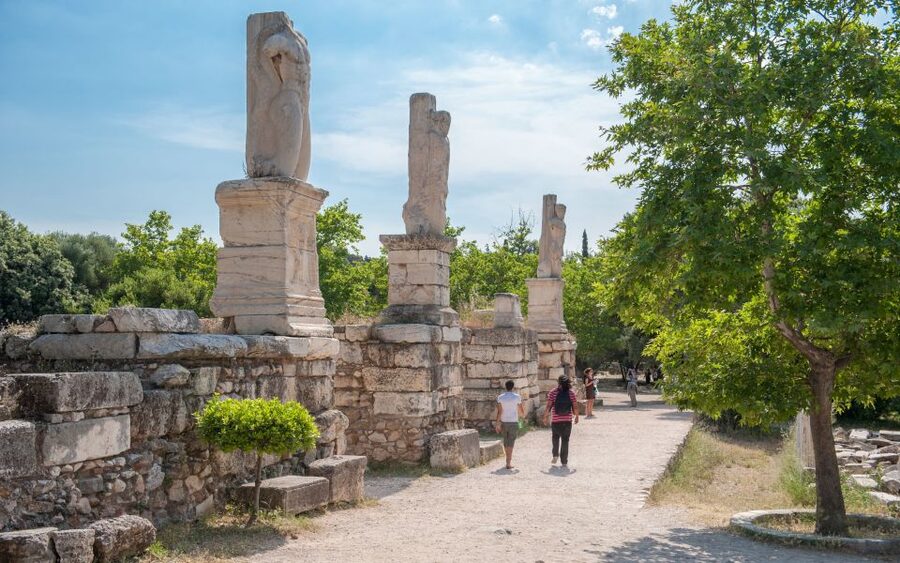
The route continues up Philopappos Hill to the prison traditionally associated with Socrates. The site connects the political story with one of Athens’ most famous thinkers.
Socrates’ life and death raise questions about citizenship, law, free speech, and the limits of public authority. The audio uses the location to add human weight to the broader story of democracy. It is one thing to hear about institutions. It is another to consider what happened when a prominent philosopher came into conflict with the city.
The prison is not a grand monument. You may find the site modest, and the historical identification is part of the tradition surrounding it. Its importance comes from the story attached to the place and from the way it connects with the wider route.
One particularly memorable thread involves Samuel the Cobbler and his relationship with Socrates. The story gives the philosophical material a more ordinary setting and helps break up the formal discussion of laws and famous statesmen.
This section includes uphill walking, so it may not suit anyone who needs a fully accessible route. Some points of interest are not wheelchair accessible, and the experience is listed as unsuitable for wheelchair users.
Finishing near the Theatre of Dionysus
The tour ends near the Acropolis archaeological site, in front of the Theatre of Dionysus. That is a smart finish because it shifts the story from civic debate to drama and public performance.
The theatre is associated with the tragedies of Aeschylus, Sophocles, and Euripides. You can picture ancient audiences watching plays that explored justice, pride, family duty, war, and the behavior of leaders. These performances were not simply entertainment. They were part of the city’s public culture.
Ending here also makes the activity easy to pair with other central Athens sights. The route does not include hotel pickup, transportation, food, or a live guide, so plan your day around the archaeological sites rather than expecting a full guided excursion.
If you are combining this visit with the Acropolis, check your ticket arrangements carefully. A broader combination ticket may make more financial sense for your schedule, but that depends on the admission products available for your dates and eligibility.
Using the audio tour without frustration
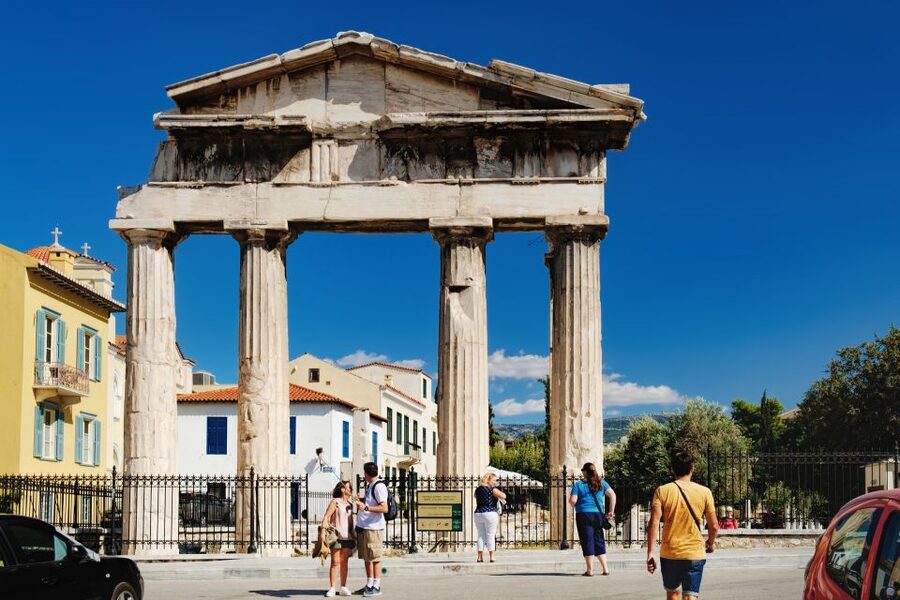
The audio guide is available in English, Italian, Greek, German, Spanish, and French. You use your own Android or iOS smartphone and headphones, so bring both a charged phone and a pair of headphones you know work.
Download the audio files and offline map before arriving. There is no internet access inside the archaeological site, and waiting until the entrance can leave you stuck without the commentary.
The app is not compatible with Windows phones, iPhone 5 or 5C and older models, older iPod Touch and iPad models, or the first iPad Mini. If you are unsure about your device, check it before purchasing.
The format suits independent visitors. You can pause, repeat sections, and take your time at the Temple of Hephaestus or museum. It also lets you avoid the fixed pace of a group.
The trade-off is that no one is there to answer a question or redirect you when a path becomes unclear. The audio gives useful information, but the route instructions could be more precise. Keep the map open, watch for site signs, and do not assume the next stop is obvious.
Who will get the most from this $30 visit
I would choose this experience if you want a clear story but do not want to join a live group. It works particularly well for first-time visitors who might otherwise walk through the Agora, admire the temple, and miss the political meaning of the foundations around it.
It is also a good choice for independent couples, families with older children, and visitors who like to stop for photographs. The relaxed pace lets you control the visit, and the museum gives you a change of setting during a long day of sightseeing.
History-minded visitors should appreciate the range. The route covers Solon, the Bouleuterion, the council of 500, Aristides, Pericles, democratic safeguards, Socrates, the Pnyx, and the Theatre of Dionysus. That is a lot of context for a visit lasting roughly two hours.
I would think twice if you need step-free access, dislike smartphone tours, or want exact turn-by-turn direction. You also need to bring your own device and headphones, and the separate ticket email is essential.
Large luggage and large bags are not allowed. Carry only what you need for the walk, especially in hot weather.
Should you book the Ancient Agora audio tour?
Book it if you want independent sightseeing with a strong historical thread. The audio commentary is the main reason to pay beyond a basic admission ticket, and it turns the Agora from a collection of ruins into a story about how people tried to build and defend democracy.
The best parts are the Temple of Hephaestus, the Bouleuterion explanation, the Agora Museum, the second-floor view of the Panathenaic Way, and the outlooks from the Pnyx and Rock of Ares. The Socrates section adds a thoughtful finish before the route reaches the Theatre of Dionysus.
Skip it if you already have a qualified guide, need wheelchair access, or want a perfectly marked route with no app handling. For everyone else, prepare the downloads in advance, visit outside the hottest part of the day, and allow time to pause. At $30, it is a fair self-guided option when you value context, flexibility, and the chance to explore at your own speed.
FAQ
How long does the Ancient Agora audio tour take?
The activity is designed to last about 90 minutes to two hours. You may need longer if you spend extra time in the museum, take photographs, or pause often.
Is a live guide included?
No. This is a self-guided audio tour for your smartphone. A live guide, hotel pickup, and hotel drop-off are not included.
What languages are available for the audio guide?
The audio guide is available in English, Italian, Greek, German, Spanish, and French.
Do I need internet access inside the Ancient Agora?
No internet access is available inside the archaeological site. Download the e-ticket, audio tour, and offline map before your visit.
Can I use the booking voucher at the entrance?
No. You need the separate e-ticket sent by the local partner. Download it to your phone or print it, since the booking voucher alone is not accepted at the entrance.
What should I bring?
Bring comfortable shoes, a charged Android or iOS smartphone, and headphones. Large bags and luggage are not allowed.
Is the activity suitable for wheelchair users?
No. Some points of interest are not wheelchair accessible, and the activity is listed as unsuitable for wheelchair users.
Can EU students and minors enter for free?
EU students and eligible minors can enter for free with an ID card or passport, but they must queue to receive a zero-value pass. Non-EU students and people over 65 may qualify for reduced tickets but must queue at the ticket office.
More Audio Tours in Athens
- Athens: National Archaeological Museum Ticket & Audio Guide
★ 4.3 · 1,330 reviews - Athens: Acropolis Ticket with Multilingual Audio Guide
★ 3.9 · 926 reviews - Athens: Acropolis Museum Ticket with Audio Guide
★ 4.1 · 835 reviews - Athens: National Archaeological Museum Ticket w/ Opt. Audio
★ 4.4 · 713 reviews
More Self-Guided Tours in Athens
- Athens: Cape Sounio & Poseidon Temple Trip with Audio Guide
★ 4.4 · 4,521 reviews - From Athens: Delphi Full Day V.R. Audio Guided Tour
★ 4.6 · 3,028 reviews - Parthenon & Acropolis Museum with Audio or Live Tour Option
★ 4.1 · 2,446 reviews - Athens: Peloponnese Highlights Day Trip and V.R. Audio Guide
★ 4.5 · 1,425 reviews
Fresh on the Athens list
- Athens Airport Arrival Transfer to Hotels or Addresses in Athens★ 3.5 · 45 reviews
- Private Luxury Tour: Unveiling the Sacred Mysteries of Eleusis★ 5.0 · 45 reviews
- Luxury Catamaran Sunset Semi-Private & Greek Gastronomy in Athens★ 5.0 · 45 reviews
- From Athens: Aegina Island guided tour in a day★ 5.0 · 45 reviews
- Delphi, Thermopylae full day private tour from Athens★ 4.9 · 46 reviews
- From Athens: City & Corinth Guided Day Tour★ 4.8 · 46 reviews
- Acropolis Private Wine Tasting @ Finewine store★ 5.0 · 46 reviews
- Ancient Corinth Half-Day Private Tour from Athens★ 5.0 · 46 reviews
Acropolis & Acropolis Museum Tours, compared.
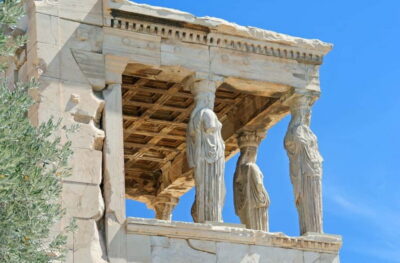
Acropolis & up to 5 Archaeological Sites Combo Pass
Read our review →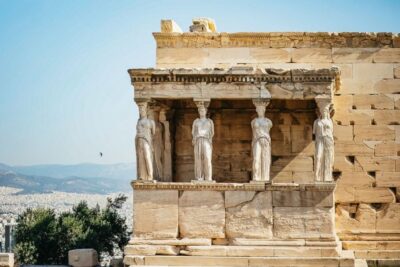
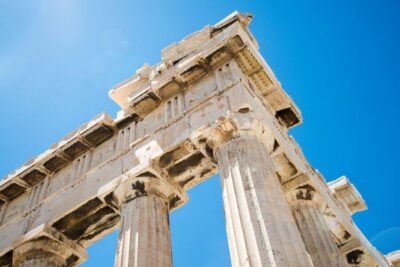
Acropolis, Parthenon & Acropolis Museum Guided Tour
Read our review →
Acropolis, Parthenon & Acropolis Museum Guided Tour
Read our review →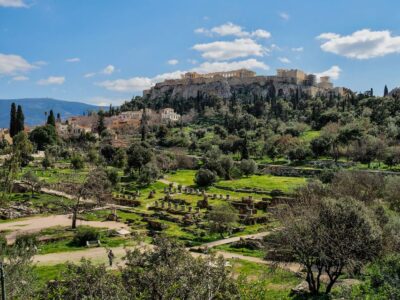

Acropolis monuments & Parthenon Walking Tour with Optional Acropolis Museum
Read our review →
Athens All Included: Acropolis and Museum Guided Tour with Ticket
Read our review →Browse the lists this tour appears in