
Reviewed · ATHENS TOURS
Biblical Tour Letters to The Corinthians – St Paul’s Footsteps
The most meaningful part of this private Athens to Corinth tour is the chance to connect New Testament passages with real places. You can stand on Areopagus Hill, where Paul addressed the Athenians, then walk around Ancient Corinth, where he preached for about 18 months and faced the Roman authorities at the Bema.
I like the private vehicle and flexible schedule, especially if you have already seen the Acropolis or want extra time at Corinth. I also like the range of stops: this is not just a quick look at the canal and Roman ruins. It reaches Isthmia, Cenchreae, a church dedicated to Paul, and the hilltop fortress of Akrokorinthos.
The main thing to consider is the guide arrangement. Your driver can explain the history in English but cannot enter the archaeological sites with you. If you want detailed commentary inside the ruins, request a licensed guide in advance, and make clear that you prefer an unhurried pace.
Key points at a glance
- Mars Hill connects Athens to Paul’s sermon: Begin at the Acropolis area and the rocky Areopagus, also called Mars Hill.
- The Corinth Canal is only part of the story: You also visit the ancient Diolkos, where ships were hauled across the isthmus.
- Isthmia adds sporting and religious context: See the former site of the Isthmian Games, the Temple of Poseidon, the stadium area, and the Sanctuary of Palaimon.
- Ancient Corinth brings the letters to life: The Roman Forum, Bema, and Temple of Apollo give physical shape to Paul’s work in the city.
- Cenchreae links faith with travel: At this quiet port, Paul is associated with a vow and a departure for Syria, while Phoebe is connected with the early church.
- The cost works best for a small group: At $386.18 for up to four people, the price becomes more attractive when shared, though entrance fees, lunch, and a possible guide cost extra.
Why this Corinth tour matters to Christian history
This is a full-day excursion built around places tied to St. Paul, not a standard sightseeing loop with a religious theme added at the end. The route follows the road west from Athens toward the Corinthian isthmus, a narrow strip of land that links mainland Greece with the Peloponnese.
That location explains much of Corinth’s importance. Ships and cargo moved through or across the isthmus, merchants passed between the Aegean and Ionian Seas, and people from many parts of the ancient world met here. Paul was preaching in a commercial center filled with different customs, gods, languages, and social groups.
For you, the value is in seeing the setting behind the New Testament. First and Second Corinthians can feel abstract when read at home. At the Bema, the Temple of Apollo, and the remains of the Roman city, the pressures facing the early Christian community become easier to picture.
The tour begins in Athens at Areopagus Hill, then spends most of the day around Corinth and Isthmia. The route includes both famous sights and quieter places that many first-time visitors would miss if they simply took a bus to Ancient Corinth and returned.
A few other Athens mornings to price up
- Athens: Acropolis & up to 5 Archaeological Sites Combo Pass
★ 4.4 · 12,619 reviews - Athens: Acropolis Ticket with Optional Audio or Live Guide
★ 4.2 · 11,055 reviews - Athens: Acropolis, Parthenon & Acropolis Museum Guided Tour
★ 4.8 · 9,316 reviews
Areopagus Hill and the sermon of the unknown God
Areopagus Hill is a short but powerful first stop. The rocky outcrop lies beside the Acropolis, and it is associated with Paul’s speech before the council of Athens. In Acts, Paul speaks to an audience familiar with many gods and refers to an altar dedicated to an unknown god.
You have about 20 minutes here, with no separate admission charge. That is enough to look across the historic center, recall the setting of the speech, and take photographs, but it is not a long Acropolis visit.
Do not book this tour expecting entry into the Parthenon. The focus is Paul’s place in Athens, not a full Acropolis tour. If you already plan to visit the Acropolis separately, this opening stop fits neatly into the day. If you have never seen the Acropolis, you may want to schedule that on another day rather than trying to add it here.
The Corinth Canal and the older Diolkos
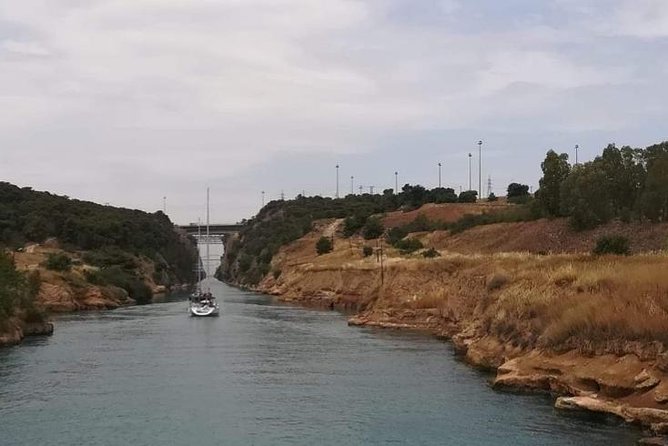
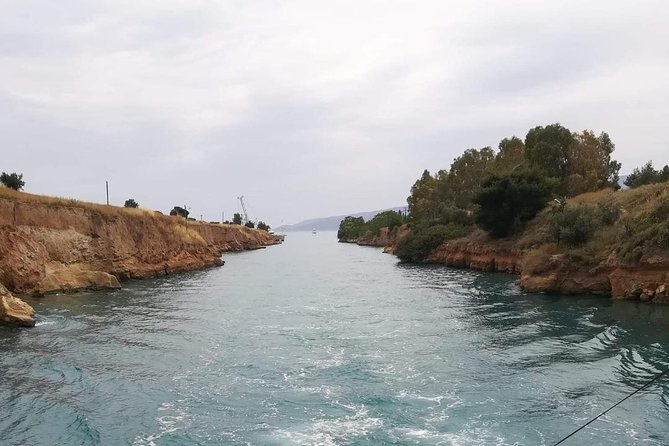
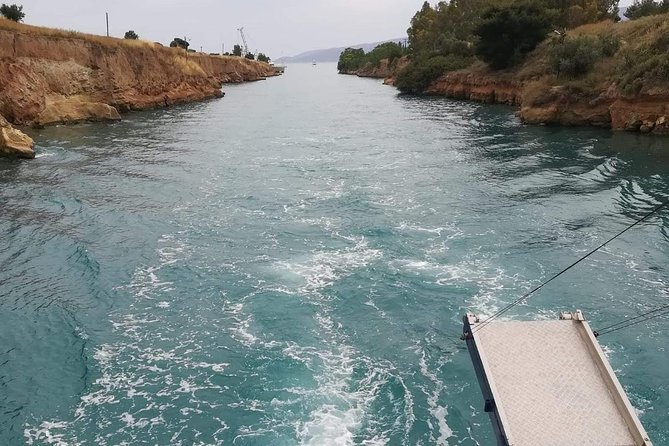
The Corinth Canal makes a dramatic roadside pause. Completed in the 19th century, it cuts through the isthmus and links the Gulf of Corinth with the Saronic Gulf. The walls drop sharply toward the water, giving you a clear sense of the engineering problem solved by the canal.
The idea was much older. Periander, ruler of ancient Corinth, is said to have imagined a shortcut more than 2,000 years ago. Before the canal, ships sailing around the Peloponnese faced an extra 185 nautical miles.
You get about 30 minutes here. That is plenty for the main view, photographs, and a short explanation from your driver. It is a good reset after leaving Athens, but it is still a brief stop rather than a museum visit.
The nearby Diolkos adds an older layer to the story. In antiquity, ships and goods could be moved across the isthmus rather than sent around the peninsula. The surviving remains help you picture the commercial traffic Paul encountered, although the stop lasts only about 20 minutes.
I like this pairing because it shows two answers to the same geographic challenge: the ancient hauling route and the modern canal. It also prevents the Corinth Canal from becoming a quick photo stop with no wider context.
Isthmia, the games, and Paul’s working world
Isthmia gives this tour its most unusual historical angle. The area hosted the Isthmian Games, one of the major athletic contests of ancient Greece after the Olympics. The games honored Poseidon and drew athletes, spectators, merchants, and officials to the isthmus.
The tour connects Paul with this setting through his work as a tentmaker. The supplied account presents him as working near the games, serving athletes and people passing through, and using contact with these crowds to share his Christian message.
That connection also helps explain Paul’s use of athletic images in his letters. References to running, discipline, competition, and prizes would have made sense to people living near a major sporting festival.
The archaeological area includes the remains connected with the Temple of Poseidon, the stadium, and the Sanctuary of Palaimon, a protector associated with sailors. The theater, used for musical events, adds another view of the festivals. Roman mosaics with sea creatures and Dionysian scenes show how strongly pagan religion shaped public life.
You will spend about 40 minutes at the main archaeological site, with an additional 30 minutes at the museum. Admission is not included. The site can feel scattered, so comfortable shoes and a willingness to walk between remains will help, although the supplied information does not give a detailed accessibility assessment.
The museum contains statues, votive objects, burial finds, and glass panels from Kenchreai. Those glass panels are especially useful because they connect Isthmia with Corinth’s eastern port, which appears later in the route.
Same island, an entirely different sort of day:
- Athens: Cape Sounion & Poseidon Temple Sunset Half-Day Trip
★ 4.8 · 8,241 reviews - Athens: Acropolis and Parthenon Guided Walking Tour
★ 4.6 · 5,882 reviews - All Day Cruise -3 Islands to Agistri,Moni, Aegina with lunch and drinks included
★ 5.0 · 4,958 reviews - Athens, Piraeus, and Coastline: Blue Hop-On Hop-Off Bus
★ 3.9 · 4,849 reviews
Ancient Corinth and the Bema of Gallio
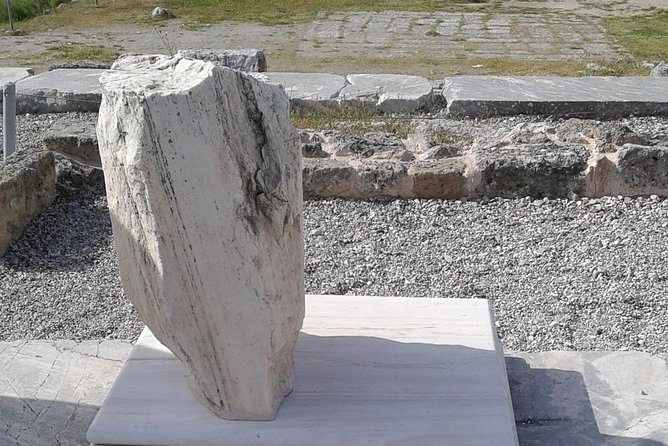
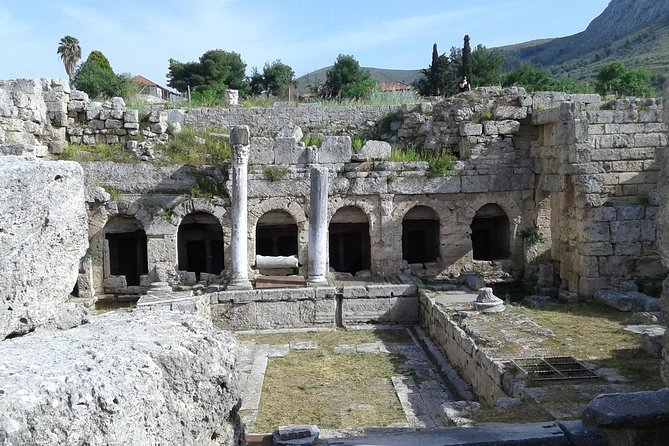
Ancient Corinth is the central stop, and you should protect enough time for it. Paul lived and preached in Corinth for roughly 18 months around AD 51 to 52. The city became one of the key early Christian communities, and the two letters to the Corinthians address its arguments, moral problems, questions, and divisions.
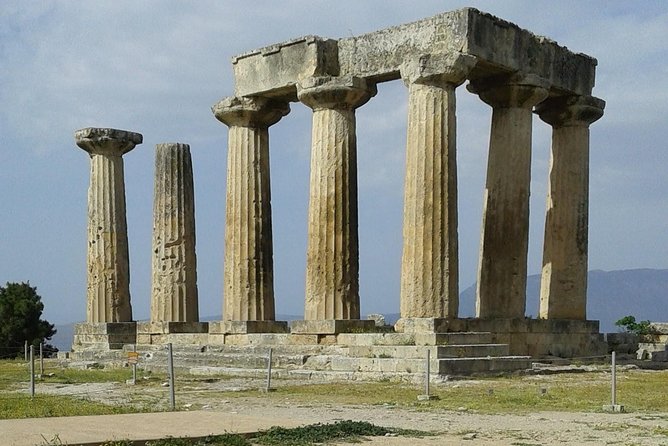
The remains spread across what was once a major Roman city. The Temple of Apollo is the most immediately recognizable monument. Built around 560 BC, it is known for its early Doric design and large limestone columns, several of which still rise above the site.
The temple creates a strong visual contrast with Paul’s message. He was teaching about one God and Jesus Christ in a city filled with established temples and long-standing religious traditions. You do not need to be a specialist in ancient religion to understand the force of that setting.
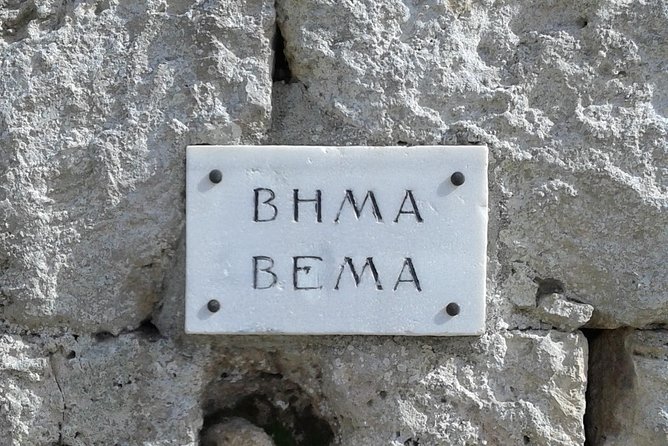
The Bema is the most direct biblical connection. This stone platform in the Roman Forum is linked with the hearing described in Acts, when Paul was brought before Gallio, the Roman proconsul. Gallio treated the case as a dispute within Jewish religious law and refused to intervene.
That decision mattered. It allowed Paul to continue his work without Roman punishment for the charge brought against him. Standing near the Bema gives you a concrete place to consider the event, even though the exact point where Paul stood cannot be proven with absolute certainty.
Ancient Corinth requires an entrance fee. The supplied price is €15 per person for Ancient Corinth and the Archaeological Museum of Corinth, purchased on-site. Since the route also includes the Archaeological Museum of Isthmia, ask the provider to clarify exactly which admissions are covered by that stated fee.
Cenchreae and the early church by the sea
Kechries is the modern site of ancient Cenchreae, Corinth’s eastern port. It is associated with Acts 18:18, when Paul stopped there before sailing for Syria with Priscilla and Aquila.
The account connects Paul with cutting his hair to fulfill a vow, probably a Nazirite vow. That detail gives the stop a personal quality. It is not only about Paul as a public preacher, but also about his private religious practice and the choices he made while moving between mission centers.
Cenchreae also appears in Paul’s letter to the Romans through Phoebe, who is commended as a respected servant of the church there. That makes the port important for another reason: it points to an early Christian community and to the significant role of a woman in its life.
You get about 30 minutes at the site. It is a quieter stop than Ancient Corinth, and the remains are less imposing. I would treat it as a place for reflection and context rather than a major ruin complex.
The church of Apostolou Pavlou
Apostolou Pavlou is a modern church honoring Paul’s time in Corinth. You spend about 20 minutes here, without a separate admission charge.
The church links the ancient mission with continuing Christian practice. Paul preached, taught, and formed one of the early Christian communities in Greece from Corinth. The church offers a place to pause after the archaeological sites and consider how the memory of that work has been carried forward.
This stop will mean more to you if your interest is devotional as well as historical. If your priority is ancient architecture alone, the visit may feel brief compared with the Roman Forum or Temple of Apollo.
Akrokorinthos and the final wide view
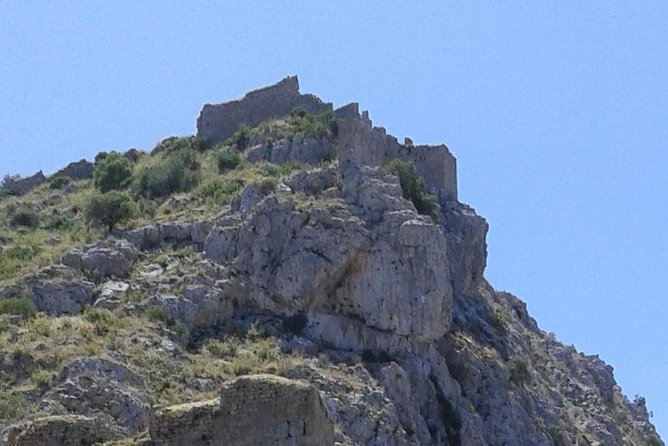
Akrokorinthos rises above Ancient Corinth and provides the tour’s biggest viewpoint. The fortress occupies a strategic height, and the route allows about 40 minutes to explore part of the site and take in the view over the city and surrounding area.
The tour presents the ascent as part of following Paul’s path and imagining his view over Corinth. That idea is evocative, but keep the historical claim in proportion. The supplied information does not establish a precise route Paul took up the fortress, so think of Akrokorinthos as a setting connected to Corinth rather than a confirmed stop in Paul’s daily movements.
The stop can also be physically more demanding than the short visits at the canal or church. Ask about the walking involved if anyone in your group has mobility concerns. The provider says most people can participate, but it does not provide a detailed accessibility description.
Lunch at a seaside taverna
The tour includes about an hour for lunch at a traditional seaside Greek taverna. Lunch itself is not included in the price, so plan to pay separately.
This is a useful break in a long day of ruins and biblical discussion. The exact restaurant and menu are not specified, so I would ask the driver about the planned stop and whether your group has any food needs.
The meal is also where the private format helps. A fixed group tour may give you little choice about timing, while this excursion is designed to adjust the pace and stops. Still, an hour can pass quickly if you want a relaxed meal, so tell the driver early if lunch is a major part of your day.
The private car, driver, and guide choice
Pickup is offered from your accommodation, and the tour uses a private, air-conditioned vehicle with bottled water, WiFi, and private transportation. You can choose among several vehicle types, but confirm the exact car before booking. One dissatisfied customer expected a larger, more comfortable vehicle, while the provider stated that a private sedan had been booked and supplied as described.
Your driver is not an official guide and will not enter the archaeological sites with you. Drivers are described as fluent in English and able to provide historical commentary from the road and at the entrances.
Several drivers have received especially warm praise for their personal approach. Alex was described as flexible and helpful with a short Athens stay. Kostas was singled out for his biblical context, local driving, and good photo stops. Spyros, Constantine, Pericles, Michael, and others were also praised for history, patience, and a pleasant manner.
Names and assignments can change, so treat those examples as useful possibilities, not a promise that one particular driver will lead your tour. If the biblical detail matters to you, request a licensed guide when booking. A guide named Pantelis was praised for bringing Corinth to life, while Vicky was noted for combining Bible knowledge with local history.
The distinction matters. A driver can make the day smooth and informative, but a licensed guide can walk through the sites and explain what you are seeing beside the ruins.
Timing, flexibility, and the risk of a rushed day
The advertised duration is about eight hours, but the actual pace depends on your group, traffic, site interest, lunch, and guide arrangement. One account described returning after about six hours and feeling hurried through the stops. Other accounts praised drivers who allowed plenty of time and adjusted the route when the group had already visited Mars Hill and the Parthenon.
That contrast tells you exactly what to do: set expectations at pickup. Tell the driver which places matter most, how long you want at Ancient Corinth, and whether you would rather skip a repeat visit to Areopagus Hill for more time in Corinth.
The private format is a real advantage here. You can ask to spend less time at a familiar Athens stop and more time at the Bema, museum, or Temple of Apollo. But flexibility only works when you speak up. A driver trying to fit ten or more stops into one day may keep the group moving unless you request a slower rhythm.
Is $386.18 good value for four people?
The price is $386.18 per group of up to four people, not per person. Split four ways, that is about $96.55 each before admissions, lunch, and any licensed guide fee. For two people, the per-person cost is much higher, but you still gain a private car, door-to-door pickup, and control over the day.
The value is strongest for a small family or group that wants more than a standard Corinth transfer. You are covering Athens, the canal, Diolkos, Isthmia, Ancient Corinth, Cenchreae, lunch, and Akrokorinthos in one outing. Doing all of that independently would require careful transport planning and a willingness to manage several separate stops.
The price is less compelling if you only want Ancient Corinth and the canal. In that case, a shorter excursion may be enough. It is also less attractive if you expect a licensed historian to accompany you inside every site, since that service costs extra and depends on availability.
Free cancellation is available until 24 hours before the start time. Changes or cancellations inside that window are not accepted for a refund.
Who should book this St. Paul tour?
I would choose this tour if you want to read the places through Paul’s life and work. It suits Christian pilgrims, Bible-study groups, church communities, and anyone interested in how early Christianity developed within the Roman and Greek world.
It also works for families and small groups that dislike rigid bus schedules. The vehicle, pickup service, and ability to adjust the route make the long day easier to manage.
I would hesitate if your main goal is a formal archaeological lecture. Without a licensed guide, your driver can explain the background but cannot provide guided commentary within the ruins. I would also hesitate if you dislike a busy schedule, since the route covers a lot of ground and includes many short stops.
Should you book it?
Book it if the Bema, Cenchreae, Isthmian Games, and Paul’s Corinth matter as much to you as the Corinth Canal. The private format, strong driver reports, and broad route give you a better connection to the subject than a simple stop at Ancient Corinth.
Before paying, confirm the vehicle type, request a licensed guide if needed, ask which admission fees apply, and agree on a slower pace if that is important to you. For a group of four, the cost is fair for a full private day. For two people, it is a more personal choice, but still worthwhile if this is a central part of your time in Greece.
FAQ
How long does the St. Paul Corinth tour last?
The tour lasts approximately eight hours. The exact length can vary depending on traffic, the pace of your group, lunch, and how much time you spend at each site.
Where does pickup take place?
This private tour offers pickup from your place in Athens or the agreed pickup location.
Is the tour private?
Yes. Only your group participates, with a maximum of four people at the listed group price.
Is a licensed guide included?
No. The standard service includes a professional driver with historical knowledge, but the driver is not licensed to accompany you inside the sites. A licensed guide can be requested, depending on availability.
What is included in the price?
The tour includes WiFi on board, bottled water, an air-conditioned vehicle, private transportation, and an English-speaking driver with historical knowledge.
Are entrance fees and lunch included?
No. Lunch is separate. The stated entrance cost is €15 per person for Ancient Corinth and the Archaeological Museum of Corinth, payable on-site. Confirm the exact admission details because the route also includes the Archaeological Museum of Isthmia.
Can I cancel for a full refund?
Yes. You can cancel at least 24 hours before the local start time for a full refund. Cancellations or changes made less than 24 hours before the tour are not accepted for a refund.
Fresh on the Athens list
- Athens Airport Arrival Transfer to Hotels or Addresses in Athens★ 3.5 · 45 reviews
- Private Luxury Tour: Unveiling the Sacred Mysteries of Eleusis★ 5.0 · 45 reviews
- Luxury Catamaran Sunset Semi-Private & Greek Gastronomy in Athens★ 5.0 · 45 reviews
- From Athens: Aegina Island guided tour in a day★ 5.0 · 45 reviews
- Delphi, Thermopylae full day private tour from Athens★ 4.9 · 46 reviews
- From Athens: City & Corinth Guided Day Tour★ 4.8 · 46 reviews
- Acropolis Private Wine Tasting @ Finewine store★ 5.0 · 46 reviews
- Ancient Corinth Half-Day Private Tour from Athens★ 5.0 · 46 reviews
Athens Tours, compared.

Acropolis & up to 5 Archaeological Sites Combo Pass
Read our review →

Acropolis, Parthenon & Acropolis Museum Guided Tour
Read our review →
Cape Sounion & Poseidon Temple Sunset Half-Day Trip
Read our review →


Cape Sounio & Poseidon Temple Trip with Audio Guide
Read our review →