
Reviewed · ANCIENT CORINTH & PELOPONNESE TOURS
Corinnt Canal, Epidaurus, Nafplio and Mycenae, Private Day Tour
The most striking part of this private Peloponnese tour is how much Greek history fits into one long day. You move from the modern engineering feat of the Corinth Canal to the healing sanctuary at Epidaurus, then on to the seaside town of Nafplio and the massive Bronze Age walls of Mycenae.
I like the flexible pickup from an Athens hotel, apartment, or Piraeus cruise port. I also like the private format, since you can adjust the pace, spend longer in Nafplio, or keep moving through the archaeological sites without waiting for a bus group.
The main consideration is the schedule. Eight to nine hours is a useful estimate, but this is a full day with several stops. Entrance fees are extra, and the driver provides commentary outside the sites rather than walking through them as a licensed archaeological guide.
Key points to know before you book
- Two UNESCO World Heritage sites: Visit the Sanctuary of Asklepios at Epidaurus and the archaeological site of Mycenae.
- The Corinth Canal saves a huge detour: This narrow waterway cuts through the isthmus and separates the Peloponnese from mainland Greece.
- Nafplio adds a welcome change of pace: Take an hour to stroll among Venetian, Ottoman, and neoclassical buildings.
- Private transport keeps the day flexible: Vehicles range from a taxi or sedan to an SUV, van, or minibus, depending on group size.
- Site tickets cost extra: Budget €20 per person for Epidaurus and €20 per person for Mycenae.
- A licensed guide is optional: Add one for Epidaurus and Mycenae for an extra €350, subject to availability.
From Athens to the Corinth Canal
Your day begins around 8:00 a.m., though the pickup time can be adjusted by request. The driver can collect you from Athens center, Piraeus hotels, residences, apartments, or the cruise port, then return you to the same general location.
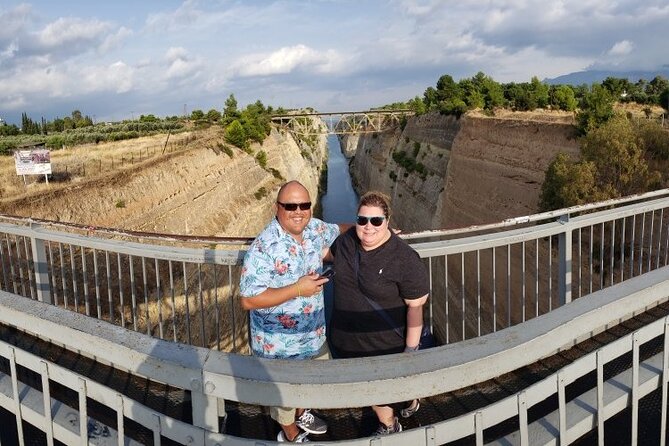
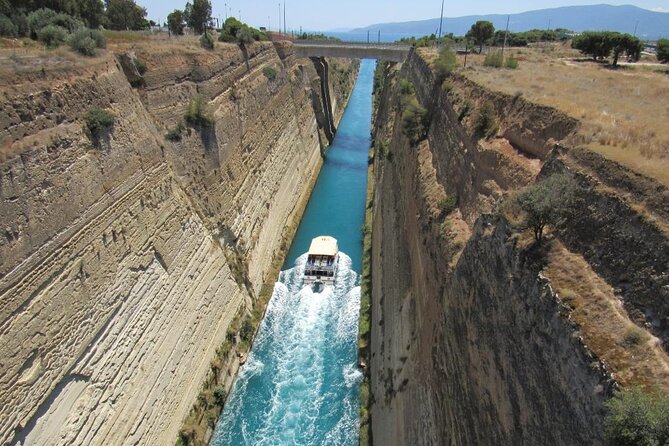
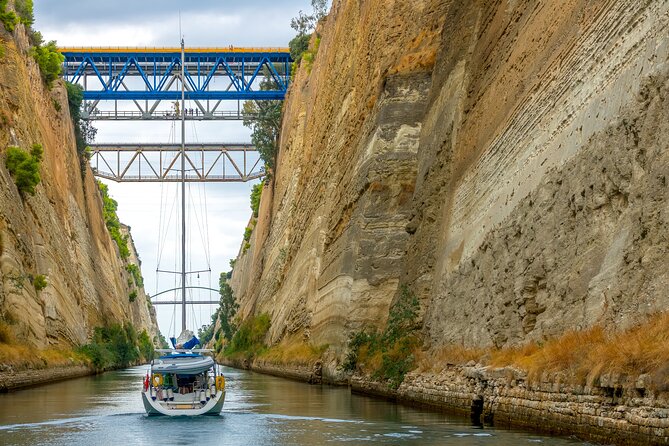
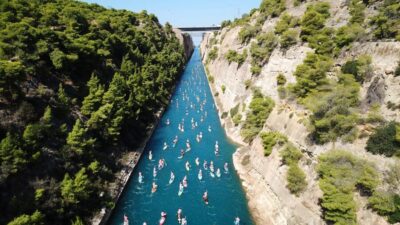
The first stop is the Corinth Canal, about 6.3 kilometers long and cut through the narrow isthmus linking central Greece with the Peloponnese. The waterway connects the Gulf of Corinth with the Saronic Gulf, giving ships a shorter route toward the Aegean.
The canal is only about 69 feet wide at its narrowest point at the bottom, and its steep walls rise roughly 170 feet. That scale is hard to grasp from a photograph. At the viewing area, you get about 30 minutes to look down into the cut, watch for passing boats, and take in the sharp contrast between the blue water and pale rock.
This is a quick stop, not a full canal cruise. Admission is free, and the value comes from seeing the engineering in person and understanding why the route matters. Your driver can explain the setting during the drive, but the visit itself is brief.
A few other Athens mornings to price up
- From Athens: Mycenae, Epidaurus & Nafplio Full Day Trip
★ 4.8 · 2,438 reviews - From Athens: Mycenae, Epidaurus & Nafplio Full-Day Tour
★ 4.5 · 1,580 reviews - From Athens: Ancient Corinth Day Trip with Canal & VR Guide
★ 4.6 · 1,073 reviews
Epidaurus and the theater of perfect acoustics
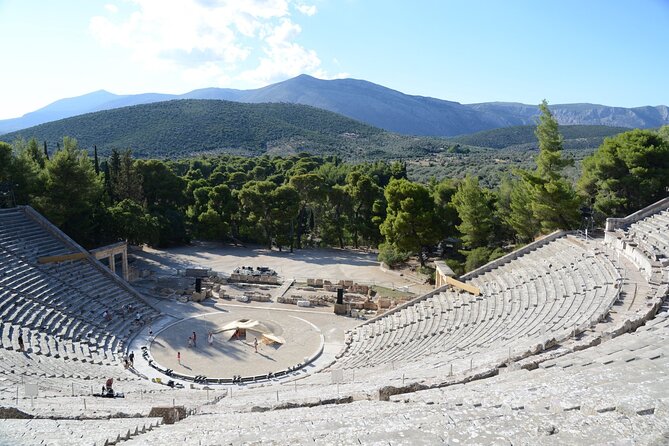
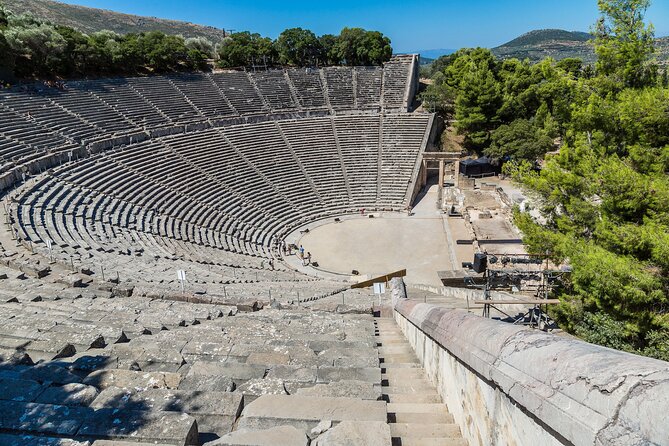
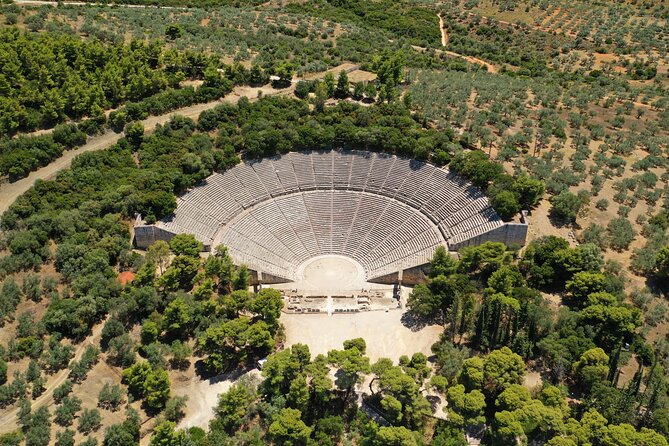
Epidaurus is the cultural heart of the day. The ancient theater was built around 330 to 320 BC and later enlarged in the second century AD. Its 55 rows of seats follow the natural slope of the hill, creating the clean, open shape associated with classical Greek theater.
The famous acoustic test is simple. Someone on the stage speaks softly, claps, or strikes a match, and the sound can carry to the upper seats, nearly 60 meters away. If the site is quiet enough, you can try it yourself. It is one of those ancient achievements that needs no long lecture.
The tour allows about 30 minutes at the theater. That is enough to see the seating, stage, and setting, but it is not generous if you want to study the structure closely or linger for photographs. If the theater matters most to you, ask in advance if the schedule can give you extra time here.
Admission is not included. The stated entrance fee is €20 per person for Epidaurus. The ticket covers the archaeological area, including the sanctuary and museum, but confirm current arrangements at booking since prices and access rules can change.
The Sanctuary of Asklepios and its ancient medical world
The Sanctuary of Asklepios lies within the same archaeological area as the theater. Asklepios was the Greek god of healing, and people came here seeking treatment, sleep, ritual care, and relief from illness.
The site matters because it shows medicine changing from a sacred practice into a more organized study of symptoms and treatment. The sanctuary once had a wide reputation, with dependent healing centers across the eastern Mediterranean.
You will see the remains of temples and other buildings spread across a peaceful rural setting. The theater is the famous image, but the sanctuary gives the visit its deeper meaning. It explains why Epidaurus was not simply an entertainment venue. It was a place built around physical and spiritual recovery.
The planned time is 30 minutes. That is enough for a brisk look, though the area includes more than you can absorb at a glance. Your driver cannot enter the archaeological sites as a licensed guide. He or she can give fluent English commentary during the drive, but the ruins themselves are self-guided unless you arrange a professional guide.
That distinction is important. If you want help separating mythology, archaeology, architecture, and medical practice, pay for the optional licensed guide if one is available. The added €350 is significant, especially for a small group, but it can make a major difference at sites as dense as Epidaurus and Mycenae.
The Epidaurus Archaeological Museum
The small museum sits inside the archaeological site and displays architectural pieces from the sanctuary, inscribed columns, pedestals, altars, bronze medical tools, sculpted offerings, and tablets. You can also see representations of the fourth-century BC temple and sections of the Tholos.
Allow about 30 minutes here. The museum is useful after walking among the ruins because it gives you a closer look at objects that explain how the sanctuary functioned. It also helps put the surviving stonework into context.
Still, you need to watch the clock. With the theater, sanctuary, and museum all scheduled for roughly 30 minutes each, the Epidaurus portion moves quickly. I would treat the timing as a guide rather than a promise, then tell the driver what you most want to see.
Same island, an entirely different sort of day:
- Athens: Acropolis & up to 5 Archaeological Sites Combo Pass
★ 4.4 · 12,619 reviews - Athens: Acropolis Ticket with Optional Audio or Live Guide
★ 4.2 · 11,055 reviews - Athens: Acropolis, Parthenon & Acropolis Museum Guided Tour
★ 4.8 · 9,316 reviews - Athens: Cape Sounion & Poseidon Temple Sunset Half-Day Trip
★ 4.8 · 8,241 reviews
A one-hour pause in Nafplio
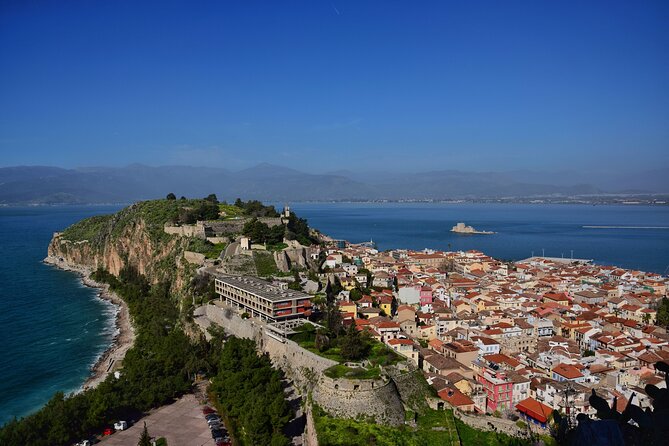
Nafplio is the day’s most relaxed stop. This attractive town served as the first capital of the modern Greek state from 1823 to 1834, and its streets mix Venetian buildings, Ottoman fountains, neoclassical facades, medieval fortifications, monuments, and statues.
The tour gives you about one hour. Use it for a walk through the old center, a coffee, photographs, or lunch. The town has enough restaurants and small shops to make this feel like a real stop rather than a roadside break.
Nafplio is also where a private tour earns its keep. If your group wants a sit-down meal, you can ask for a recommendation and use the hour as a pause between ancient sites. One restaurant recommendation connected with this tour service is Mitato, but food is not included, so plan to pay separately.
One hour will not cover every corner of Nafplio or its hilltop fortress. That is fine. The point is to change the rhythm of the day and let you walk through a living Greek town after several hours among ruins. If you prefer archaeological sites to town time, you can ask for a shorter stop, though the planned hour is a sensible break.
Mycenae and the world of Agamemnon
Mycenae sits on a hill above the Argolic plain and gives its name to the Mycenaean civilization, which spread through much of the Greek world during the Late Bronze Age. The site was occupied from the Neolithic period, roughly 4000 BC, but reached its peak around 1350 to 1200 BC.
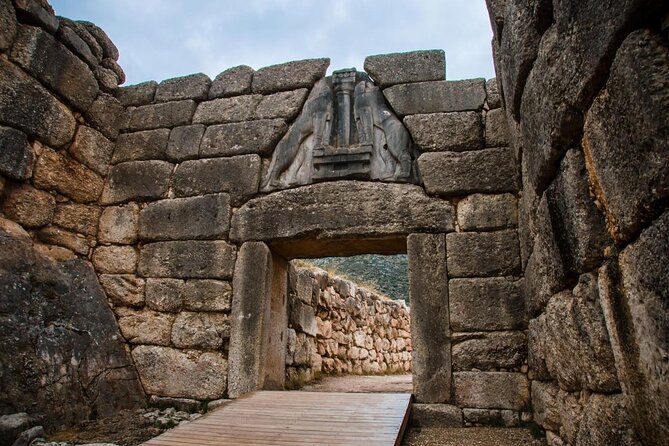
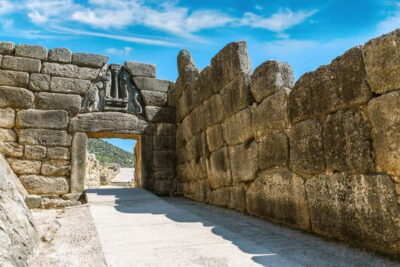
The first thing you notice is the scale of the walls. Built from huge blocks of stone, the so-called Cyclopean walls were laid in several stages around 1350, 1250, and 1225 BC. Ancient people later imagined that only Cyclopes could have moved such stones.
The Lion Gate is the familiar entrance, with two carved lions or lionesses set above the gateway. Beyond it are the remains of the acropolis, palace area, cult center, and Grave Circle A, where royal burials were found.
The site is open and uneven, with slopes and stone paths. Wear shoes with a firm sole and bring water, especially in warm weather. The tour allows about one hour, enough to see the main parts but not enough for an unhurried study of every feature.
As at Epidaurus, your driver can explain the area on the road but cannot guide inside the ruins. Mycenae is a place where a licensed guide is especially useful because the surviving walls can be difficult to read without explanation. The optional private guide for Epidaurus and Mycenae costs €350, subject to availability.
The Treasury of Atreus and its huge lintel
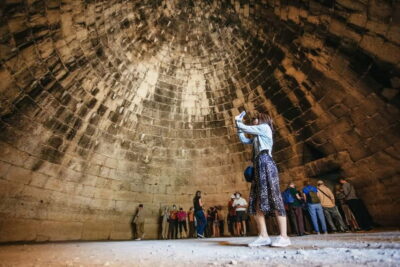
The Treasury of Atreus, also called the Tomb of Agamemnon, is a large tholos tomb built around 1250 BC on Panagitsa Hill. Its beehive-shaped chamber is formed from carefully fitted stone courses that rise inward until they close above the burial room.
The doorway is the showpiece. The lintel above it weighs about 120 tons and measures approximately 8.3 by 5.2 by 1.2 meters. It is described as the largest known lintel in the world.
You have about 30 minutes for the citadel and tomb area, usually enough to appreciate the tomb’s shape and the engineering involved. The Treasury of Atreus is separate from the main acropolis, so the stop adds another short walk and a second impressive view of Mycenaean building skill.
The myth of Agamemnon gives the site its drama, but you should keep legend and evidence apart. Mycenae is connected to the stories of the Atreid royal family, yet the tomb’s name does not prove that Agamemnon was buried there. A good guide should make that difference clear.
The Mycenae Archaeological Museum
The museum is located within the archaeological site, making it easy to visit after the citadel. It displays objects and architectural material found at Mycenae and helps explain the people who built and used the palace center.
The planned visit lasts about 30 minutes. That works well for a first visit, especially after seeing the Lion Gate, walls, palace area, and Treasury of Atreus. If you enjoy Bronze Age pottery, burial customs, or ancient architecture, you may wish for more time.
The full Mycenae stop combines the archaeological site, Treasury of Atreus, and museum. In practice, the one-hour and 30-minute blocks create a compact visit. Tell your driver if you want to prioritize the acropolis over the museum, or the museum over the tomb.
What the private vehicle adds
The tour uses a clean, air-conditioned, non-smoking vehicle suited to your party. Depending on group size, that may be a taxi, sedan, SUV, van, or minibus. Vehicles are insured and certified for tourist use, and child seats are available by request.
Private transport matters here because the sites are spread across the eastern Peloponnese. You avoid coordinating public transport between the canal, Epidaurus, Nafplio, and Mycenae, and you can return directly to Athens or Piraeus.
The driver also handles parking fees and provides bottled water. Service animals are allowed. For families, the route can be adjusted to suit children, though the long day and uneven ruins may still call for sensible pacing.
Several drivers associated with Private Greece Tours include Apostle, Vasilis, Sakis, Spyros, Tassos, George, Dominik, and Tolis. Driver assignments are not guaranteed, but you can ask about availability when booking. The strongest service descriptions point to drivers who are punctual, funny, careful, and good at explaining Greek culture during the long transfers.
Price, tickets, and guide costs
The listed price is $312.38 per person. That is not a budget day trip, but the value improves as your group gets larger because you are paying for a private vehicle and service rather than a seat on a shared coach.
The price includes hotel or port pickup and return, private transportation, parking, bottled water, an English-speaking driver, taxes, and help purchasing entrance tickets in advance. It does not include admission to the archaeological sites, food, drinks, or a licensed guide inside Epidaurus and Mycenae.
For the two main sites, budget another €40 per person based on the stated €20 fee for Epidaurus and €20 for Mycenae. If you add the private licensed guide, the extra €350 is likely easier to justify for a family or larger group than for one or two people.
The service includes skip-the-line help to purchase the appropriate tickets in advance, but that does not make the admission free. Ask for a full cost estimate before departure so the final price is clear.
Who should choose this tour
I would choose this tour if you have one full day from Athens and want the Peloponnese highlights without changing hotels. It suits families, couples, cruise passengers, and small groups who value a private vehicle and direct pickup.
It is also a good fit if you want control over the day. You can request a pickup time, ask for more or less time in Nafplio, and adjust the route around your group’s energy and interests.
I would think twice if you want a slow archaeological study. The schedule covers a great deal of ground, and the driver is not a site guide. In that case, book the licensed guide or choose a tour focused on just one or two major sites.
Free cancellation is available up to 24 hours before the start time. The experience requires good weather, and a weather-related cancellation offers a different date or a full refund.
Should you book the Corinth Canal, Epidaurus, Nafplio, and Mycenae tour?
Book it if you want maximum variety in one private day and accept that each stop will be fairly short. The Corinth Canal adds an unusual engineering stop, Epidaurus brings ancient theater and medicine together, Nafplio offers a pleasant town break, and Mycenae supplies the day’s strongest Bronze Age setting.
The tour earns its price through private transport, flexible pickup, and the ability to shape the pace. For the best experience, reserve an early start, budget for the €40 in site tickets, ask about a licensed guide, and decide in advance whether Nafplio lunch or extra archaeological time matters more to you.
FAQ
What time does the tour start?
The stated start time is 8:00 a.m., but pickup can be scheduled according to your preferences by request.
Can I be picked up from my Athens hotel?
Yes. Pickup and return are available from Athens center hotels, residences, apartments with an exact address, and Piraeus hotels or the cruise port. If the location is in a pedestrian-only area, an alternative vehicle-accessible meeting point may be provided.
Are entrance fees included?
No. Entrance fees are separate. The stated price is €20 per person for Epidaurus and €20 per person for Mycenae.
Does the driver guide me inside the archaeological sites?
No. The English-speaking driver provides commentary during the journey but cannot enter the archaeological sites as a licensed guide. A private licensed guide for Epidaurus and Mycenae can be arranged for an additional €350, depending on availability.
How long does the experience last?
The tour lasts approximately eight to nine hours. The itinerary includes about 30 minutes at the Corinth Canal, three 30-minute sections at Epidaurus, one hour in Nafplio, one hour at Mycenae, and 30 minutes each at the Treasury of Atreus and the Mycenae museum.
Can I cancel for a refund?
You can cancel at least 24 hours before the scheduled start for a full refund. Cancellations or changes made less than 24 hours before departure are not refunded or accepted. If poor weather causes the operator to cancel, you will be offered another date or a full refund.
Fresh on the Athens list
- Athens Airport Arrival Transfer to Hotels or Addresses in Athens★ 3.5 · 45 reviews
- Private Luxury Tour: Unveiling the Sacred Mysteries of Eleusis★ 5.0 · 45 reviews
- Luxury Catamaran Sunset Semi-Private & Greek Gastronomy in Athens★ 5.0 · 45 reviews
- From Athens: Aegina Island guided tour in a day★ 5.0 · 45 reviews
- Delphi, Thermopylae full day private tour from Athens★ 4.9 · 46 reviews
- From Athens: City & Corinth Guided Day Tour★ 4.8 · 46 reviews
- Acropolis Private Wine Tasting @ Finewine store★ 5.0 · 46 reviews
- Ancient Corinth Half-Day Private Tour from Athens★ 5.0 · 46 reviews
Ancient Corinth & Peloponnese Tours, compared.
Ancient Corinth Day Trip with Canal & VR Guide
Read our review →
Private Biblical Tour Ancient Corinth & Isthmus Canal from Athens
Read our review →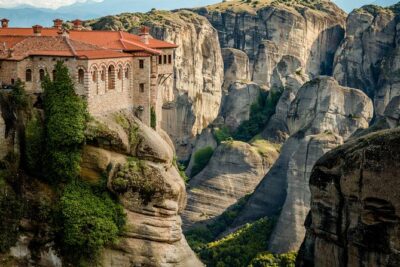
4-Day Classical Greece Tour: Epidaurus, Mycenae, Olympia, Delphi, Meteora
Read our review →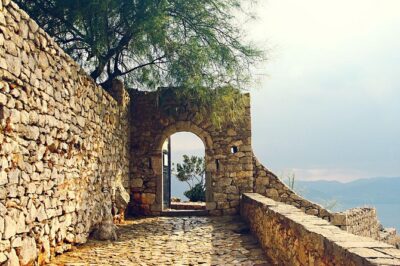
Ancient Corinth & Nafplio Full Day Trip with Swim
Read our review →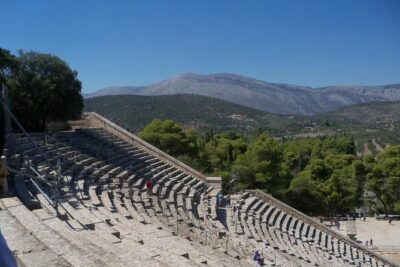
Mycenae and Nafplion Day Trip from Athens with Official guide
Read our review →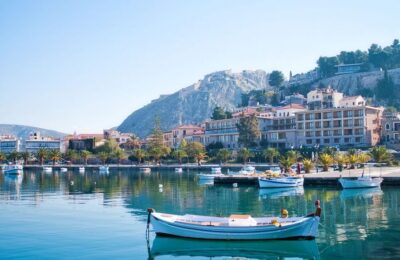
Browse the lists this tour appears in