
Reviewed · ATHENS TOURS
The Apostle Paul’s Missionary Journey in Athens and Corinth
Paul’s story comes alive when you move from the Athens Agora and Areopagus to the harbor where he arrived in Corinth. This private day trip links the biblical account to the political, commercial, and religious world around it, rather than treating Paul as an isolated figure.
I like the door-to-door transport and the freedom of a private vehicle, especially for a long day that covers two cities. I also like the mix of major ruins and quieter places such as ancient Kenchreai, where the setting helps you picture Paul’s arrival by sea.
The main drawback is the pace. You spend eight to nine hours on the road and on uneven ground, and admission fees plus a licensed guide are extra. If you want a slow archaeological tour with every inscription explained, this may feel brisk.
Key points to know before booking
- Paul’s route has a clear shape: Athens introduces his public debate, while Corinth shows the port, marketplace, court platform, and churches connected with his mission.
- Private transport keeps the day comfortable: Hotel and port pickup are included, with a sedan used for groups of one to four people.
- The best guide makes a major difference: English-speaking drivers such as Ruslan, Yannis, Kostas, George, Fortis, and Katerina have led departures, depending on availability.
- Acrocorinth is the physical high point: The hill offers grand views, but the climb and rough footing require sturdy shoes.
- The price is easier to justify for a small group: At $200.25 per person, you pay for a full private day, transport, water, Wi-Fi, and local guidance, but not entry tickets or a licensed site guide.
- Plan for heat and walking: A hat, sunscreen, water, and comfortable shoes are not optional extras in Greece’s summer sun.
Why this Athens and Corinth tour works for Bible-focused visitors
This is not simply a drive to a few ancient ruins. The day follows an idea: Paul entered Athens as a Jewish missionary in a city shaped by philosophy and civic debate, then reached Corinth through one of the busiest ports in the eastern Mediterranean.
That connection gives the tour more meaning. At the Agora, you can picture Paul meeting people in the city’s public center. At the Areopagus, you see the setting linked with his address to Athenian thinkers. In Corinth, the harbor, marketplace, court platform, and temple ruins help place his letters and ministry in a real urban setting.
I find this approach useful because biblical places can seem abstract when read only on a page. Here, you move through the spaces where trade, government, religion, and daily life overlapped.
The private format also helps. Your group alone participates, so the driver can adjust explanations and walking time within reason. Past departures have included guides and drivers named Ruslan, Yannis or Giannis, Kostas, George, Fortis, and Katerina. The exact person assigned to your tour may differ, but the service is offered in English.
One important distinction: the package includes a professional English-speaking tour driver with strong historical knowledge, but it does not include a licensed guide inside the archaeological sites. If you want formal guiding at the Agora or Ancient Corinth, ask about arranging that separately.
A few other Athens mornings to price up
- Athens: Acropolis & up to 5 Archaeological Sites Combo Pass
★ 4.4 · 12,619 reviews - Athens: Acropolis Ticket with Optional Audio or Live Guide
★ 4.2 · 11,055 reviews - Athens: Acropolis, Parthenon & Acropolis Museum Guided Tour
★ 4.8 · 9,316 reviews
Starting at the Ancient Agora of Athens
The Ancient Agora was the practical heart of Athens. Politics, trade, social life, and religious activity met here, making it an apt place to begin a tour about Paul’s public mission.
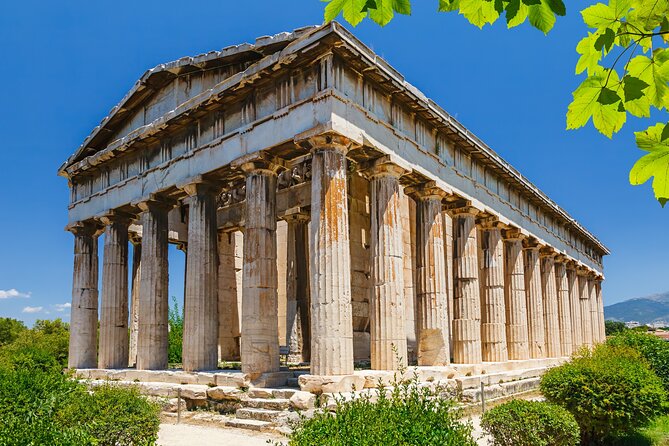
You have about an hour at the site. That is enough to get a feel for the layout and focus on the parts tied to Paul, but it is not enough for a slow study of every ruin. The Temple of Hephaistos, often called the Hephaisteion, is one of the major visual highlights in the Agora area, and it helps you understand how classical religious architecture shaped the city.
The tour gives you space to look around at your own pace while the driver or guide explains what matters. That balance is useful for a private group. You are not forced to follow a large flag through every corner, but you also are not left to guess which stones matter.
Admission to the Agora is not included. Keep this in mind when comparing the $200.25 price with other private tours. The cost covers the vehicle and service, not all site tickets.
Standing on the Areopagus
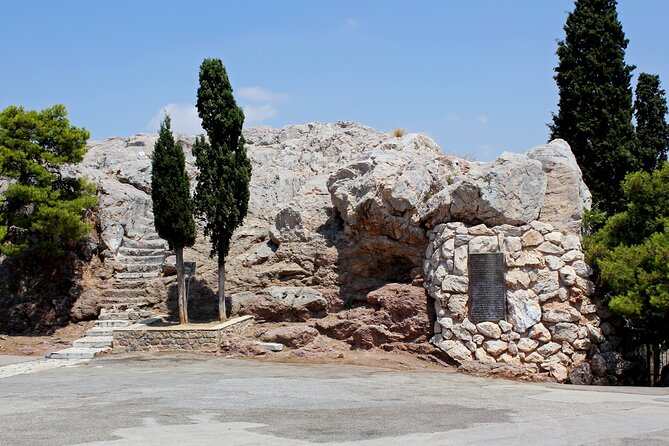
The Areopagus is a short but meaningful stop. This bare marble hill northwest of the Acropolis was tied to law and civic authority, and it also served as a place for public discussion.
Paul’s speech here is one of the best-known episodes of his time in Athens. He addressed people familiar with Greek philosophy, civic debate, and traditional religion. The tour uses the location to show how Paul presented his message in a setting shaped by ideas and argument.
You get about 30 minutes, and there is no admission charge. That makes this an easy addition to the day, though the stone surface can be awkward underfoot. Take care as you climb and walk across the rock, especially in hot weather.
The hill itself is exposed. Bring a hat and sunscreen, and do not expect much shade. The short stop works best as a focused explanation and photo opportunity rather than a long visit.
A brief look at Saint Dionysius in Kolonaki
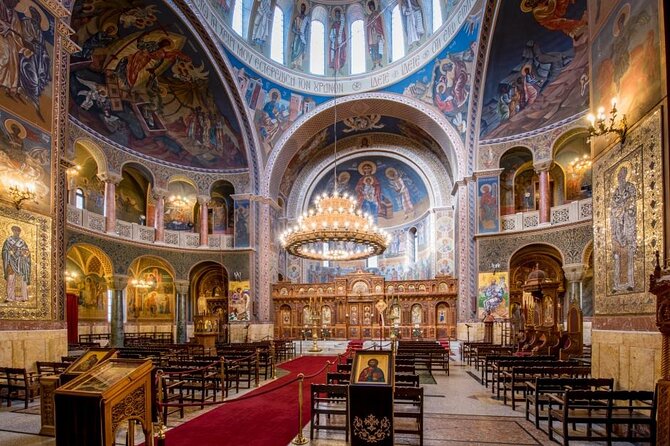
The Church of Saint Dionysius the Areopagite adds an early Christian link to the Athens portion. It is on Skoufa Street in the Kolonaki district and is dedicated to Athens’ patron saint.
According to the tradition presented on the tour, Dionysius was converted by Paul and later became the first bishop of Athens. The church gives you a later Christian setting connected with that story, after the philosophical debates and public speech at the Areopagus.
You spend about 20 minutes here, and entry is free. This is a quick stop, not a full church tour. Its value comes from connecting Paul’s Athenian visit with the growth of the Christian community that followed.
Depending on timing, the tour may also pass notable Athens landmarks such as the Academy, the University, the National Library, or the Olympic Stadium. These additions have appeared during departures, but the exact route can depend on traffic and the day’s schedule.
Same island, an entirely different sort of day:
- Athens: Cape Sounion & Poseidon Temple Sunset Half-Day Trip
★ 4.8 · 8,241 reviews - Athens: Acropolis and Parthenon Guided Walking Tour
★ 4.6 · 5,882 reviews - All Day Cruise -3 Islands to Agistri,Moni, Aegina with lunch and drinks included
★ 5.0 · 4,958 reviews - Athens, Piraeus, and Coastline: Blue Hop-On Hop-Off Bus
★ 3.9 · 4,849 reviews
Crossing to Corinth and the canal
The drive from Athens toward Corinth is a major part of the day. Complimentary Wi-Fi helps you stay connected, while the air-conditioned vehicle and bottled water make the long transfer easier.
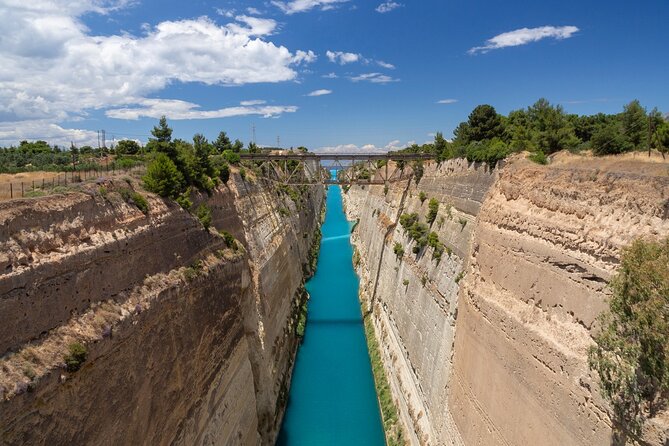
The Corinth Canal is a 20-minute photo stop. It cuts through the Isthmus of Corinth, linking the Gulf of Corinth with the Saronic Gulf and separating the Peloponnese from mainland Greece.
The canal was built long after Paul’s time, so it is not a biblical site. Its value is geographic. It shows why Corinth occupied such an important position between different parts of Greece and why movement through this narrow strip of land mattered for trade and travel.
You should treat this as a visual pause rather than a major historical visit. The canal is impressive, but the strongest Paul-related parts of the day come later at Kenchreai and Ancient Corinth.
Reaching Corinth through Kenchreai
Ancient Kenchreai, also spelled Kechrees, was Corinth’s eastern port. This is one of the most distinctive stops because it connects Paul’s mission with an actual arrival point, not only with a famous ruin.
The tour identifies Kenchreai as the place where Paul arrived in 51 A.D. The harbor once handled trade and travel during the Roman period. Today, much of it is underwater or reduced to ruins, but you can still see traces of storerooms, breakwaters, a nymphaeum, sanctuaries, and a fourth-century Christian basilica.
You have about 20 minutes here, so do not expect a full archaeological study. The remains are scattered and less immediately dramatic than the Temple of Apollo or Acrocorinth. Their strength is the story they tell: Corinth was a working port, and Paul entered this region through a commercial gateway.
I like this stop because it slows the day down. Instead of seeing Corinth only as a collection of columns, you begin to understand how people, goods, and ideas arrived there.
Ancient Corinth and the Bema
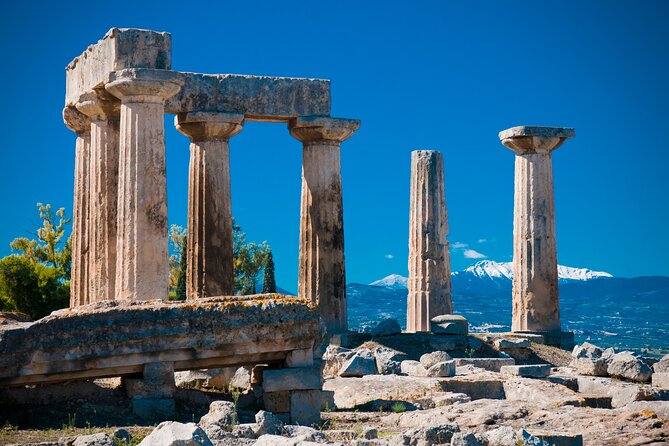
Ancient Corinth is the central stop of the tour. Allow about an hour for the archaeological site, with additional time in the museum afterward.
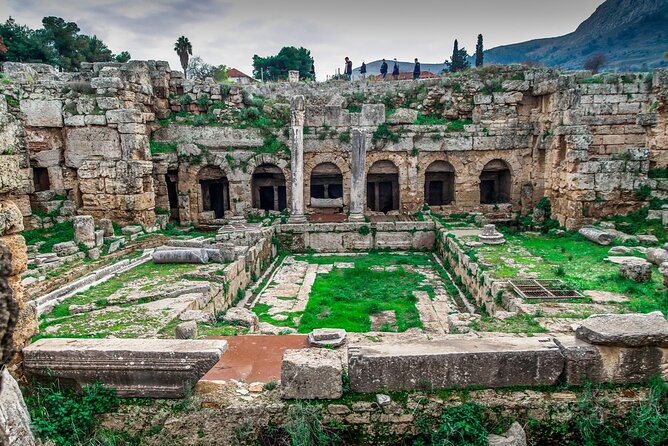
The Agora gives you a sense of Corinth as a busy city center. It was a place for commerce, public life, and contact between people from many parts of the Roman world. This is the setting that helps Paul’s letters feel connected to ordinary urban life, not only to theology.
The Bema is the key biblical feature. This raised platform in the center of the city is linked with Paul’s appearance before the Roman proconsul. The site also helps explain the legal and civic structure Paul faced while working in Corinth.
The Temple of Apollo provides a striking contrast. Its surviving columns reach back to the city’s older religious traditions, while the Christian story belongs to a later period. Seeing both in one place makes Corinth’s religious life easier to understand.
You will walk on uneven paving and rough ground. Good shoes matter, and the site may be tiring in the heat. The one-hour visit is enough for the major points, but anyone fascinated by archaeology may want more time than the standard schedule allows.
The Museum of Ancient Corinth
The Museum of Ancient Corinth gives shape to what you see outdoors. It was founded in 1932 to protect objects found in the area and includes material from prehistoric periods as well as finds from the Sanctuary of Asklepios.
You have about 45 minutes inside. That is a sensible amount of time after the open-air ruins because the displays help explain how people lived, worshipped, and worked in Corinth.
The museum is especially useful if columns and foundations leave you wanting more detail. Objects can show the daily side of the city more clearly than a broken wall can. Look for the way the exhibits connect household life, religious practice, and art.
Admission is not included in the tour price. Check the current ticket cost when planning your budget, since the listed price covers transport and the tour service rather than archaeological entry.
Climbing Acrocorinth
Acrocorinth is the final major stop and the most physically demanding one. The fortified hill rises above Ancient Corinth and served as a military defense point and religious center over many centuries.
The ruins include links with the Temple of Aphrodite, which was traditionally associated with up to 1,000 priestesses. The hill also offers broad views over Corinth and the surrounding area.
The scheduled visit is about 30 minutes. That is enough to reach a viewpoint and take in the setting, but it may not allow a leisurely exploration of every fortification. The climb can be steep, and the ground is uneven. If you have mobility limits, tell the operator before booking, since the tour includes walking on rough surfaces and no health restrictions are listed as a barrier for participation.
Some departures have included lunch at a local taverna near Acrocorinth, but lunch is not part of the stated inclusions. If you want a local meal, discuss it with your driver and budget separately. One useful feature of a private day is the ability to ask for a restaurant recommendation, as long as the timing allows.
Transport, timing, and the private format
Pickup is available from Athens hotels, apartments, or the port. At a hotel or apartment, the driver waits outside. At the port, the driver waits in the arrival area with a sign showing your name.
Airport pickup costs extra. That matters if you are arriving in Athens and hoping to begin immediately. The included pickup service is designed for hotels, apartments, and cruise port arrivals.
For one to four people, the tour uses a sedan. A private sedan is comfortable for a small party, but it is not a large coach with space to spread out. The vehicle is air-conditioned and includes Wi-Fi and bottled water.
The day lasts about eight to nine hours. An early pickup is wise because traffic, site visits, and the drive to Corinth take time. One departure began at 7:30 a.m. and returned to Athens around 2 p.m., though your schedule can vary.
The private setup is most valuable when your group has a shared interest in Paul, early Christianity, or classical Greece. You can ask questions, spend less time at a place that does not interest you, or request a local lunch if the schedule permits. The tradeoff is that you do not have a full-time licensed archaeological guide included at every site.
Is $200.25 per person good value?
At $200.25 per person, this is not a budget excursion. It becomes more reasonable when you consider what the fee covers: a private vehicle, hotel or port pickup and drop-off, an English-speaking driver, bottled water, onboard Wi-Fi, and a full day connecting Athens with Corinth.
For two people, the cost buys privacy and flexibility that a large group tour cannot offer. For four people sharing the sedan, the per-person value improves. The calculation changes if you add entrance fees, a licensed guide, lunch, or airport pickup.
I would compare the price with the cost of arranging separate taxis, admission tickets, and independent transport to Corinth. The convenience is a real part of the value, especially if you are visiting from a cruise ship or have limited time in Athens.
Still, you should not book this expecting every expense to be covered. Ask about current admission fees and licensed guiding before departure.
Who should book this day trip?
I would choose this tour if you want biblical places explained alongside Greek and Roman history. It suits couples, families, small groups, cruise passengers, and anyone who prefers a private vehicle to a large coach.
It is also a good match for people who want more than Athens alone. Corinth adds a major archaeological site, a port connected with Paul, the canal, the museum, and Acrocorinth.
You should think twice if you dislike long drives, hot weather, or uneven ground. The schedule is full, and the hill at Acrocorinth may be too much for some people. A slower Athens-only tour would suit you better if you want extended time at museums and classical monuments.
Bring comfortable walking shoes, a hat, sunscreen, and water-friendly clothing for the heat. Child seats are available on request. Most people can participate, but you should discuss mobility concerns with the operator before paying.
Free cancellation is available up to 24 hours before the start time for a full refund. Changes made inside that window are not accepted, and poor weather can lead to a different date or a full refund.
Should you book The Apostle Paul’s Missionary Journey?
Book it if Paul’s time in Greece is central to your trip and you want to see both the Athenian debate setting and the Corinthian world he entered by sea. The strongest parts are the private transport, the clear route from Athens to Corinth, the quieter Kenchreai stop, and the chance to ask questions throughout the day.
The tour is especially worthwhile with a driver who explains both the biblical account and the archaeology. Names associated with past departures include Ruslan, Yannis or Giannis, Kostas, George, Fortis, and Katerina, but assignments can change.
Do not book it expecting a relaxed museum day or a fully guided archaeological study. You pay admission separately, a licensed site guide is not included, and Acrocorinth requires care on rough ground.
For the right visitor, this is a thoughtful way to connect Paul’s words with actual streets, harbors, courts, and temples. You leave Athens with the speech at the Areopagus in mind and reach Corinth with a clearer picture of the city behind the letters.
FAQ
How long does the tour last?
The tour takes approximately eight to nine hours. Exact timing can vary with traffic, site visits, and pickup arrangements.
Is hotel pickup included?
Yes. Pickup and drop-off are included from Athens hotels and apartments. The driver waits outside the property.
Can I be picked up at the cruise port?
Yes. For port pickup, the driver waits in the arrival area holding a sign with your name.
Is airport pickup included?
No. Airport pickup is optional and costs extra.
Are entrance fees included?
No. Entrance fees for archaeological sites and museums are not included. The Ancient Agora and Ancient Corinth list admission tickets as extra.
Is a licensed guide included?
No. The package includes a professional English-speaking tour driver with historical knowledge. A licensed guide to accompany you inside archaeological sites is not included.
Is this a private tour?
Yes. Only your group participates. Groups of one to four people use a sedan vehicle.
What should I bring?
Wear comfortable shoes for uneven surfaces and walking. A hat and sunscreen are recommended because the Greek sun can be strong. Bottled water is provided, and child seats are available on request.
Fresh on the Athens list
- Athens Airport Arrival Transfer to Hotels or Addresses in Athens★ 3.5 · 45 reviews
- Private Luxury Tour: Unveiling the Sacred Mysteries of Eleusis★ 5.0 · 45 reviews
- Luxury Catamaran Sunset Semi-Private & Greek Gastronomy in Athens★ 5.0 · 45 reviews
- From Athens: Aegina Island guided tour in a day★ 5.0 · 45 reviews
- Delphi, Thermopylae full day private tour from Athens★ 4.9 · 46 reviews
- From Athens: City & Corinth Guided Day Tour★ 4.8 · 46 reviews
- Acropolis Private Wine Tasting @ Finewine store★ 5.0 · 46 reviews
- Ancient Corinth Half-Day Private Tour from Athens★ 5.0 · 46 reviews
Athens Tours, compared.

Acropolis & up to 5 Archaeological Sites Combo Pass
Read our review →

Acropolis, Parthenon & Acropolis Museum Guided Tour
Read our review →
Cape Sounion & Poseidon Temple Sunset Half-Day Trip
Read our review →


Cape Sounio & Poseidon Temple Trip with Audio Guide
Read our review →