
Reviewed · ATHENS TOURS
The Apostle Paul’s Missionary Journey in Athens and Corinth
Paul’s time in Athens and Corinth comes alive through places you can still walk across: the Ancient Agora, Areopagus Hill, the Corinth Canal, and the old harbor at Kechries. This private day trip links biblical events with the wider story of Greek cities, Roman rule, trade, and early Christianity.
I like two things right away. The private format gives you control over the pace, and the drivers are praised for adjusting the day to suit families, couples, and personal interests. I also like the stop at Kechries, a less familiar site tied to Paul’s meeting with Aquila and Priscilla.
The main catch is clear: your driver is not a licensed archaeological guide, so you explore the Agora, Acrocorinth, museum, and Ancient Corinth on your own. Bring some background reading, especially the Book of Acts, if you want more than a scenic walk among the ruins.
Key points to know before you book
- Paul’s Athens is more than the Acropolis: You visit the Ancient Agora and Areopagus, the hill linked with Paul’s speech to the Athenians.
- Kechries adds a personal biblical connection: The old port is tied to Paul, Aquila, and Priscilla.
- Corinth gets most of the sightseeing time: Plan on about two hours and 15 minutes at Acrocorinth, the museum, and the ancient city.
- The car ride is part of the experience: You have hotel pickup, bottled water, WiFi, air conditioning, and a private group.
- Site visits are self-guided: The English-speaking driver explains the wider setting but cannot guide you inside the archaeological sites.
- The $79 price is strongest for small groups: Four people sharing a private sedan receive better value than a solo visitor paying alone.
Why this Paul-focused day trip works
This is not simply a bus ride between famous ruins. It is built around a clear story: Paul arrives in Athens, speaks in a city full of competing ideas, then travels toward Corinth, an important commercial center where the Christian community became a major part of his work.
You get the best of two different settings. Athens gives you the public and intellectual side of Paul’s mission. Corinth gives you the practical side: ports, roads, trade, Roman power, local worship, and the daily life of an ancient city.
The driver is a major part of the experience. Names that appear repeatedly in the tour’s recent feedback include Michael, Ruslan, Giannis, George, Johnnie, and Konstantinos. The strongest praise goes to their grasp of Greek history and Paul’s journeys, along with patience, good English, and willingness to tailor the day.
That personal approach matters. You are not locked into a large coach timetable. If you want extra time for photographs, more explanation about Paul, or advice about food and places to visit in Athens, the day can be shaped around you. One couple even received flexible help when a member of the group became ill.
Still, set the right expectation. The tour driver can provide historical context and explain what you are seeing, but the archaeological stops are listed as self-guided. If you want a formal lecture beside each monument, hire a licensed guide separately or prepare before you go.
A few other Athens mornings to price up
- Athens: Acropolis & up to 5 Archaeological Sites Combo Pass
★ 4.4 · 12,619 reviews - Athens: Acropolis Ticket with Optional Audio or Live Guide
★ 4.2 · 11,055 reviews - Athens: Acropolis, Parthenon & Acropolis Museum Guided Tour
★ 4.8 · 9,316 reviews
Starting in Athens at Saint Dionysius and the Ancient Agora
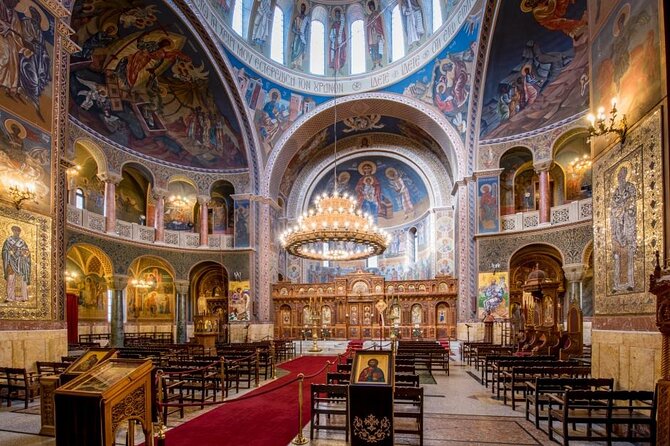
Pickup takes place in Athens, followed by a transfer of about 30 minutes to the Holy Church of Saint Dionysius the Areopagite, patron saint of Athens. This is a short photo stop of about 20 minutes, not a long church visit.
The church adds a modern Greek Orthodox note to a day otherwise centered on ancient sites. It also helps connect Paul’s first-century mission with the continuing Christian life of Athens. A driver such as Ruslan may add context about present-day Christianity in Greece, as well as the city’s older traditions.
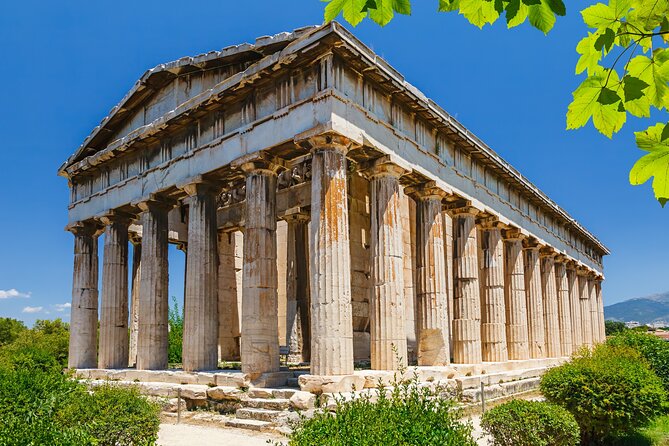
Next comes the Ancient Agora, where you have about an hour for a self-guided visit. The Agora was the civic heart of ancient Athens, a place of political debate, business, religious activity, and public life. It is one of the most useful places for understanding why Athens mattered when Paul arrived.
The biblical connection is especially strong here. Paul is described as speaking and reasoning in public spaces in Athens, and the Agora gives you a feel for the setting in which ideas were exchanged. You are not just looking at broken columns. You are standing in the sort of public environment where a new message could be discussed, challenged, or dismissed.
One hour is enough for a focused visit, but not for every corner. Since no licensed guide enters with you, read a basic site guide before the tour or save notes on your phone. Focus on the main ruins, the surviving buildings, and how the open public center fits into ancient Athenian life.
Standing on the Areopagus, where Paul addressed Athens
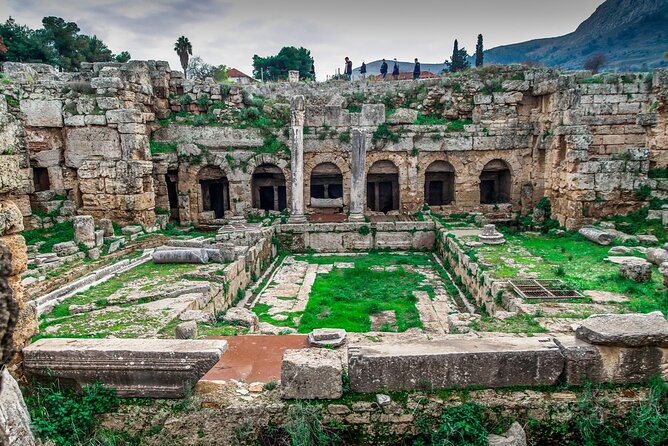
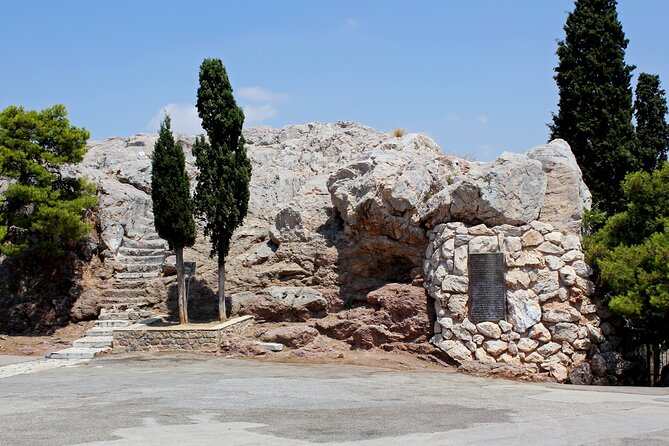
The Areopagus comes next, with about 30 minutes for sightseeing. This rocky hill is linked to the account of Paul speaking before the Athenians in Acts 17. It is one of the most direct physical links between the biblical text and the modern visit.
The stop is short, but the setting is powerful. From the rock, you can look across the city and think about Paul addressing people who valued philosophy, debate, and public speech. The location also helps explain why Athens could feel both open to new ideas and resistant to a message that challenged familiar religious habits.
Wear shoes with a good grip. The Areopagus is a rocky outdoor site, and comfortable footwear is listed as an important item to bring. In hot weather, the exposed stone can make the stop feel more demanding than its 30-minute schedule suggests.
One practical note comes from the tour feedback: work at Mars Hill occasionally affects access. If construction is taking place, your view or movement around the site may be limited. Your driver can still explain the location, but the physical experience may not be exactly the same every day.
The road west to the Corinth Canal
After Athens, the vehicle travels for about an hour toward the Isthmus of Corinth. This is when the private transport becomes especially useful. You can rest in an air-conditioned car, use the onboard WiFi, and keep cold bottled water close at hand instead of managing a large group on a long road transfer.
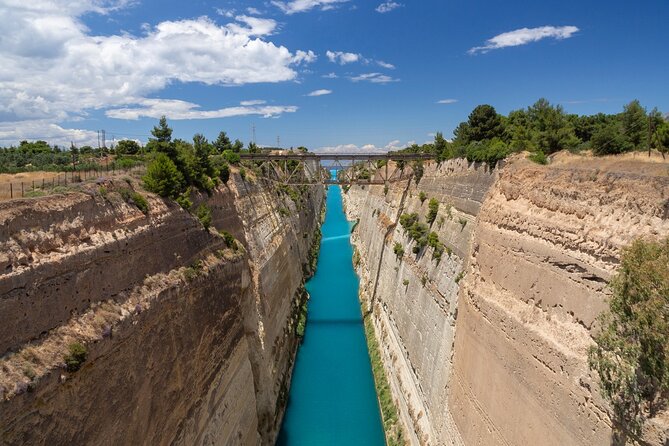
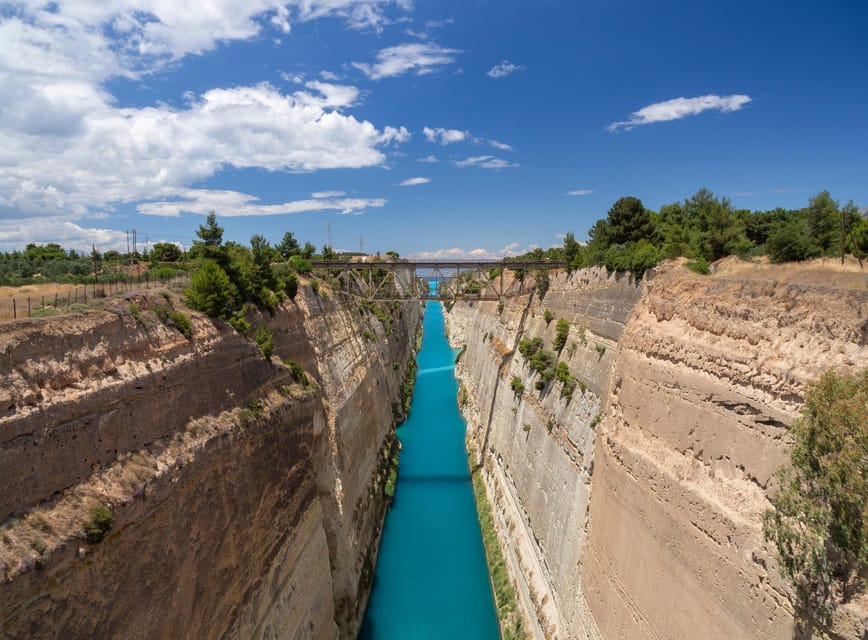
The Isthmus Canal stop lasts about 20 minutes. The canal cuts through the narrow strip of land linking mainland Greece with the Peloponnese. Its steep sides make it an easy place for photographs and give you a quick sense of why this route has mattered for movement between the Aegean and Ionian seas.
Do not expect a long canal cruise or an extended engineering visit. This is a sightseeing stop, designed to break up the drive and show you the strategic geography of Corinth. Its value is visual and geographic: it helps explain why Corinth became such a significant center in antiquity.
The tour’s pace is fairly full. You will cover a lot of ground in one day, so use the drive to ask questions. Giannis and other drivers have been praised for explaining Paul’s movements, Greek customs, and local culture along the way.
Same island, an entirely different sort of day:
- Athens: Cape Sounion & Poseidon Temple Sunset Half-Day Trip
★ 4.8 · 8,241 reviews - Athens: Acropolis and Parthenon Guided Walking Tour
★ 4.6 · 5,882 reviews - All Day Cruise -3 Islands to Agistri,Moni, Aegina with lunch and drinks included
★ 5.0 · 4,958 reviews - Athens, Piraeus, and Coastline: Blue Hop-On Hop-Off Bus
★ 3.9 · 4,849 reviews
Kechries, the port connected with Paul’s companions
From the Isthmus, the drive continues for about 15 minutes to Kechries, where you have roughly 20 minutes. This old port is one of the more distinctive stops because it is less familiar than Athens or Ancient Corinth.
Kechries is associated with Paul’s departure from the Corinth area and with his connection to Aquila and Priscilla. The visit gives the biblical story a practical setting. Paul’s mission depended not only on speeches and letters, but also on ports, roads, households, workshops, and people who helped move the early Christian message from one city to another.
The site is best approached as a brief historical pause. You may find excavated remains and a quiet coastal setting rather than a fully restored monument complex. That is part of its appeal, but it also means you should not expect a large museum or a long structured presentation.
For anyone planning a Christian heritage trip, Kechries is a useful inclusion. It adds a human dimension to Paul’s travels and keeps the day from becoming only a tour of famous ruins.
Acrocorinth and the views above the ancient city
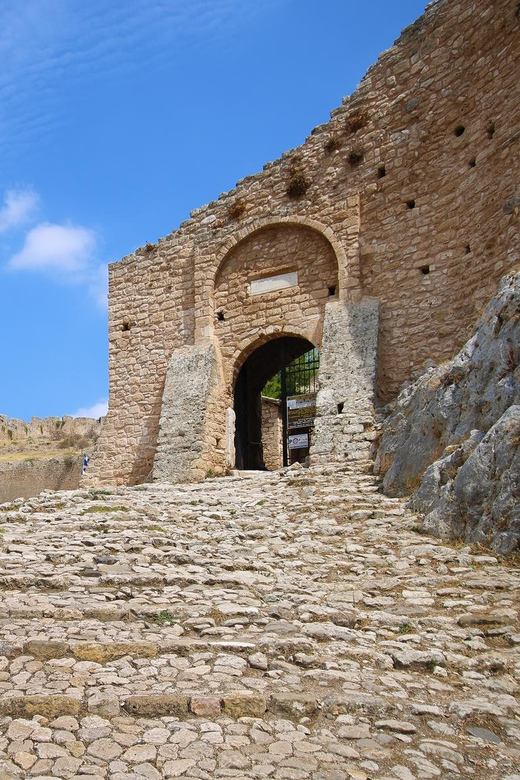
The next stop is Acrocorinth, reached after another short transfer. You have about 30 minutes for a self-guided visit. The site is a mountain fortress above Corinth, and the drive up provides wide views across the surrounding region.
The fortress has a long story that reaches beyond Paul’s era. Its walls and high position show how valuable this location was for controlling movement through the Corinth area. Even with a short visit, you can understand the military logic of the site and see how closely power, trade, and geography were linked.
The time limit is the main consideration. Thirty minutes does not allow for a full exploration of the fortress. You will need to stay focused, follow your driver’s timing, and choose viewpoints rather than trying to inspect every path.
The climb and uneven ground also make comfortable shoes essential. If someone in your group has trouble walking, tell the driver early so the day can be adjusted where possible. The tour is private, which gives you more flexibility than a fixed coach excursion, but it does not remove the physical demands of an ancient hilltop site.
Ancient Corinth, the museum, and Paul’s working world
The Archaeological Museum of Ancient Corinth receives about 45 minutes. This is a valuable stop because artifacts can fill in details that ruins alone cannot show. You may find it easier to understand the city’s religious life, household goods, public culture, and artistic traditions after seeing objects in a museum setting.
Then you have about an hour at Ancient Corinth itself. This is the main archaeological portion of the day, and most of your Corinth sightseeing time is concentrated here.
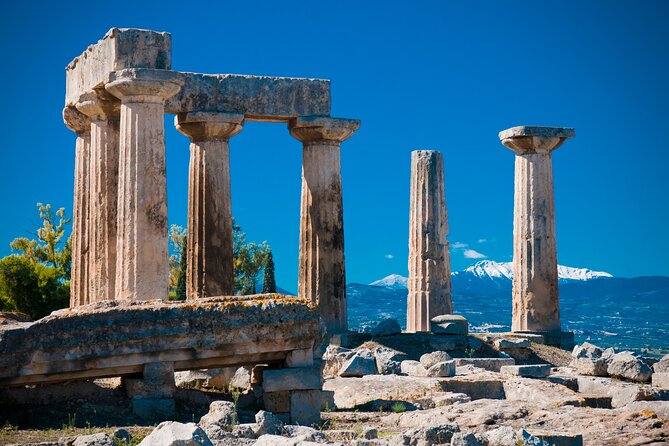
Corinth was a major city shaped by trade and travel. Its position between two seas made it important long before Paul arrived, and its Roman-era remains help explain the setting in which the early Christian community developed. The ruins let you consider Paul not as a figure moving through empty countryside, but as a person speaking to people in a busy, diverse urban center.
The site is also where preparation pays off most. Because your driver does not serve as a licensed guide inside, bring a guidebook with pictures or read the relevant sections of Acts in advance. A simple plan helps: first identify the main public spaces, then look for the religious and civic remains, and finally connect the physical setting with Paul’s letters to the Corinthians.
The driver can point out key features and answer questions before or after you enter. Guides such as Michael, Ruslan, and Giannis are praised for their ability to explain Paul’s journey and broader Greek history, but the experience remains partly independent once you walk through the gate.
What the private vehicle adds to an eight-hour day
For groups of one to four, the tour uses a sedan. Larger arrangements may use a bigger vehicle, with one past booking describing a comfortable seven-passenger Mercedes van. The included vehicle is air-conditioned, and bottled water is provided.
Those details matter in Greece, especially during warm months. You move between exposed ruins, a rocky hill, a canal viewpoint, and a long road route. Having water waiting in the car can make the day much easier.
Hotel pickup and drop-off in Athens are included. Airport pickup is possible for an extra charge, so do not assume it is part of the advertised price. The return transfer to Athens takes about an hour, and traffic can affect the final arrival time.
The private format is the biggest practical advantage. You can ask for more or less time at a stop, discuss food suggestions, and avoid spending the day with strangers. It also makes the $79 per-person price more appealing for four people, since the total private transport cost is shared across the group.
For one person or a couple, the value depends on your priorities. Entrance fees are not included, and you are paying for private transportation, an English-speaking driver, water, WiFi, and a tailored route rather than a formal guided archaeological lecture. If you value comfort and a personal biblical focus, the price is fair. If you mainly want the lowest-cost way to reach Corinth, public transport and separate site tickets may cost less, though they will not offer the same door-to-door ease.
Who will get the most from this experience
I would choose this tour if Paul’s life and early Christianity are central to your visit, especially if you also want a broad introduction to Athens and Corinth. It suits couples, families, small church groups, and people arriving in Athens with limited time.
It is also a good fit if you prefer conversation to a fixed script. The strongest guide experiences come from drivers who answer questions, adjust the pace, and share practical suggestions about Greek food, culture, and places near your hotel.
I would be more cautious if you need full archaeological interpretation at every stop. The Agora, Acrocorinth, museum, and Ancient Corinth are self-guided. You should prepare with Acts and a reliable site guide, or arrange for a licensed guide if detailed monument-by-monument explanation is important.
The day also asks a lot of your energy. There are several transfers, outdoor sites, uneven surfaces, and a tight schedule. Comfortable shoes are not a minor suggestion here.
Cancellation is flexible up to 24 hours before departure, with a full refund, and you can reserve now while paying later. Those terms help if your Athens plans are still shifting, but they do not change the need to confirm starting times and site entry costs before booking.
Should you book the Athens and Corinth Paul tour?
Book it if you want private transport, a strong biblical theme, and a full day that reaches both Athens and Corinth without arranging several separate trips. The visit to Kechries, the Areopagus, and the hilltop fortress at Acrocorinth gives the route more character than a simple Athens to Corinth transfer.
The tour is especially good with a driver such as Michael, Ruslan, Giannis, or Konstantinos, all of whom are praised for clear English, warmth, and strong command of Paul’s story. Guide assignments can change, so you may not be able to select a specific person.
Skip it if you want a fully guided archaeological tour or a slow, unhurried day at each ruin. For everyone else, this is a well-planned way to connect the Book of Acts with the actual roads, ports, hills, and city remains of central Greece.
FAQ
How long does the tour last?
The experience lasts about eight hours, including transfers between Athens, Corinth, and the archaeological sites.
Is hotel pickup and drop-off included?
Yes. Hotel pickup and drop-off in Athens are included. Airport pickup is optional and costs extra.
Are entrance fees included?
No. Entrance fees for archaeological sites and museums are not included in the $79 price.
Is the tour fully guided inside the archaeological sites?
No. The Ancient Agora, Acrocorinth, Archaeological Museum of Ancient Corinth, and Ancient Corinth are listed as self-guided visits. The English-speaking tour driver provides historical information but is not a licensed guide for site entry.
What type of vehicle is used?
Groups of one to four people use a sedan. The vehicle is air-conditioned and includes WiFi and bottled water.
Can I cancel the booking?
Yes. You can cancel up to 24 hours in advance for a full refund. You can also reserve now and pay later.
Fresh on the Athens list
- Athens Airport Arrival Transfer to Hotels or Addresses in Athens★ 3.5 · 45 reviews
- Private Luxury Tour: Unveiling the Sacred Mysteries of Eleusis★ 5.0 · 45 reviews
- Luxury Catamaran Sunset Semi-Private & Greek Gastronomy in Athens★ 5.0 · 45 reviews
- From Athens: Aegina Island guided tour in a day★ 5.0 · 45 reviews
- Delphi, Thermopylae full day private tour from Athens★ 4.9 · 46 reviews
- From Athens: City & Corinth Guided Day Tour★ 4.8 · 46 reviews
- Acropolis Private Wine Tasting @ Finewine store★ 5.0 · 46 reviews
- Ancient Corinth Half-Day Private Tour from Athens★ 5.0 · 46 reviews
Athens Tours, compared.

Acropolis & up to 5 Archaeological Sites Combo Pass
Read our review →

Acropolis, Parthenon & Acropolis Museum Guided Tour
Read our review →
Cape Sounion & Poseidon Temple Sunset Half-Day Trip
Read our review →


Cape Sounio & Poseidon Temple Trip with Audio Guide
Read our review →