
Reviewed · ATHENS TOURS
Unexpected Athens Orientation Tour
Athens reveals its modern character when you leave the Acropolis behind. This four-hour walk crosses five sharply different neighborhoods, from polished Kolonaki to political Exarchia and lively Psiri, showing how the city changed from royal capital to working city, university town, and creative center.
I like the small-group limit of 12, which makes it easier to ask questions and move through crowded streets. I also like the practical ending in Monastiraki, where you can continue with lunch, shopping, or a visit to Hadrian’s Library. The drawback is simple: this is a serious walk, with hills, some steep climbs, and heat to contend with.
Key points at a glance
- A modern Athens orientation: Focuses on neighborhoods, daily life, architecture, politics, and the making of the modern Greek state.
- Five districts in four hours: Connects Syntagma, Kolonaki and Lykavittos, Exarchia, Psiri, and Monastiraki.
- Small groups up to 12: A better setup for conversation and narrow city streets than a large coach or crowded walking group.
- Strong local guiding: Guides including Nikos, Leo, Simos, Antigoni, Mary-Kate, and Elissavet have been praised for clear explanations and personal recommendations.
- A walk with hills: Wear comfortable shoes, bring water, and expect more exertion than the relaxed title might suggest.
- Best early in your stay: The route helps you understand where Athens neighborhoods sit before you explore the city on your own.
Why this tour makes sense before the Acropolis
Many first visits to Athens revolve around ancient monuments. That is sensible, but it can leave you with a partial picture. The Unexpected Athens Orientation Tour puts the city’s last two centuries beside its older remains, so you can see Athens as a lived-in capital rather than an open-air museum.
I like that the route uses neighborhoods as its organizing idea. You learn how social class, politics, education, commerce, migration, and nightlife shape different parts of the city. A ruin in the middle of a modern street or a bunker left from the Nazi occupation can say as much about Athens as a temple column.
The tour begins at 9:30 a.m. at Syntagma Square and ends in Monastiraki. That timing is useful if you have just arrived, since you get oriented before spending the rest of your trip crossing the city on your own. It also leaves you near restaurants, shops, and major sights at lunchtime.
The guiding is a major part of the value. Past guides have included Nikos, Leo, Simos, Antigoni, Mary-Kate, Elissavet, and Niko. Simos has an archaeology and cultural history background, while other guides have been praised for adapting the walk to questions and interests. The exact guide is not guaranteed, but the experience clearly depends on having someone who can connect buildings and streets to larger events.
A few other Athens mornings to price up
- Athens: Acropolis & up to 5 Archaeological Sites Combo Pass
★ 4.4 · 12,619 reviews - Athens: Acropolis Ticket with Optional Audio or Live Guide
★ 4.2 · 11,055 reviews - Athens: Acropolis, Parthenon & Acropolis Museum Guided Tour
★ 4.8 · 9,316 reviews
Syntagma Square: Athens begins at the crossroads
Syntagma is not just a meeting point. It is the civic heart of the capital, dominated by the Greek Parliament, a building that began life as the Royal Palace. The square’s constant flow of pedestrians, public transport, workers, and visitors gives you an immediate sense of Athens as a working capital.
The 30-minute introduction helps place the city on the map. You start with national institutions and public life, then move into the quieter streets of central Athens. Since there is no admission fee at any stop, your payment goes toward the guide, the route, and the interpretation rather than entry tickets.
This is also a good place to arrive early. The meeting point is easy to reach by public transport, and the tour does not include hotel pickup. Give yourself enough time to find Plateia Syntagmatos without rushing into a four-hour walk.
Kolonaki and Lykavittos: polished Athens with a hill climb
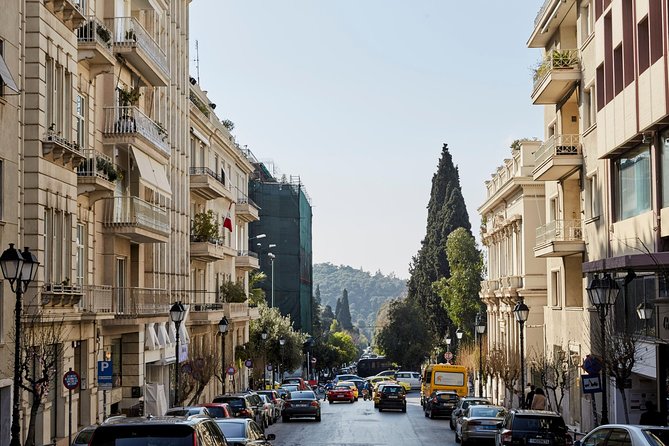
The route then heads toward Kolonaki, the city center’s long-established upscale district. Its boutiques, sidewalk cafés, and gourmet restaurants present a different face of Athens from the market lanes and ancient sites around Monastiraki.
This section lasts about an hour and may include uphill walking toward the Lykavittos area. The climb is part of what makes the route useful, since you see how quickly Athens changes from a central square to a more residential and affluent district. You also get a better feel for the city’s slope and layout.
Do not mistake the polished cafés for the whole of Athens. That contrast is the point. A good guide can explain how neighborhoods reflect social divisions and changing tastes, rather than simply pointing out attractive streets.
If you want an effortless stroll, this section may test you. Several people specifically advise good shoes, and one description notes uphill climbs even though the overall pace was relaxed. On a hot day, the elevation matters more than the mileage.
Exarchia: politics, students, and everyday affordability
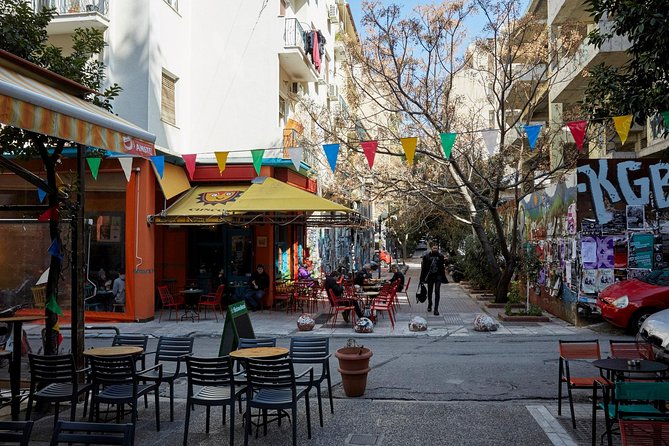
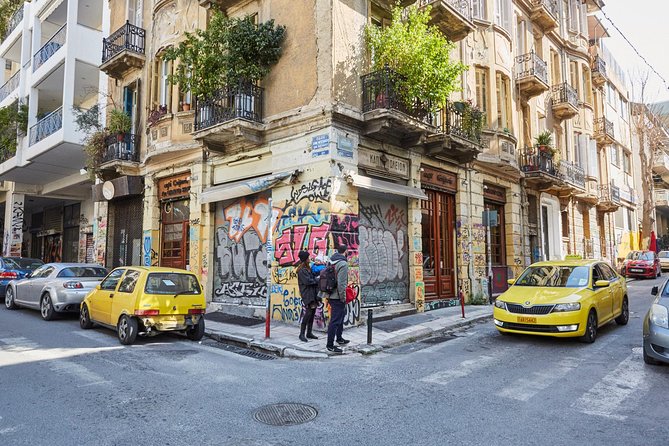
Exarchia brings a sharp change in tone. This central district is associated with progressive politics, universities, inexpensive tavernas, bars, and snack shops. It has a strong student presence and a reputation for social debate, making it one of the better places to discuss Athens as a modern city.
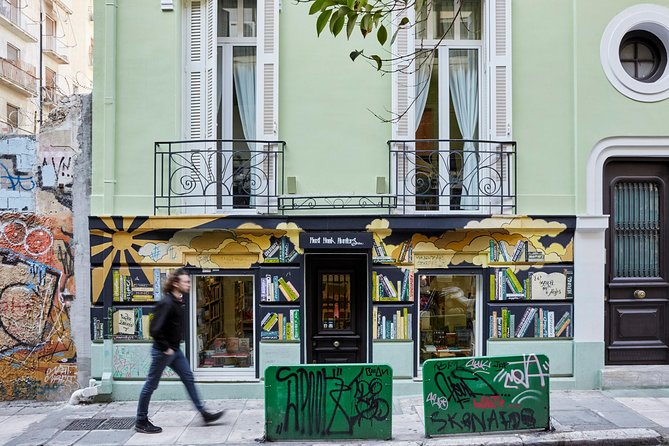
The one-hour visit is not mainly about checking off monuments. It is about reading the signs of city life around you. Bookstores, cafés, old buildings, posters, and street scenes can open a conversation about education, political ideas, and the pressures facing an urban neighborhood.
This part is especially valuable if you want to understand how Athenians use the city beyond the main sightseeing routes. It also helps explain why a neighborhood can feel culturally important without having a famous landmark at every corner.
Your guide matters here. Exarchia has a strong identity, and a thoughtful explanation is more useful than a quick pass through. Simos, Leo, Nikos, and Antigoni have each been praised for making the city’s political and social changes understandable, but the experience will naturally vary with the person leading your group.
Same island, an entirely different sort of day:
- Athens: Cape Sounion & Poseidon Temple Sunset Half-Day Trip
★ 4.8 · 8,241 reviews - Athens: Acropolis and Parthenon Guided Walking Tour
★ 4.6 · 5,882 reviews - All Day Cruise -3 Islands to Agistri,Moni, Aegina with lunch and drinks included
★ 5.0 · 4,958 reviews - Athens, Piraeus, and Coastline: Blue Hop-On Hop-Off Bus
★ 3.9 · 4,849 reviews
Psiri: workshops turned into nightlife streets
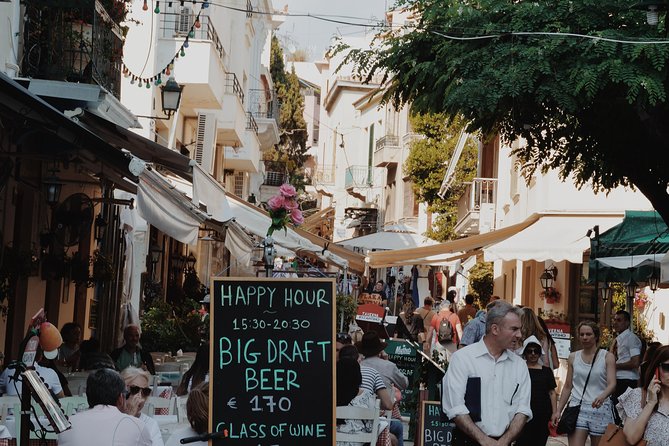
Psiri was once known for small craft workshops. Today, it is one of central Athens’ popular areas for evening food and drink, with street art adding another layer to its older working identity.
The hour spent here shows how a district can change use without losing every trace of its past. You may see the remains of workshop streets beside newer bars and restaurants, along with murals and painted walls that reflect Athens’ current creative side.
This is a good place to ask your guide about places to eat later. Elissavet, for example, has been praised for giving specific restaurant suggestions after learning what people liked. Niko also helped with finding a lunch spot. Such advice can be more useful than a generic list because it comes after seeing the areas in context.
Remember that Psiri is more atmospheric in the evening, while this tour begins in the morning. You are seeing the district as a neighborhood first, not as a nightlife crawl. Food and drinks are not included, so plan to return later if you want to experience its evening character.
Monastiraki: ruins, markets, and the tour’s practical finish
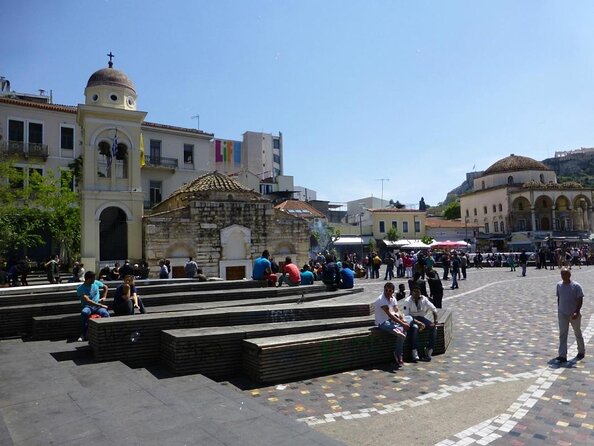
The walk ends in Monastiraki after about 30 minutes in this famous central district. Here, ancient remains, street food, flea-market stalls, and traces of Ottoman Athens come together in a compact area.
Hadrian’s Library gives you an ancient stop near the end of a tour focused mainly on modern Athens. The contrast works well. You have spent hours seeing how the city developed in recent centuries, then finish among Roman remains, market lanes, and the few surviving signs of Ottoman rule.
The metro station conceals an underground river, another reminder that Athens often places old layers beneath modern routines. You also have access to street food and shopping once the tour ends, making Monastiraki a useful place to continue your day.
Because the route ends here rather than returning to Syntagma, plan your afternoon around Monastiraki. You will not need to backtrack to collect belongings from a hotel pickup vehicle, since no transport is included, but you should know where you want to go next.
What the four-hour pace feels like
The advertised duration is about four hours, but some people find the walk longer than expected. That is not necessarily a problem, especially when the guide pauses for questions or a coffee break, but you should treat it as a substantial morning rather than a quick introduction.
The pace is generally described as relaxed, with rest stops built into the route. Still, relaxed does not mean flat or effortless. Expect city pavement, hills, and some steep sections, particularly around Kolonaki and Lykavittos.
I would wear supportive walking shoes and carry water. A coffee stop may be included during the walk, but food and drinks are not part of the price, so bring money for anything you want along the way. On warm days, a hat and sun protection are sensible additions.
Most people can take part, and service animals are allowed. The supplied information does not promise a fully accessible route, so anyone who needs an entirely step-free walk should check before booking.
Small groups and the guide’s role
The maximum group size is 12. That is small enough for a conversational tour and much easier to manage in narrow streets than a large group. Smaller departures can be even better, with some walks having only three people or becoming private when no one else booked.
A small group also lets you ask practical questions. You can ask where to eat, how neighborhoods connect, what to see next, or how Athens changed after the ancient period. Guides have sometimes adjusted the discussion to individual interests, which makes the route feel less like a fixed script.
The strongest guiding examples come from people who combine facts with stories. Simos has brought archaeology and cultural history to the route. Leo has focused on modern Greek development, buildings, street art, and local people. Mary-Kate has been praised for recommendations ranging from neighborhoods to hot chocolate.
That said, the guide is not assigned in advance in the information provided. Book this for the route and concept, not because you are guaranteed a particular person. English is the offered language.
What the $64.12 price buys you
At $64.12 per person, this is not the cheapest way to walk around central Athens. You could visit many streets for free with a map and a phone. The question is what you would miss without someone explaining why those streets matter.
The value is strongest if this is your first or second day in Athens. In four hours, you cover districts you might otherwise treat as disconnected points on a map. You also get context for choosing restaurants, understanding local life, and deciding which areas deserve a return visit.
The included fun map adds a practical touch, though the main value is the guide. There are no attraction admission fees included because the route is primarily outdoors and neighborhood-based. Food, drinks, hotel pickup, and drop-off are not included.
I would compare this price with the cost of a standard ancient-sites tour. If you already have the Acropolis and Ancient Agora planned, this walk fills a different need. It gives you modern Athens, local context, and orientation rather than another round of major ruins.
Who should book, and who should think twice
I would recommend this tour to first-time visitors who want to understand the city before exploring it alone. It also suits repeat visitors who have already seen the Acropolis and want streets, politics, food culture, architecture, and daily life.
It is a good match for people who enjoy asking questions and noticing small details. If you like moving between an upscale district, a student neighborhood, a former craft quarter, and an old market area in one morning, the route gives you plenty to think about.
Older walkers can manage it if they are comfortable with four hours on foot and some uphill sections. A 75-year-old participant found the walk manageable, but that should not be read as a guarantee for every fitness level.
I would hesitate to book it if you dislike hills, hot-weather walking, or neighborhood discussion. It is also not the right choice if you want a tour built around entering major archaeological sites. This is an outdoor orientation walk, not a ticketed monument tour.
Booking timing and cancellation
The experience is often booked about 53 days ahead, which suggests that popular dates can fill early, especially for a small group. Confirmation is normally provided at booking, though reservations made within one hour of departure are confirmed as soon as possible and depend on availability.
You can cancel for a full refund up to 24 hours before the 9:30 a.m. start. Changes or cancellations inside that 24-hour window are not accepted for a refund. If the minimum number is not reached and the tour is canceled, you are offered another date or experience, or a full refund.
Should you book the Unexpected Athens Orientation Tour?
Book it if you want modern Athens explained through its neighborhoods, not just ancient stones. The combination of Syntagma, Kolonaki, Exarchia, Psiri, and Monastiraki gives you a useful mental map and a better sense of how the capital works.
My advice is to schedule it near the start of your stay, wear your best walking shoes, and leave room afterward for lunch in Monastiraki. Skip it only if four hours of walking and uphill streets sound unpleasant, or if your priority is entry to archaeological sites. For everyone else, the route offers a thoughtful and practical introduction to the Athens you might otherwise walk past.
FAQ
Where does the Unexpected Athens Orientation Tour start?
It starts at Syntagma Square, Plateia Syntagmatos, Athens.
Where does the tour end?
The tour ends in Monastiraki, Athens.
What time does the tour begin?
The listed start time is 9:30 a.m.
How long does the tour last?
It lasts approximately four hours.
What neighborhoods does the tour visit?
The route includes Syntagma, Kolonaki and Lykavittos, Exarchia, Psiri, and Monastiraki.
Is food or coffee included?
No. Food and drinks are not included. A coffee stop may occur during the walk, but you pay for any refreshments yourself.
How large is the group?
The tour has a maximum of 12 participants.
What happens if I need to cancel?
You can receive a full refund if you cancel at least 24 hours before the local start time. Cancellations or changes made less than 24 hours before departure are not refunded or accepted.
Fresh on the Athens list
- Athens Airport Arrival Transfer to Hotels or Addresses in Athens★ 3.5 · 45 reviews
- Private Luxury Tour: Unveiling the Sacred Mysteries of Eleusis★ 5.0 · 45 reviews
- Luxury Catamaran Sunset Semi-Private & Greek Gastronomy in Athens★ 5.0 · 45 reviews
- From Athens: Aegina Island guided tour in a day★ 5.0 · 45 reviews
- Delphi, Thermopylae full day private tour from Athens★ 4.9 · 46 reviews
- From Athens: City & Corinth Guided Day Tour★ 4.8 · 46 reviews
- Acropolis Private Wine Tasting @ Finewine store★ 5.0 · 46 reviews
- Ancient Corinth Half-Day Private Tour from Athens★ 5.0 · 46 reviews
Athens Tours, compared.

Acropolis & up to 5 Archaeological Sites Combo Pass
Read our review →

Acropolis, Parthenon & Acropolis Museum Guided Tour
Read our review →
Cape Sounion & Poseidon Temple Sunset Half-Day Trip
Read our review →


Cape Sounio & Poseidon Temple Trip with Audio Guide
Read our review →