
Reviewed · METEORA MONASTERIES TOURS
From Athens:Meteora Caves & Monasteries History Day Trip by Train
Meteora is one of Greece’s great visual surprises: six monasteries perched on towering rock pillars, with cliffs, caves, and open countryside stretching below. This Athens to Meteora day trip gives you a practical way to see it without arranging trains, local transport, and monastery stops yourself.
I like the train ride for its broad views of central Greece, and I like the small-group minibus once you reach Kalambaka. Guides such as Chrysa, Kris, Joanna, and Juliana have been praised for good local stories and for taking photos. The catch is simple: this is a very long day, with roughly seven to eight hours of transport for about four hours at Meteora.
Key points to know before booking
- The train journey begins at Athens Larissis Station: You board without a guide in Athens, using the emailed e-tickets and your assigned carriage and seat.
- You see all six monasteries from outside: The tour usually takes you inside three, with the exact choices depending on the day.
- The Hermit Caves are included: This adds an unusual human touch to a visit often focused only on the famous monasteries.
- The small group is capped at 15 people: Transport is by Mercedes minibus, with Wi-Fi, USB chargers, and bottled water.
- Monastery entry costs €5 each: Bring cash, since credit cards are not accepted for these fees.
- The day can run from 7 a.m. until around 10 p.m.: Meteora is worth the effort, but you need stamina for the transport and steep paths.
Why Meteora is worth such a long day
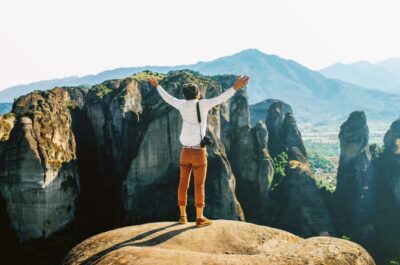
Meteora means suspended in the air, and the name makes sense once you see the monasteries above the plain. The rock pillars rise abruptly from the countryside, creating a setting that feels unlike the whitewashed islands, ancient ruins, and coastal towns most people associate with Greece.
The monasteries were built and expanded over more than 700 years. Monks sought out these high shelves of stone for quiet and protection, then added churches, living quarters, stairways, and storage rooms to places that look nearly impossible to reach.
I find the combination of scenery and human effort especially powerful here. You are not simply looking at an old building. You are looking at religious communities built into cliffs, with narrow paths, ladders, and stone steps linking the rock to the outside world.
A day trip from Athens lets you see this remarkable place during a Greece visit that does not include time for an overnight stay. But the tradeoff is real. You spend a large part of the day seated, and the time at Meteora is focused on highlights rather than a slow study of every monastery.
A few other Meteora mornings to price up
- Meteora Sunset with Monastery & Hermit Caves Tour in Small Group
★ 5.0 · 706 reviews - Meteora Small Group Hiking tour with Transfer and Monastery Visit
★ 5.0 · 484 reviews - Meteora: Morning Half Day Sightseeing and Monasteries Tour
★ 4.7 · 478 reviews
Starting at Athens Larissis Station
The morning starts at Larissis Station, Athens’ main railway station, at about 7 a.m. You are responsible for reaching the station and boarding the train. This is important: nobody meets you at the Athens station to hand over tickets or escort you to your seat.
The train e-tickets are sent by email a few days before departure. Check your inbox carefully, and contact the operator if the tickets have not arrived. You need them to board.
Larissis Station is above the Larissa underground station. One useful detail is that the train has departed from platform 8, though platforms can change, so check the station information before boarding. Confirm your carriage and seat number rather than assuming you can sit anywhere.
The train journey is a major part of the experience. It is not a quick transfer to the attraction. You get several hours of Greek countryside from your window, with fields, mountain views, and changing scenery along the route. Some people enjoy this quiet stretch. You can read, rest, play cards, or watch the country roll past.
Transport conditions can change. Flood damage to part of the rail line has caused some departures to use a train and bus connection, including a transfer at Paleofarsalos. That can make the journey longer and less comfortable. Check the latest instructions before departure, especially if your confirmation email describes a replacement bus.
The train ride is also the least polished part of the day. Some passengers have found the bathrooms unpleasant, and the replacement buses can feel cramped or hot. I would bring water, snacks, a light layer, and a portable battery, even though the tour minibus has USB chargers later.
Meeting your guide in Kalambaka
When you reach Kalambaka, your local guide meets you with a sign showing your name. This is where the organized part of the tour begins. The guide and driver take you around Meteora in an air-conditioned Mercedes minibus, rather than sending you to figure out the hill roads and monastery entrances on your own.
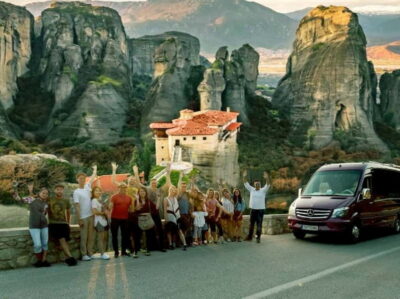
The group limit is 15 people. That is small enough for the guide to answer questions, help with photos, and keep the day moving without the feel of a large coach excursion.
The quality of the day depends heavily on the local team. Guides named Chrysa, Kris, Joanna, Juliana, Celia, and Maria have all been singled out for warm service, clear explanations, and a strong feel for the area. The most useful guides do more than recite dates. They explain how the rocks formed, why monks chose the cliffs, and what to notice in the churches and surrounding villages.
Drivers also play a large role. The roads around Meteora are winding, and the driver knows where to stop for wide views and photographs. Several guides and drivers have helped with family photos, making it easier for you to appear in the picture instead of returning home with only scenery.
Seeing all six monasteries from the road
The minibus route takes you past all six surviving monasteries. You get outside views and photo stops, while the interiors of three monasteries are included. The specific three depend on the day and opening schedule.
That arrangement gives you a good sense of Meteora as a whole. You see how the buildings sit on separate rock towers and how each approach differs. Some monasteries are reached by many stairs, some by shorter paths, and one is known for its especially demanding access.
The six monasteries are:
- Great Meteoron: The oldest and largest monastery in the group.
- Varlaam: The second-largest monastery, with a substantial complex and dramatic position.
- St. Stephen: The easiest monastery to reach.
- Holy Trinity: One of the hardest to access, and familiar from a James Bond film.
- Roussanou: Considered easier to reach than several of the others.
- St. Nicholas: An important early stop on the approach to Meteora, known for its iconography.
You should not expect a full interior visit at all six. The value here is the broad view, three monastery entrances, and a guide who helps you understand how the group fits together.
Same island, an entirely different sort of day:
- Meteora: Guided Sunset Tour with Monasteries & Caves Visit
★ 4.7 · 409 reviews - Meteora: Majestic Sunset Tour & Monasteries with Local Guide
★ 4.7 · 359 reviews - Meteora Monasteries Half-Day Small Group Tour with Transport
★ 5.0 · 339 reviews - Meteora: Panoramic Morning Small Group Tour with Local Guide
★ 4.7 · 334 reviews
Entering three monasteries
Inside the monasteries, you can see Christian architecture, religious art, and the practical spaces that supported monastic life. The churches are the main draw, but the setting matters just as much. Windows and terraces open onto the rock towers and the plain far below.
Entry fees are not included. Plan on €5 per monastery, or €15 if you enter all three. Bring cash. Credit cards are not accepted for the monastery admission fees.
The steps are the main physical challenge. You may climb steep stairways, walk on uneven paths, and cross cliffside sections. The exact effort varies by the three monasteries selected that day. St. Stephen is the most accessible, while Holy Trinity requires more work.
This is not a good fit if you need completely level access or want to avoid stairs. On the other hand, the activity is not limited to serious hikers. One person with a recent knee replacement managed the steps, but that should not be taken as a promise for every ability level. Wear shoes with a firm grip and take your time.
Clothing matters inside the monasteries. The provided information does not specify a dress code, but these are active religious sites, so modest clothing is the sensible choice. Carry a small amount of cash, water, and anything you need for the walk rather than a bulky bag.
The Hermit Caves and the human side of Meteora
The Hermit Caves add something different to the usual monastery circuit. These openings and shelters in the rocks show how early religious figures lived in isolation before larger monastic communities developed.
The caves help you picture the earliest stage of Meteora’s religious life. The monasteries can look grand and almost theatrical from a distance. The caves bring the story back to individual people seeking a hard, quiet place to pray.
Access and the amount of time spent there can depend on conditions and the day’s route. Still, this stop is one reason to choose a local tour rather than simply taking a bus to the main viewpoints. Your guide can connect the cliffs, caves, and monasteries into one story.
Lunch and free time in Kalambaka
After the monastery circuit, you are returned to Kalambaka’s town center. The schedule allows about an hour for lunch, coffee, or a short break beneath the giant rocks.
Lunch is not included, but the local restaurant stop has been a strong part of the day for many people. A set meal has cost about €15 in some cases, with generous portions and home-cooked Greek food. The tour team may recommend a family-run restaurant such as Taksiki.
You can also use this hour for a slower look at Kalambaka. Do not expect a major town tour. This is a chance to sit, eat, use the restroom, and recover before the return journey.
The guide gives you instructions for getting back to the train station. Pay attention here. The return transfer is not necessarily a single escorted ride all the way to Athens, and you need to follow the directions for the train or replacement bus connection.
How good is the value at $126.71?
At $126.71 per person, the price covers the round-trip Athens to Kalambaka transport, local minibus, English-speaking tour leader, bottled water, Wi-Fi, USB charging, the six-monastery route, three interior visits, and the Hermit Caves.
That is fair value if you want the convenience of a planned day and do not want to rent a car or arrange a local driver. Meteora is far enough from Athens that transport planning can become a nuisance. Here, the local team handles the mountain route, timing, and monastery sequence.
The price looks less attractive if you measure value by time spent at the destination. The day can involve over 12 hours of total travel, with some people arriving back in Athens around 10 p.m. The actual sightseeing portion may feel closer to three and a half or four hours, depending on rail conditions.
You also pay extra for three monastery admissions and lunch. Gratuities, travel insurance, and transport from your Athens accommodation to Larissis Station are not included.
I would compare this with a two-day Meteora stay before booking. An overnight visit gives you more time for the monasteries, viewpoints, and Kalambaka. But if your Greece schedule is tight, $126.71 buys a workable way to see one of the country’s most unusual places.
Who should choose this day trip
I would choose this tour if you have only one free day, enjoy scenic rail travel, and want a local driver to handle Meteora’s roads. It also suits families who want help with photos and a guide who can keep children involved. Chrysa, for example, has been praised for explaining the site in a way that held the attention of children aged 7 and 11.
It works well for people who prefer a small group over a large coach. Wi-Fi and USB chargers are useful on a long day, and the air-conditioned minibus is much better suited to the narrow mountain roads than a large vehicle.
I would think twice if you dislike long transport days, need a relaxed pace, or want detailed time inside every monastery. A two-day trip is the better choice for those priorities.
Weather can also affect the experience. The tour requires good weather, and poor conditions can lead to a different date or a full refund. The cancellation policy allows a full refund when you cancel at least 24 hours in advance. Changes or cancellations inside 24 hours are not accepted for a refund.
Practical ways to make the day easier
- Check your train e-tickets several days before departure and save them where you can access them quickly.
- Arrive early at Larissis Station so you have time to find the correct platform and carriage.
- Confirm your seat number. Do not assume the guide will be waiting in Athens.
- Bring cash for three monastery admissions, at €5 each.
- Wear shoes suitable for steep steps and uneven cliff paths.
- Pack water and snacks for the rail journey.
- Bring a portable battery, even though the tour minibus has USB chargers.
- Keep your camera ready. The driver may stop at excellent viewpoints between monasteries.
- Expect a late return to Athens and avoid scheduling another major activity that night.
- Listen carefully to the return instructions in Kalambaka.
Should you book the Athens to Meteora train tour?
Book it if Meteora is high on your list and you cannot spare an overnight stay. The views are extraordinary, the monasteries are genuinely unusual, and the local portion of the tour is usually the strongest part. Having an English-speaking guide and a small minibus makes the visit far easier than trying to connect local transport on your own.
Skip it if you want a leisurely archaeological day or dislike spending most of your day in transit. The train and occasional replacement bus connection can be tiring, and the three-monastery limit means you will only get a taste of the interiors.
My practical verdict: this is a worthwhile but demanding introduction to Meteora. Take it for the dramatic rocks, the chance to enter three monasteries, and the help of a strong local guide. Choose two days instead if you can. Meteora rewards extra time.
FAQ
How long does the Athens to Meteora day trip last?
The experience lasts approximately 14 hours. The advertised start time is 7 a.m., and some departures have returned to Athens at around 10 p.m.
Where does the train leave from in Athens?
The train leaves from Larissis Station, Athens’ main railway station. The station is above the Larissa underground station.
Will a guide meet me at the Athens train station?
No. You board the train in Athens on your own using the e-tickets sent by email. The guide meets you in Kalambaka with a sign showing your name.
How will I receive the train tickets?
The train e-tickets are sent by email a few days before the tour. Contact the operator if you have not received them, since you cannot travel by train without the tickets.
How many monasteries can I enter?
You see all six surviving monasteries from outside and enter three of them. The three selected depend on the arrival day.
Are monastery admission fees included?
No. Admission costs €5 per person for each monastery. Credit cards are not accepted, so bring cash.
Is lunch included?
No. Lunch is not included. You have about an hour in Kalambaka for lunch or coffee, and a local meal has cost about €15 on some departures.
Is transport from my Athens accommodation included?
No. You must arrange your own transport to and from Larissis Station in Athens.
What is the group size?
The tour has a maximum of 15 people. Local transport is provided in an air-conditioned Mercedes minibus.
More Train Experiences in Meteora
- Chersonissos: Mini-Train City Highlights Tour
★ 3.8 · 148 reviews - Corinth, Cave of Lakes, Odontotos Railway Private Tour with Greek Lunch Included
★ 5.0 · 141 reviews - Mount Olympus And Dion Full-Day Tour From Athens By Train
★ 4.5 · 59 reviews
More Historic Sites in Meteora
- Discover Meteora’s Monastic Heritage: Personalized Private Tour
★ 5.0 · 122 reviews - Historical Delphi One Day Tour with Arachova Stop & Expert Guide
★ 4.5 · 1,247 reviews - Historic Athens: Small Group Electric Bike Tour
★ 4.9 · 740 reviews - Naxos Half Day History and Culture Guided Tour
★ 5.0 · 491 reviews
Fresh on the Meteora list
- Sunset Meteora Tour on E-Bike★ 5.0 · 46 reviews
- Private Tour: Meteora Tour with Transport from Kalambaka★ 5.0 · 50 reviews
- Meteora Motorized or Footlaunch Flight Experience★ 5.0 · 54 reviews
- Meteora Sunset Tour on E-bikes★ 5.0 · 54 reviews
- Meteora: Guided Sunset Tour with Monasteries and Caves Visit★ 5.0 · 58 reviews
- Meteora: Monasteries Tour with Lunch and Athens Transfer Option★ 5.0 · 64 reviews
- Kalabaka: Meteora Monasteries Minibus Tour with Photo Stops★ 5.0 · 74 reviews
- Meteora: Monasteries Tour, Lunch, and Athens Transfer Option★ 4.8 · 102 reviews
Meteora Monasteries Tours, compared.
Meteora Monasteries Day Trip with Caves and Lunch
Read our review →
Meteora Tour with Local Guide and Greek Lunch
Read our review →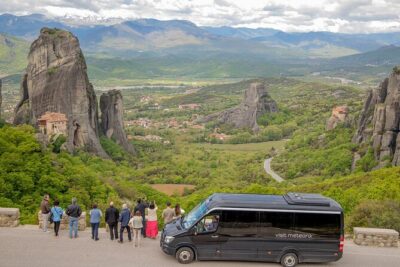
Meteora Monasteries, Caves & Coastal Stopovers with Lunch
Read our review →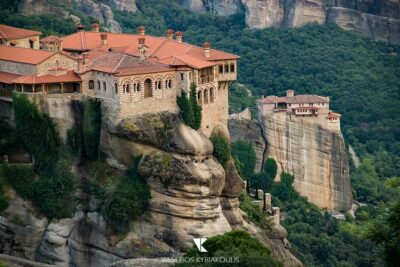
Meteora Monasteries & Caves DayTrip from Athens with Greek Lunch
Read our review →
4-Day Classical Greece Tour: Epidaurus, Mycenae, Olympia, Delphi, Meteora
Read our review →
Meteora Monasteries, Hermit Caves Tour with Pickup
Read our review →Browse the lists this tour appears in